Algeria
 Egypt
 Libya
 Morocco
 Sudan
 Tunisia
 Benin
 Burkina Faso
 Cabo Verde
 Côte d'Ivoire
 Ghana
 Guinea
 Guinea-Bissau
 Liberia
 Mali
 Mauritania
 Niger
 Senegal
 Sierra Leone
 The Gambia
 Togo
 Cameroon
 Central African Republic
 Chad
 DR Congo
 Equatorial Guinea
 Gabon
 Republic of the Congo
 São Tomé and Príncipe
 Burundi
 Comoros
 Djibouti
 Eritrea
 Ethiopia
 Kenya
 Madagascar
 Malawi
 Mauritius
 Mozambique
 Rwanda
 Seychelles
 Somalia
 South Sudan
 Tanzania
 Uganda
 Angola
 Botswana
 Eswatini
 Lesotho
 Namibia
 South Africa
 Zambia
 Zimbabwe
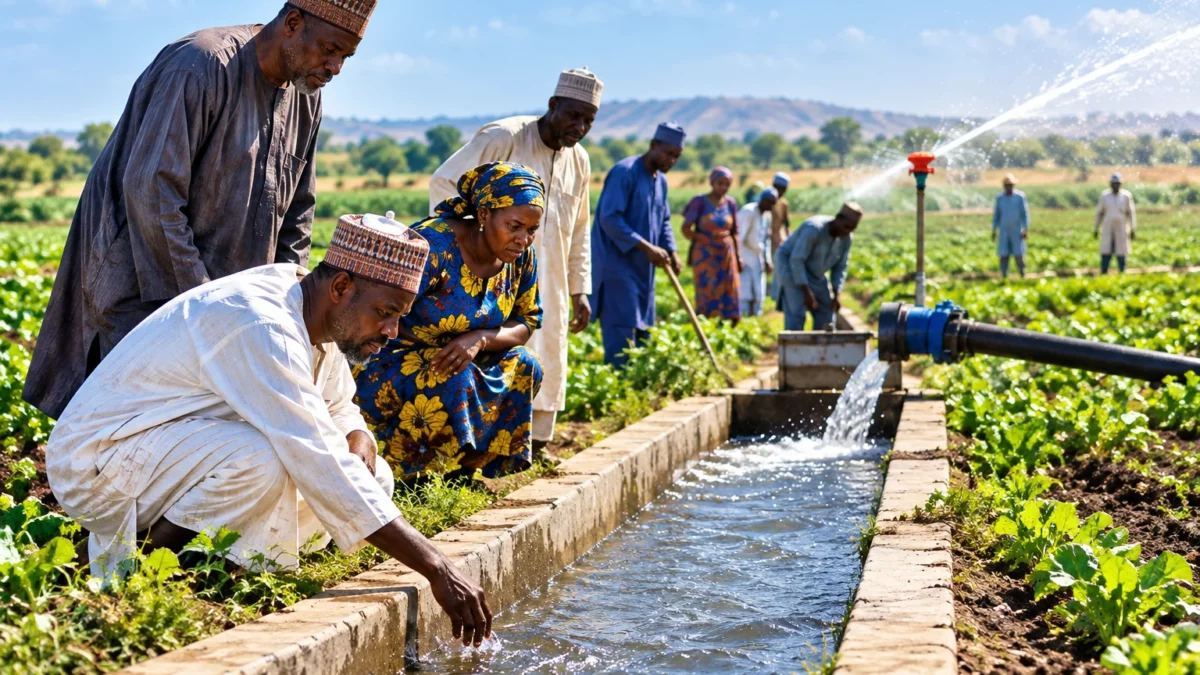
An announced factory is not enough to irrigate a field. In Nigeria, the challenge will be to turn an industrial agreement into accessible equipment, maintenance services and water for farmers.
An agreement still at the commitment stage
On 22 November 2026, Dahiru Muhammed, president of the Presidential Implementation Committee on Technology Transfer, announced a memorandum of understanding with Valmont Industries, a US group specialising in irrigation equipment. Nigerian media also reported the signing of the agreement, concluded with Kalle Autto, Valmont’s regional head for the Middle East and Africa.
The project envisages cooperation with the National Agency for Science and Engineering Infrastructure (NASENI), Nigeria’s public agency tasked with supporting scientific and industrial capabilities. The partners are considering an irrigation equipment manufacturing plant and a transfer of skills. But the investment amount, the precise location of the factory, its capacity and its timetable remain unknown. The agreement therefore does not mean that production has begun.
A pilot programme is also being considered across 40,000 hectares in Adamawa State, in the country’s north-east. It would involve the Nigeria Incentive-Based Risk Sharing System for Agricultural Lending (NIRSAL), which facilitates agricultural finance, and the National Agricultural Development Fund (NADF). This area is an announced target, not land that has already been irrigated.
An ambition within a national effort
The project forms part of a broader strategy. Nigeria is seeking to expand irrigation, strengthen agricultural production and limit its dependence on food imports. The FAO estimates that 331,150 hectares in Nigeria were equipped for irrigation in 2023. This indicator measures land with infrastructure, not necessarily land actually irrigated each year.
The government aims to irrigate 500,000 hectares by 2030. In parallel, the Sustainable Power and Irrigation for Nigeria (SPIN) programme, backed by the World Bank with $500 million, is expected to modernise irrigated areas and improve water and dam management. Authorities have said the programme aims, among other things, to rehabilitate about 40,000 hectares.
These targets build on work already carried out. The TRIMING project, completed in 2025, reportedly modernised more than 43,000 hectares, according to Nigeria’s Ministry of Information. SPIN is intended to extend that effort, but investment will have lasting effects only if infrastructure works and users can maintain it.
Local production will not solve everything
Manufacturing locally could reduce dependence on imported equipment and make spare parts more accessible. It could also create skilled jobs in assembly, installation and repair. However, no public details are yet available to assess the share of production that would genuinely be Nigerian or the future cost of the systems.
Valmont is already present in Africa through its Valley Irrigation brand, notably in South Africa. Its centre-pivot systems rotate an irrigation device around a fixed point. This technology suits some large plots, but does not automatically meet the needs of every farm. Small farms, often less well equipped and with limited access to finance, may not benefit directly from a model designed for large areas.
The Adamawa pilot will therefore need to clarify who will farm the land, how farmers will access water and credit, and who will cover energy, maintenance and repairs. Management choices will matter as much as the equipment. Without transparent rules on access to water and costs, the benefits risk being concentrated among the best-funded players.
Irrigation also requires careful management of resources. In northern Nigeria, periods of heat and changes in rainfall are making water supply more difficult. Any expansion of irrigated land must therefore be accompanied by monitoring of available resources and techniques suited to local crops and conditions.
An issue extending beyond Nigeria
For Nigeria, Africa’s most populous country, the issue affects both agricultural incomes and the supply of its cities. More consistent production could help stabilise food supply chains between rural areas in the north and major markets in the south, but would not by itself guarantee lower prices.
Across West Africa, the case highlights a central question for agricultural policy: how to combine finance, industrial expertise and equitable access to water. ECOWAS, a regional organisation bringing together West African countries, encourages economic and agricultural cooperation. But the project’s effects will depend first on its implementation in Nigeria, not merely on its regional profile.
The next step will be to see whether the agreement leads to financing deals, an industrial site and a verifiable timetable. For the pilot, the decisive indicators will be the hectares actually developed, the number of farms served and the ability to keep the systems in working order. Until these points are clarified, the announcement signals a direction, not yet a measurable change in the fields.
The Nigerian report on the agreement between the government and Valmont describes the factory project, the transfer of skills and the planned pilot in Adamawa. The FAO’s AQUASTAT factsheet on water resources and irrigation in Nigeria provides data on equipped land.