Algeria
 Egypt
 Libya
 Morocco
 Sudan
 Tunisia
 Benin
 Burkina Faso
 Cabo Verde
 Côte d'Ivoire
 Ghana
 Guinea
 Guinea-Bissau
 Liberia
 Mali
 Mauritania
 Niger
 Senegal
 Sierra Leone
 The Gambia
 Togo
 Cameroon
 Central African Republic
 Chad
 DR Congo
 Equatorial Guinea
 Gabon
 Republic of the Congo
 São Tomé and Príncipe
 Burundi
 Comoros
 Djibouti
 Eritrea
 Ethiopia
 Kenya
 Madagascar
 Malawi
 Mauritius
 Mozambique
 Rwanda
 Seychelles
 Somalia
 South Sudan
 Tanzania
 Uganda
 Angola
 Botswana
 Eswatini
 Lesotho
 Namibia
 South Africa
 Zambia
 Zimbabwe
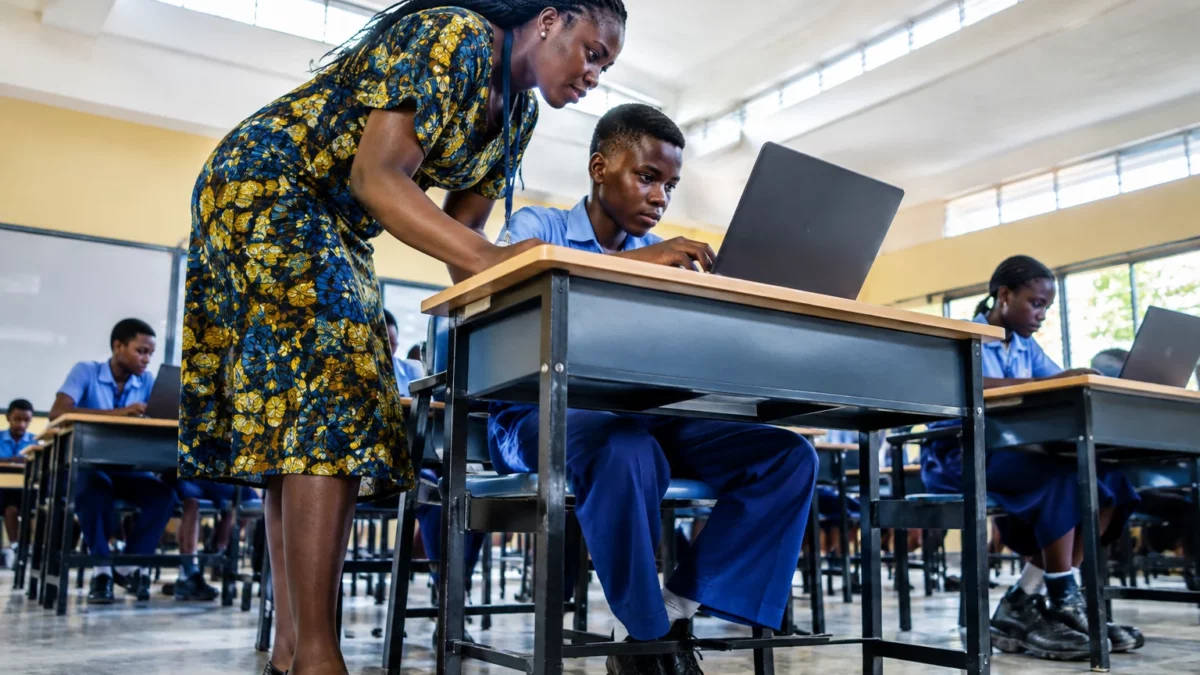
In the classroom, artificial intelligence can help prepare a lesson or identify a pupil’s difficulties. It can also produce an answer that is false, biased or unsuitable. In Bayelsa, in southern Nigeria, a new training programme aims to teach teachers not only how to use AI, but also how to check its outputs.
A local programme within a national effort
Bayelsa is not starting from scratch on digital education. The state has already launched continuing professional development programmes for its teachers. In November 2025, for example, 400 teachers and school leaders took part in training on English, digital skills and school leadership, run with the British Council. This earlier initiative shows that the AI programme is part of a broader policy to develop teaching skills. Radio Nigeria South South on teacher training in Bayelsa.
The programme is also part of a national initiative led by UNESCO and funded by the European Union: EISS, or “Expand, Integrate and Strengthen Systems to Build Teachers’ Capacity and Resilience”. Its aim is to strengthen teachers’ skills and education systems. UNESCO said its digital pedagogy and artificial intelligence platform had trained 30,290 teachers in Nigeria. The figure gives a sense of the programme’s reach, but does not yet show whether pupils are learning more. UNESCO’s published figures.
At regional level, Nigeria is a member of ECOWAS, the Economic Community of West African States. Bayelsa’s training is not an ECOWAS regional programme. It nevertheless addresses a challenge shared by West African education systems: preparing teachers to use digital tools without widening disparities between schools and regions.
Forty trainers to support 1,445 teachers
The programme uses a cascade training model. Forty trainers, selected from among computer science teachers at tertiary institutions, are to go on to support 1,445 teachers. The training-of-trainers phase will last three days. Workshops for teachers are scheduled from 16 to 21 November at three centres: Yenagoa, the capital of Bayelsa, as well as Kolokuma/Opokuma and Sagbama.
The announcement was made on 10 November 2026, during a training-of-trainers session. Details of the numbers, timetable and locations were reported by Nigerian media and the NAN news agency. The Gazette’s report on the Bayelsa training programme and The Sun’s report on the launch also covered the initiative.
The curriculum does not begin with artificial intelligence. It starts with basic computer skills, then covers the use of Word, Excel and PowerPoint, the creation of teaching resources, multimedia and digital assessment. The final modules introduce the fundamentals of AI, prompt writing — the instructions given to a tool — and the use of these technologies to save time on certain tasks.
The training also aims to teach teachers to check generated answers, identify bias and protect pupils online. The intended applications are practical: preparing lessons, adapting resources to pupils’ needs and tracking their progress. AI is presented as a support for teaching, not a substitute for teachers’ judgement.
Access and classroom use remain the decisive tests
After the workshops, support is to continue remotely. The platform offers short videos and office files for practice. Modules can be downloaded for offline use, an option that is useful where internet access is unreliable or costly. Certification is based on a 26-question test, with a pass mark of 70%.
But completing training does not, by itself, guarantee a change in practice. Teachers will need available equipment, a sufficiently stable connection and resources suited to the school curriculum. Conditions may vary between Yenagoa and more remote communities. They also differ from one school to another: a teacher with a computer and regular access to the internet does not work under the same conditions as a colleague relying on a shared phone or an intermittent connection.
The impact on pupils will therefore require an evaluation separate from the number of people trained. It will be necessary to see whether teachers continue using the tools, whether generated answers are checked and whether content is appropriate for pupils’ levels and languages of instruction. UNESCO has published national figures for its platform, but that total does not measure educational outcomes. In Bayelsa, the number of beneficiaries indicates the planned scale of the programme, not yet its impact in the classroom.
What happens next will also depend on continued support. The 40 trainers will need to assist teachers beyond the workshops and help resolve problems as they arise. Final certification checks knowledge at a given point; on its own, it cannot guarantee that skills will be used consistently in lessons.
A Nigerian challenge with West African implications
For education authorities, the initiative offers a chance to test a method for rolling out training on a large scale: train a group of trainers, then rely on them to support more teachers. For teachers, the challenge is to integrate the tools without losing control of content and assessment. For pupils, any benefit will depend on the quality of resources and adults’ ability to distinguish a plausible answer from a correct one.
The challenge is therefore as much about teaching as it is about infrastructure and rules of use. The question is not simply how many teachers have completed an AI module, but under what conditions they will be able to apply what they have learnt. Monitoring training, access to equipment and changes in classroom practice will be the next indicators to examine in Nigeria and across West Africa.