Algeria
 Egypt
 Libya
 Morocco
 Sudan
 Tunisia
 Benin
 Burkina Faso
 Cabo Verde
 Côte d'Ivoire
 Ghana
 Guinea
 Guinea-Bissau
 Liberia
 Mali
 Mauritania
 Niger
 Senegal
 Sierra Leone
 The Gambia
 Togo
 Cameroon
 Central African Republic
 Chad
 DR Congo
 Equatorial Guinea
 Gabon
 Republic of the Congo
 São Tomé and Príncipe
 Burundi
 Comoros
 Djibouti
 Eritrea
 Ethiopia
 Kenya
 Madagascar
 Malawi
 Mauritius
 Mozambique
 Rwanda
 Seychelles
 Somalia
 South Sudan
 Tanzania
 Uganda
 Angola
 Botswana
 Eswatini
 Lesotho
 Namibia
 South Africa
 Zambia
 Zimbabwe

Diplomatic tensions go beyond migration
In Abuja, the issue is no longer just about foreigners living in South Africa. It now concerns the protection of Nigerian citizens and respect for the law, as well as how two major African economies manage their disagreements without severing ties. In this case, every violent incident affects families and businesses, as well as the continent’s image.
The issue has resurfaced as Pretoria and Abuja have spent several months trying to contain the effects of rising anti-immigration protests in South Africa. The South African government has repeatedly taken a tough line on enforcing its immigration laws, while insisting that it rejects xenophobia and Afrophobia. At the same time, Nigeria has stepped up its consular and humanitarian response, organising the repatriation of citizens described as vulnerable.
The meeting in Abuja on 27 July between Nigeria’s Minister of State for Foreign Affairs, Sola Enikanolaiye, and Ronald Lamola, special envoy of South African President Cyril Ramaphosa, is part of this sequence of events. Nigeria’s message was clear: the protection of Nigerians in South Africa must become a visible priority, not just a matter of principle. Nigeria says it has recorded at least 98 deaths since 2022 in mob violence, hate-motivated attacks and extrajudicial killings. The figure was cited in Abuja and reported by several international and local sources, though no single public tally currently allows each case to be verified individually.
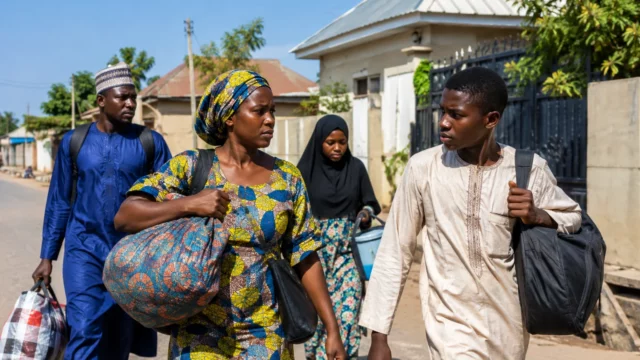
Meanwhile, Nigeria’s Ministry of Foreign Affairs has confirmed that at least 1,490 Nigerians have been evacuated from South Africa on several humanitarian flights, with the support of consular services and relief agencies. The South African government has acknowledged the repatriation of Nigerian citizens and reiterated that people in the country unlawfully must comply with the law. The dispute therefore concerns two issues at once: the safety of migrants and immigration control.
What the two capitals are seeking to avoid
The issue is as political as it is human. In Abuja, memories of Nigeria’s support for the struggle against apartheid remain a powerful moral argument. They serve as a reminder that bilateral relations cannot be reduced to deportations, street attacks or hostile rhetoric. Pretoria, for its part, stresses the sovereignty of its migration policy and the fight against criminal networks, arguing that some foreigners, including Nigerians, are involved in illegal activities. That view does not erase the central question: migrants, whether documented or not, must remain protected from mob violence.
The debate is also unfolding amid tensions in South Africa. High unemployment, pressure on public services, campaigns against irregular immigration and the rapid spread of rumours regularly fuel local tensions. In working-class neighbourhoods, informal markets and some sectors of the urban economy, the effects are immediate: temporary shop closures, forced displacement, lost income and fear of going out. For the authorities, the challenge is to enforce the law without allowing mobs to take the place of the justice system.
For Nigeria, the response is also a domestic matter. The repatriation of hundreds of citizens is a reminder that mobility within Africa, often presented as an economic opportunity, remains precarious when consular protection channels are overwhelmed. Organised returns involve several institutions, from diplomacy to emergency management. They carry a budgetary cost, but also a social one, as returning families must reintegrate in a country where employment remains under pressure. Nigeria, West Africa’s largest economy, cannot afford to treat the vulnerability of its citizens abroad as normal, especially in a country as strategically important as South Africa.
The latest developments also reveal a broader difficulty: South Africa and Nigeria are two of the continent’s major powers and influential members of their respective regional blocs, ECOWAS for Abuja and SADC for Pretoria. When their relations deteriorate, political, economic and diplomatic ties between West and Southern Africa come under strain. Yet the two countries remain connected through trade, investment, academic exchanges, religious networks and diaspora communities. Breaking off dialogue would cost more than managing their disagreements.
That is why both delegations stressed the need for cooperation, a reduction in inflammatory rhetoric and the revival of a bilateral early-warning mechanism that has long been on hold. In the short term, the task is clear: prevent further deaths and stop local violence from becoming a lasting diplomatic crisis. In the medium term, Abuja and Pretoria will have to clarify their joint mechanisms for monitoring, justice and the protection of citizens. Across the continent, the issue once again tests African states’ ability to treat intra-African migration as a matter of law and security, rather than a temporary concern. The South African precedent, often raised in debates at the African Union, shows that no major African economy is immune to tensions between unemployment, social anxiety and regional mobility.