Algeria
 Egypt
 Libya
 Morocco
 Sudan
 Tunisia
 Benin
 Burkina Faso
 Cabo Verde
 Côte d'Ivoire
 Ghana
 Guinea
 Guinea-Bissau
 Liberia
 Mali
 Mauritania
 Niger
 Senegal
 Sierra Leone
 The Gambia
 Togo
 Cameroon
 Central African Republic
 Chad
 DR Congo
 Equatorial Guinea
 Gabon
 Republic of the Congo
 São Tomé and Príncipe
 Burundi
 Comoros
 Djibouti
 Eritrea
 Ethiopia
 Kenya
 Madagascar
 Malawi
 Mauritius
 Mozambique
 Rwanda
 Seychelles
 Somalia
 South Sudan
 Tanzania
 Uganda
 Angola
 Botswana
 Eswatini
 Lesotho
 Namibia
 South Africa
 Zambia
 Zimbabwe
In Nigeria, an energy project can remain stalled for more than 20 years because of a contractual dispute. The decision issued in September 2026 in the Mambilla case reduces this legal risk, but it does not yet turn the project into an operational power plant.
A legal obstacle removed, but construction has not begun
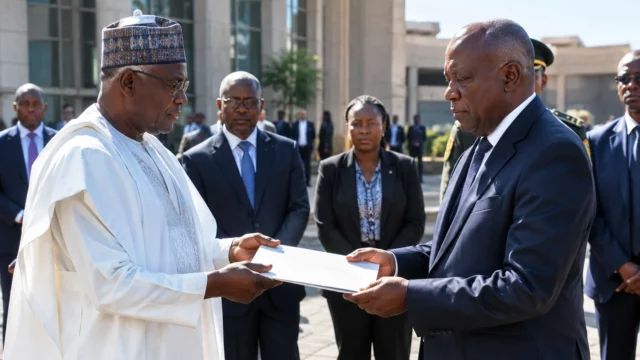
On 17 September 2026, an arbitral tribunal of the International Chamber of Commerce, sitting in Paris, rejected claims brought by Sunrise Power and Transmission Company against the Nigerian state. The company sought enforcement of agreements concluded in 2020 with government representatives, worth up to $400 million including interest.
The tribunal found that the officials who signed the documents could not bind the Federation of Nigeria on their own. Presidential approval was required. The agreements therefore did not meet the conditions needed to bind the state.
The award also found that the agreements were linked to corrupt practices and contrary to Nigerian public policy. This characterisation forms part of the arbitral tribunal’s reasoning in the civil and commercial dispute. It does not, by itself, amount to a final criminal conviction of the people named in the proceedings.
The tribunal also ordered Sunrise and its promoter, Leno Adesanya, to reimburse Nigeria for part of its defence costs. Nigerian media put the sum at about $11.8 million, in addition to arbitration costs.
In a statement published by the presidency, President Bola Tinubu described the decision as removing the main legal obstacle that had paralysed Mambilla. Abuja can now seek to resume discussions on financing and implementing the project. However, another proceeding relating to Sunrise’s claims remains separate from this award.
A contractual history dating back to 2003
The dispute dates back to May 2003. At the time, Sunrise secured an agreement to develop a major hydropower plant in Taraba State, in north-eastern Nigeria. The arrangement was based on the “build-operate-transfer” model, under which a private operator finances and runs infrastructure before transferring it to the state.
The announced capacity has changed across successive versions of the project. Historical documents refer to a 3,050-megawatt plant. Recent statements by Nigerian authorities, meanwhile, describe a project that could reach 3,960 megawatts. The difference reflects technical and financial revisions to the programme. It must be clarified before any definitive restart.
The cost has also varied depending on the period and scope considered. Some estimates put the investment at around $4 billion. Other documents have cited about $6 billion. In either case, Mambilla is among the most ambitious infrastructure projects ever envisaged in Nigeria’s electricity sector.
The dispute escalated after the initial award. Sunrise argued that Nigeria had breached its commitments. The state challenged the validity of the contract and the authority of the officials who had awarded it. In 2017, the company launched arbitration proceedings seeking several billion dollars.
An attempt to settle the dispute took place under the administration of Muhammadu Buhari. An agreement signed in January 2020 provided for a payment of $200 million. An addendum signed in March of the same year could have increased Nigeria’s total exposure to $400 million in the event of default, with additional interest.
These documents were ultimately not implemented. Sunrise then took the matter to the International Chamber of Commerce to enforce them. The September 2026 award closes this part of the case by rejecting claims based on those agreements.
Chinese financing returns to the centre of the case
The next step concerns financing. The Export-Import Bank of China, or Exim Bank of China, had been involved in Mambilla’s financing arrangements. Discussions included a loan intended to cover a large share of construction costs.
The legal proceedings posed a risk to the lender. They could have led to a new compensation claim, prevented clarification of rights over the project and weakened contracts with construction companies. The arbitral decision gives Abuja a clearer position from which to resume negotiations.
This progress does not, however, guarantee that the loan will be disbursed or construction will begin. Nigeria will still need to update the technical studies, confirm the cost, secure financial guarantees and define the role of Chinese companies. It will also have to resolve land, environmental and social issues in Taraba State.
The project must also be assessed against the realities of the national grid. In April 2026, the Nigerian Electricity Regulatory Commission reported an installed grid-connected capacity of 13,625 megawatts. Average available capacity, however, stood at about 4,286 megawatts. The gap shows that Nigeria’s problem is not limited to building new power plants.
Transmission lines, equipment maintenance, fuel supplies for thermal power plants and the financial position of distribution companies remain crucial. A major power plant will have a lasting impact only if its electricity can be transmitted, distributed and paid for effectively.
An issue for Nigeria and West Africa
Nationally, Mambilla could boost electricity supply to households, businesses and industries. The impact would not be uniform, however. Major urban centres and industrial areas would first benefit from a more stable grid. Communities near the site would expect jobs, roads, compensation and meaningful access to electricity.
The project is also part of the energy strategy of the Economic Community of West African States, ECOWAS. Its West African Power Pool is progressively organising regional interconnections and electricity trade.
Nigeria plays a central role in this system. Additional hydropower generation could support the regional market, provided cross-border lines and settlement mechanisms work effectively. ECOWAS is working to establish a regional electricity market and clearing services between operators.
Caution is therefore still warranted. Abuja’s legal victory removes a significant financial threat. It does not settle the remaining disputes, automatically validate the old contract or replace the technical decisions still to come.
The next test will be tangible: whether the Nigerian government can turn this legal room for manoeuvre into a credible financing agreement, a public timetable and a project compatible with the grid’s actual capacity. For Mambilla, the end of the legal dispute opens a door. Nigeria still has to build the road to commissioning.