Algeria
 Egypt
 Libya
 Morocco
 Sudan
 Tunisia
 Benin
 Burkina Faso
 Cabo Verde
 Côte d'Ivoire
 Ghana
 Guinea
 Guinea-Bissau
 Liberia
 Mali
 Mauritania
 Niger
 Senegal
 Sierra Leone
 The Gambia
 Togo
 Cameroon
 Central African Republic
 Chad
 DR Congo
 Equatorial Guinea
 Gabon
 Republic of the Congo
 São Tomé and Príncipe
 Burundi
 Comoros
 Djibouti
 Eritrea
 Ethiopia
 Kenya
 Madagascar
 Malawi
 Mauritius
 Mozambique
 Rwanda
 Seychelles
 Somalia
 South Sudan
 Tanzania
 Uganda
 Angola
 Botswana
 Eswatini
 Lesotho
 Namibia
 South Africa
 Zambia
 Zimbabwe
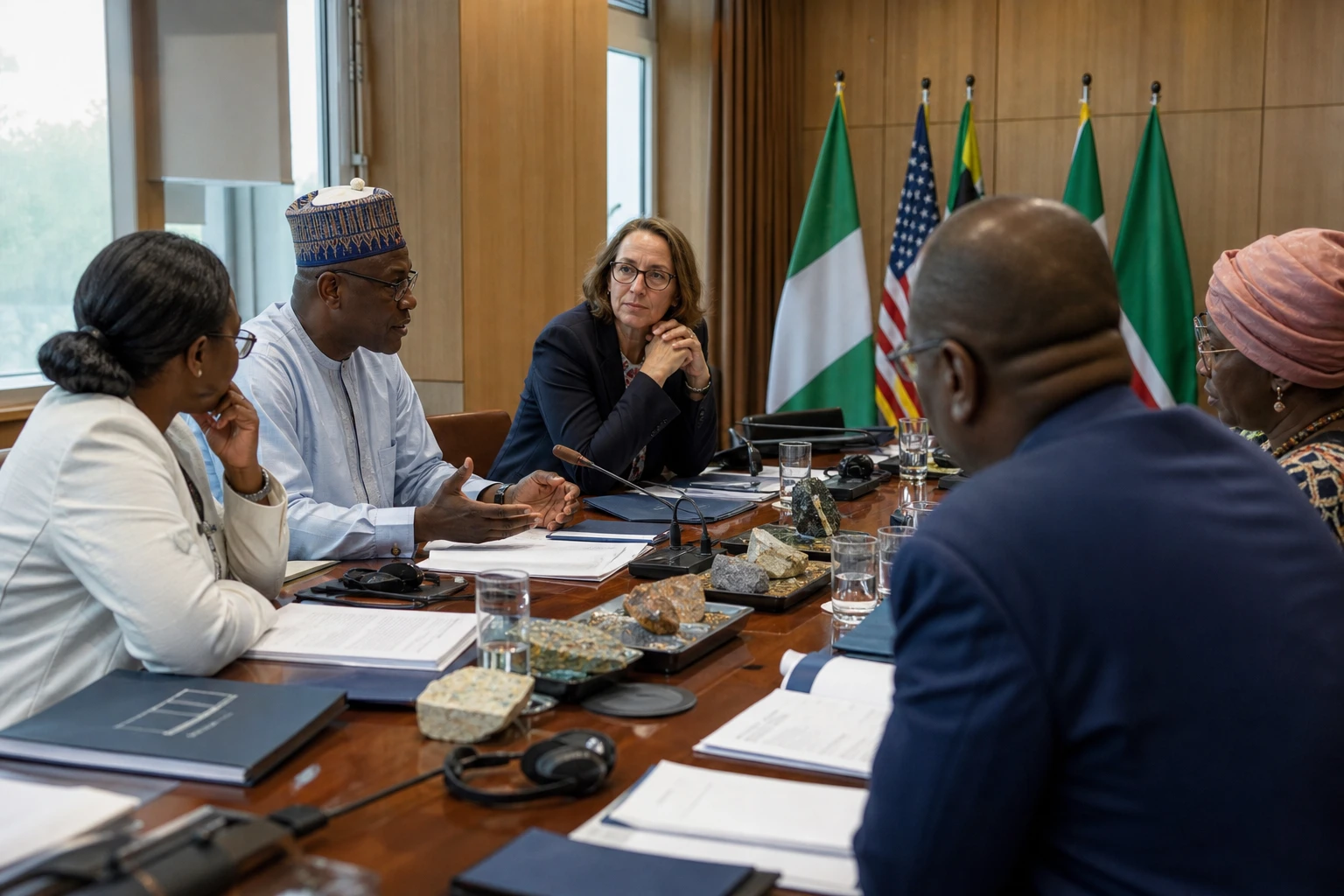
In Abuja, the country’s mineral wealth is becoming a lever for economic diversification. But the challenge is no longer simply to attract foreign capital. The aim now is to process Nigerian minerals locally, so that jobs, skills and a greater share of the value remain in the country.
Nigeria and the United States signed a framework agreement in New York on 23 September 2026 to strengthen cooperation in the mining sector. The ceremony took place on the sidelines of the United Nations General Assembly, according to the Nigerian Federal Ministry of Information.
A framework agreement, not yet a $700bn investment
The text was signed by Dele Alake, Nigeria’s Minister of Solid Minerals Development, and Christopher Landau, the US Deputy Secretary of State. It is intended to facilitate exchanges between public institutions and private companies in both countries.
The framework covers several links in the mining chain. These include geological data collection, exploration, deposit development, processing, infrastructure and the development of technical capacity.
Nigeria estimates the value of its mineral resources at about $700bn. This figure represents an overall assessment of the country’s subsoil potential. It is neither US funding already committed nor the financial value of the agreement signed in New York.
This distinction is essential. The text establishes a framework for cooperation. Specific projects will still require studies, contracts, financing and approvals. Their implementation will also depend on the quality of infrastructure and the security of mining sites.
Lithium at the heart of a new industrial contest
Nigeria has deposits of lithium, gold, tin, iron ore, phosphate and precious stones. Lithium is attracting particular attention. The metal is used in the manufacture of many batteries for electric vehicles and energy storage systems.
Data from the US Geological Survey indicate that the country has already begun to develop lithium-processing capacity. An industrial plant commissioned in Nasarawa State in 2024 has a stated capacity of 4,000 tonnes a day.
The Nigerian government wants to go further. It is seeking to curb exports of raw minerals and promote local processing. The strategy targets concentrates, refined products, industrial components and, eventually, some parts of the battery supply chain.
The stakes are considerable for Nigerian companies. An industry limited to extraction creates fewer skilled jobs and leaves a small share of the value in the country. Processing, by contrast, requires technicians, laboratories, equipment, electricity and specialist services.
Washington seeks more diversified supplies
For the United States, closer ties address a strategic concern. Critical minerals have become indispensable to several sectors: batteries, electricity grids, advanced electronics and technologies linked to the energy transition.
Washington is therefore seeking to diversify its supply chains. This policy reduces dependence on a limited number of suppliers and processing countries. Nigeria is emerging as a potential partner, particularly for lithium and other minerals that are still largely undeveloped.
This momentum comes amid an African sector in which Chinese companies already play a significant role. They have industrial experience, commercial networks and financing capacity across several industries. The arrival of US players could intensify competition among investors.
For Abuja, this competition could improve its negotiating position. However, it does not, by itself, guarantee a fairer distribution of revenues. Nigeria will need to set clear rules on taxation, local content, environmental protection and skills transfer.
Local processing remains the real test
Nigeria’s mining sector still faces several obstacles. Geological data need to be improved. Roads and power lines are lacking in some areas. Artisanal mining remains difficult to regulate, while informal trade deprives the state of revenue.
Lithium illustrates these tensions. International demand has risen rapidly. However, investigations have documented risks associated with informal sites, including dangerous working conditions and the presence of children in some mining activities. Formalisation will therefore need to protect workers and nearby communities.
The effects of the agreement will also vary between regions. Major economic centres could benefit from financial services, engineering and logistics. Producing states such as Nasarawa, Kebbi and Taraba will be looking instead for local jobs, roads and a fairer distribution of public revenues.
The authorities will also need to prevent rural communities from bearing the environmental costs without sharing in the economic benefits. Transparency in licensing, community consultation and export controls will be crucial.
An issue that goes beyond bilateral ties
Nigeria remains the most populous economy in West Africa and a central player in the Economic Community of West African States, ECOWAS. A stronger mining sector could therefore reshape regional flows of capital, transport and skills.
It could also strengthen African debates on economic sovereignty. The African Union has for several years advocated greater local processing of resources and industrialisation based on the continent’s raw materials. Nigeria wants to align its partnership with Washington with this approach.
The next step will be practical: identifying projects, publishing investment terms and measuring actual commitments. The agreement’s success will not be judged by the number of announcements, but by the creation of industrial activity, growth in public revenues and Nigerian companies’ ability to move up the value chain.