Algeria
 Egypt
 Libya
 Morocco
 Sudan
 Tunisia
 Benin
 Burkina Faso
 Cabo Verde
 Côte d'Ivoire
 Ghana
 Guinea
 Guinea-Bissau
 Liberia
 Mali
 Mauritania
 Nigeria
 Senegal
 Sierra Leone
 The Gambia
 Togo
 Cameroon
 Central African Republic
 Chad
 DR Congo
 Equatorial Guinea
 Gabon
 Republic of the Congo
 São Tomé and Príncipe
 Burundi
 Comoros
 Djibouti
 Eritrea
 Ethiopia
 Kenya
 Madagascar
 Malawi
 Mauritius
 Mozambique
 Rwanda
 Seychelles
 Somalia
 South Sudan
 Tanzania
 Uganda
 Angola
 Botswana
 Eswatini
 Lesotho
 Namibia
 South Africa
 Zambia
 Zimbabwe
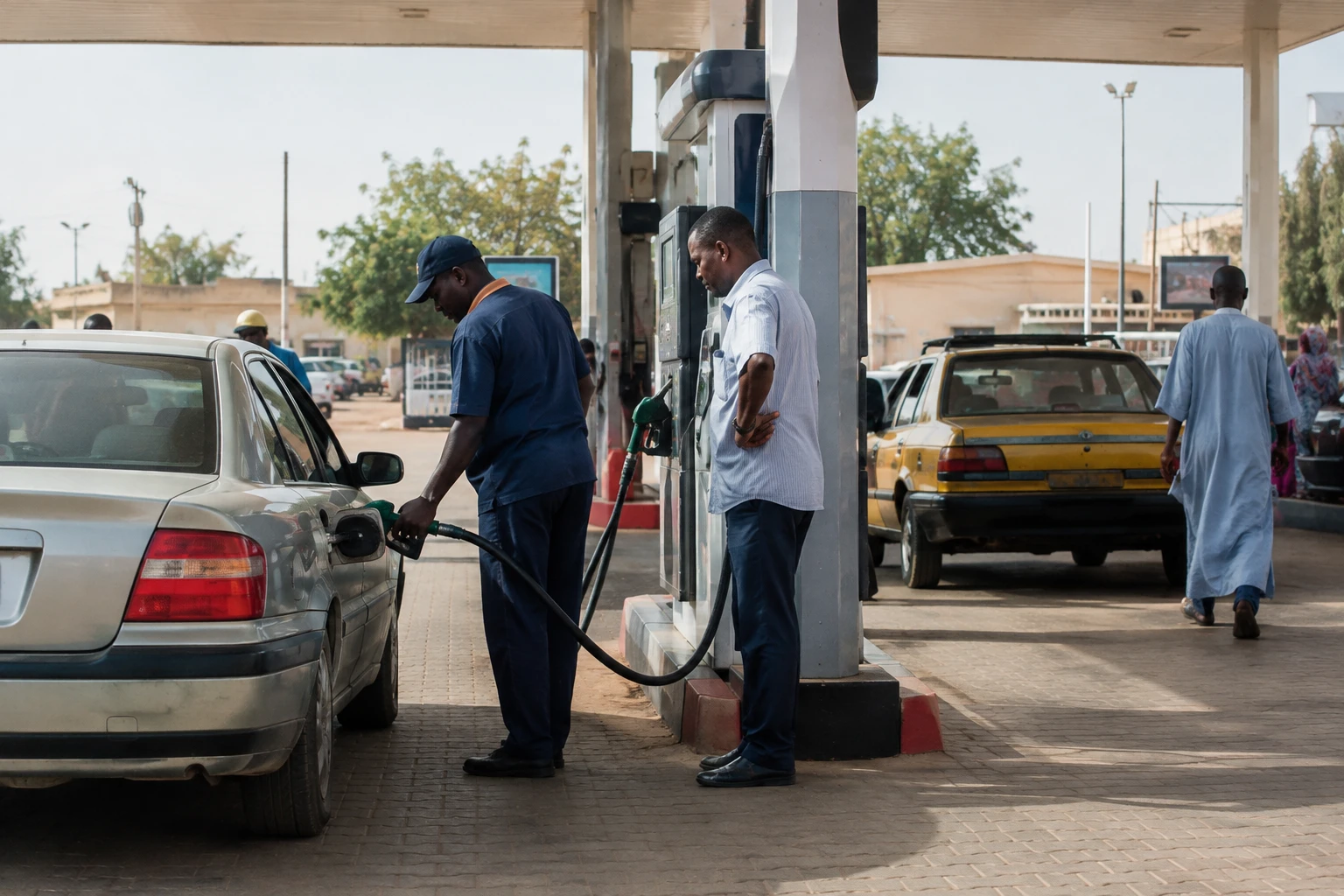
When a station closes at night, the difficulty does not end at the pump. In Niamey, taxi drivers can lose hours of work, while the authorities seek to organise deliveries and limit tensions over fuel.
Fuel supply reorganised overnight
Since Monday 19 October 2026, fuel stations in Niger have normally stopped selling fuel between 9pm and 6am. Designated stations are nevertheless providing overnight service. The measure is intended to facilitate the replenishment of outlets by the Société nigérienne de pétrole (SONIDEP), according to the joint statement by the ministries concerned, signed in Niamey on 19 October.
The arrangement is temporary and applies until further notice or until it is reviewed by the authorities. The overnight stations are intended to meet needs during the night. In the Maradi region, the Nigerien Press Agency reported that five stations had been selected to provide this service, distributed across different areas of the city.
The authorities have also banned fuel sales outside stations in localities with at least one station. This rule targets, in particular, sales in jerrycans, often associated with informal networks. Its enforcement may, however, affect people who, because they lack easy access to a station or face shortages, used to buy from nearby vendors.
Shortages go beyond opening hours
The night-time restriction is a response to strained availability, reported in several cities before reaching Niamey. The official statement presents the measure as a way to streamline deliveries and improve availability at the pump. On its own, it does not set out the causes of the shortage or the volumes actually delivered.
Dependence on a supply chain under pressure makes the problem more complex than a simple question of opening hours. Niger has the Zinder refinery, operated by the Société de raffinage de Zinder (SORAZ), but crude oil produced in the country does not automatically translate into sufficient quantities of fuel for every region and every period. Imports supplement domestic supply. Explanations put forward in the public sphere also point to a decline in informal deliveries from Nigeria and limits on refining capacity; these points should be distinguished from the reasons explicitly stated in the government communiqué.
Initial observations after the measure came into force show varying effects depending on the location and the day. On 23 October, the Nigerien Press Agency reported an improvement in the situation in Niamey and no long queues at the stations it visited. Users and a station manager it interviewed attributed this change to overnight replenishment. This snapshot, however, is not enough to establish a lasting return to normal across the country.
Taxi drivers on the front line
For drivers, access to fuel directly determines their daily income. A Niamey driver, Moussa Idé Boubacar, describes his usual takings as 20,000 to 23,000 CFA francs. He estimates that he spends about 12,500 francs on fuel and pays 8,000 francs a day for his vehicle. He says he missed two days’ payments, amounting to 16,000 CFA francs, because of difficulties obtaining fuel.
These figures are based on his testimony: they are not an average for all Nigerien taxi drivers. They nevertheless illustrate the narrow margins available to a driver when working days are cut short or when he has to wait to fill up. A night without fuel availability can affect the following day’s work, particularly if overnight stations are far away or very busy.
The Taxi Drivers’ Union (Synctaxi) is calling for the arrangement to be eased. Its secretary-general, Ganda Sanda, notes that access to fuel is now tied to authorisations and the opening hours of overnight stations. The request highlights a practical trade-off: reserving time and routes for replenishment can help fill tanks, but overly rigid restrictions risk reducing journeys and the income of transport workers.
A test of distribution and trust
The measure also affects households, small businesses and activities that depend on travel early in the morning or late in the evening. In Niamey, taxis account for a significant share of urban journeys. In secondary cities and rural areas, the distance to an open station can make overnight service less accessible. The effectiveness of the arrangement therefore depends on how it is implemented locally: the location of stations, information for users, the regularity of deliveries and the handling of emergencies.
Niger is a member of the Economic Community of West African States (ECOWAS), a regional organisation whose integration is based in particular on the movement of goods and people. The situation is a reminder that energy security is measured not only by crude oil production: it also depends on refining, transport, storage and distribution to consumers. Supply difficulties can therefore affect both cross-border trade and daily mobility.
In the immediate term, the next indicators will be the regularity of SONIDEP deliveries, changes in queues and the duration of the night-time arrangement. The communiqué provides for monitoring and possible adjustments depending on product availability. For drivers and other users, the question is whether this temporary system will genuinely improve access to fuel without shifting the cost of the shortage on to those whose work depends on every journey.
The official communiqué can be consulted on the Nigerien Ministry of Trade and Industry website. The on-the-ground reports published by the Nigerien Press Agency in Niamey and in Maradi provide further information on how overnight services are operating locally.