Algeria
 Egypt
 Libya
 Morocco
 Sudan
 Tunisia
 Benin
 Burkina Faso
 Cabo Verde
 Côte d'Ivoire
 Ghana
 Guinea
 Guinea-Bissau
 Liberia
 Mali
 Mauritania
 Niger
 Nigeria
 Senegal
 Sierra Leone
 The Gambia
 Togo
 Cameroon
 Central African Republic
 Chad
 Equatorial Guinea
 Gabon
 Republic of the Congo
 São Tomé and Príncipe
 Burundi
 Comoros
 Djibouti
 Eritrea
 Ethiopia
 Kenya
 Madagascar
 Malawi
 Mauritius
 Mozambique
 Rwanda
 Seychelles
 Somalia
 South Sudan
 Tanzania
 Uganda
 Angola
 Botswana
 Eswatini
 Lesotho
 Namibia
 South Africa
 Zambia
 Zimbabwe
In Muanda, a bank’s responsibility is also measured by the ocean
Along the Kongo Central coastline, events that draw crowds are no longer confined to the stage or the pitch. Increasingly, they are becoming a practical test of beach protection, opportunities for young people and the local economy. In Muanda, this balance is particularly delicate: the coast is fragile, mangroves serve as an ecological barrier, and every public or private initiative has an impact on a region exposed to erosion and human pressures.
Against this backdrop, the initiative around the Muanda Beach Cup Festival took on a significance beyond that of a simple festive gathering. It formed part of a broader trend in which Congolese companies are seeking to show they can act beyond sponsorship, with measurable benefits for residents. Rawbank, which in its 2025 annual report describes itself as a leading bank serving the DRC’s economic and social transitions, has also highlighted its recent financial results, reporting $6.82bn in assets and more than 500,000 clients, according to its corporate communications.
Muanda, a strategic region for the DRC and Central Africa
Muanda is more than a seaside resort. It is a sensitive point on the Congolese Atlantic coast, in the heart of Kongo Central province. The area is home to tourism, fishing and oil activities, but is above all marked by the vulnerability of its mangroves, which protect the coastline, store carbon and support biodiversity. For years, authorities and researchers have warned that these ecosystems are directly threatened by deforestation, plastic waste and marine erosion.
This coastline also has regional importance. As a member of SADC and the Economic Community of Central African States, the DRC has a stake in Muanda’s management that extends beyond the province. It concerns coastal resilience, climate adaptation and the protection of a natural heritage at the meeting point of the Congo Basin and the Atlantic Ocean. In its climate communications to the UN, the DRC has documented the risks of coastal inundation, flooding and infrastructure loss along the Muanda-Banana corridor if current trends worsen.
What the festival achieved beyond the images
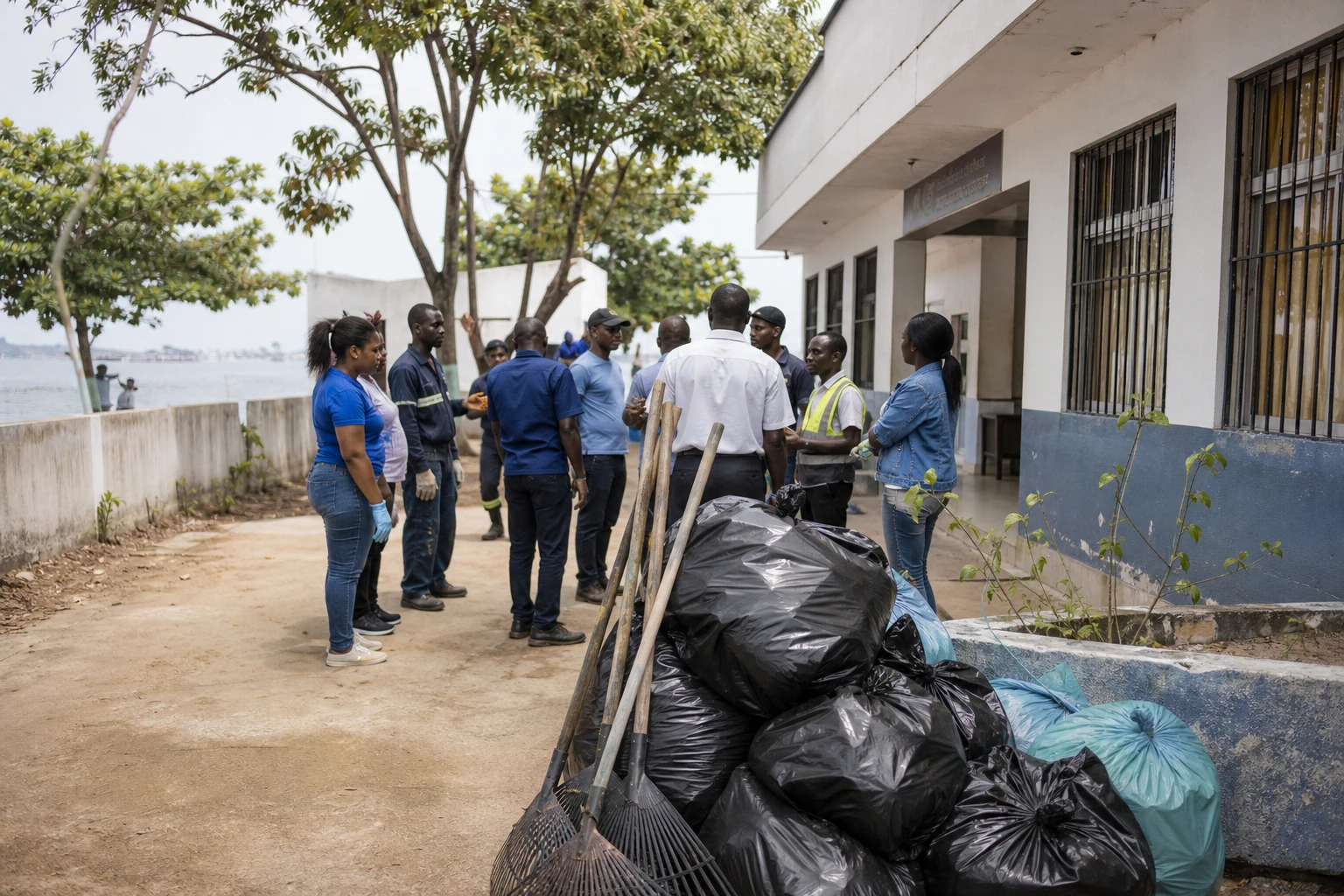
The first edition of the Muanda Beach Cup Festival took place from 17 to 19 July 2026. According to information published on Rawbank’s website and reported by other Congolese media, the programme combined a beach soccer tournament, social initiatives and environmental operations. An inter-orphanage tournament brought together six orphanages in Muanda, while a clean-up operation mobilised hundreds of volunteers from Muanda, Kongo Central and Kinshasa.
The figures cited by the organisers give an idea of the initiative’s scale: more than 18,000 visitors over three days, 317 people involved in cleaning the beaches, more than a tonne of waste collected and 500 sq m of mangrove restored. These figures, drawn from the festival’s communications, were also reported by the local press and on partners’ institutional accounts. They describe an event designed to combine visibility, civic engagement and tangible results on the ground.
Rawbank presented its involvement as a commitment to local communities, rather than a publicity exercise. In its communications, the bank stresses its support for initiatives that benefit Congolese communities, particularly through solidarity with children, social inclusion and environmental protection. This approach is consistent with its broader CSR policy, already reflected in projects to improve access to water, equip healthcare facilities and support social causes.
What this means for residents, young people and traders
The main value of such a festival lies in more than the spectacle. For Muanda, the economic stakes also matter. Organisers highlighted attendance at the site and the activity generated for vendors, small traders and local service providers. In a city where the informal economy accounts for a large share of people’s subsistence income, an event of this kind can, even briefly, generate spending that benefits the local area more than a closed-door gathering would.
Socially, the inter-orphanage tournament and awareness-raising activities put children and young people at the centre. This matters in a country where young people make up the majority of the population and access to spaces for expression, sport and organised leisure remains unequal across provinces. In Muanda, inclusion was not treated as a slogan but as a practical, visible format for activities that families could readily take part in.
The environmental stakes are even greater. Cleaning a beach does not, on its own, solve the waste problem. But waste collection, awareness-raising and mangrove restoration have immediate educational value. They show that plastic waste, pressure on coastal resources and mangrove degradation are not inevitable. In the DRC’s climate documents, the authorities warn that erosion and coastal inundation could eventually threaten entire areas of the coastline. A well-run local initiative therefore also sends a political signal.
A Congolese approach to CSR, and a signal for the region
The Muanda case points to a useful shift: major companies operating in the DRC are increasingly expected to deliver visible results, not just make declarations. Rawbank, which says in its institutional communications that it is Central Africa’s leading bank, is now tying part of its reputation to its ability to support specific communities and address their urgent needs. In a regional environment where banking competition is intensifying, this approach of being close to communities could become a strategic advantage as well as a civic commitment.
For the DRC, the message is broader. The country has a short but highly strategic coastline, rare coastal biodiversity and a large youth population looking for activities, jobs and quality public spaces. When a private-sector player joins efforts to promote conservation and inclusion, its contribution does not replace the state or local authorities. It can, however, complement public action and set a useful precedent, especially in secondary cities that are often less visible than Kinshasa.
The continental significance is clear: as African coastal countries increasingly raise the alarm over erosion, plastic pollution and climate shocks, Muanda is a reminder that solutions also depend on local coalitions. The network of institutions, companies, young people, schools and associations is what makes lasting protection possible. The next test will be straightforward: whether the initiatives launched during the festival continue beyond the three days of mobilisation.