Algeria
 Egypt
 Libya
 Morocco
 Sudan
 Tunisia
 Benin
 Burkina Faso
 Cabo Verde
 Côte d'Ivoire
 Ghana
 Guinea
 Guinea-Bissau
 Liberia
 Mali
 Mauritania
 Niger
 Nigeria
 Senegal
 Sierra Leone
 The Gambia
 Togo
 Cameroon
 Central African Republic
 Chad
 DR Congo
 Equatorial Guinea
 Gabon
 Republic of the Congo
 São Tomé and Príncipe
 Burundi
 Comoros
 Djibouti
 Eritrea
 Ethiopia
 Kenya
 Madagascar
 Malawi
 Mauritius
 Mozambique
 Rwanda
 Seychelles
 Somalia
 South Sudan
 Uganda
 Angola
 Botswana
 Eswatini
 Lesotho
 Namibia
 South Africa
 Zambia
 Zimbabwe
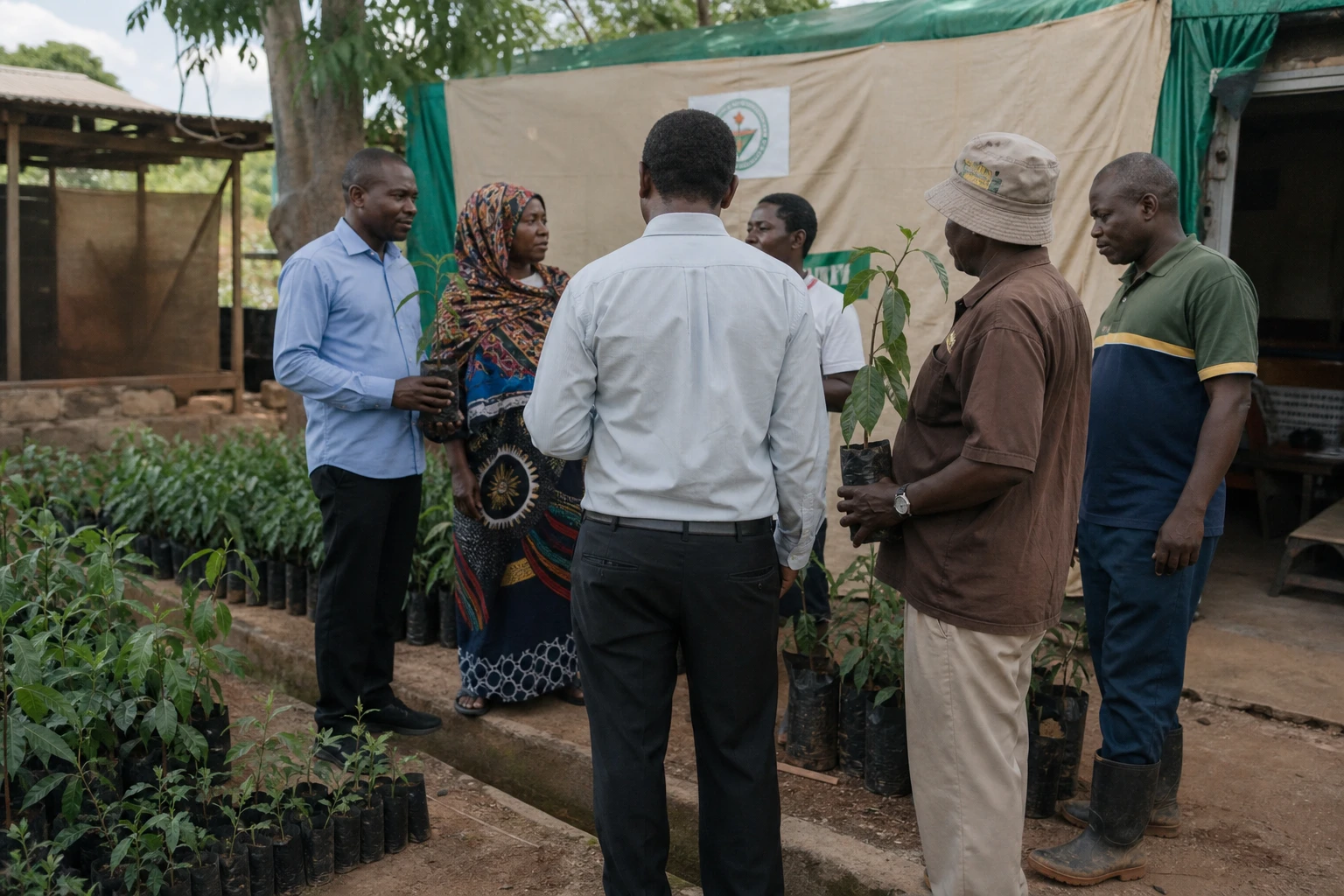
In Morogoro, rain is not just a threat to be contained. For some smallholders, it can also open a rare window to replant, diversify crops and cut irrigation costs.
At the foot of the Uluguru Mountains, the Tanzanian association Agriwezesha was preparing clove, cocoa and mango seedlings ahead of the rainy season forecast for late 2023. The aim was simple: to use the available water to replace dead trees and bring the agricultural calendar forward.
In Morogoro, farming between mountains and climate pressures
The Morogoro region plays an important role in Tanzanian agriculture. Its plains, hills and foothill areas are home to family farms, food crops and fruit plantations. Its proximity to Dar es Salaam also strengthens commercial opportunities, although access to markets remains more difficult for producers far from major routes.
The political capital, Dodoma, lies in the centre of the country. Morogoro, however, is part of another strategic area: the eastern seaboard and the East African Community, or EAC, which brings several countries in the region together around economic cooperation and trade.
In this area, farmers still depend heavily on the timing of the rains. Farms without irrigation systems have to wait for the first rainfall before planting young seedlings. Regular rain can therefore reduce costs. Conversely, excessively heavy showers can wash away soil, damage seedlings or cause flooding.
El Niño refers to the periodic warming of surface waters in the equatorial Pacific. It can alter rainfall patterns far beyond that region. In Tanzania, meteorological authorities had forecast a risk of heavy rainfall from October to December 2023, with a possible extension into January 2024.
Plant earlier, but protect young trees
Agriwezesha, a non-governmental organisation founded in 2019, supports smallholders with production techniques, soil conservation and access to markets. Its agroforestry project combines trees with agricultural crops to strengthen incomes while improving vegetation cover.
The association kept several species in its nursery for farmers’ plots. Clove seedlings aged about six months stood alongside cocoa and mango trees ready to be taken to the fields. Planting depended chiefly on the arrival of sufficiently regular rain.
For Deograsia Ignas, Agriwezesha’s founder, this period could be used to replace trees lost during the previous season. Farmers would then be able to devote the following season to new plantings, rather than combining replacement with orchard expansion.
This strategy does not, however, eliminate the risks. Heavy rain can benefit one plot and damage another. Everything depends on the slope, soil type, quality of drainage and condition of the plants.
At the nursery, gardener Mustafa Mtawa said he had dug drainage channels to divert water away from the pots and limit damage. This adaptation illustrates a less visible aspect of climate policy: preparedness also depends on modest measures carried out at the scale of a farm or village.
An opportunity that comes with conditions
The forecast rains could benefit short-cycle crops in mountainous areas. They could also help fruit and forest trees take root, provided producers have quality seedlings and technical advice.
The success of a planting depends on more than the amount of water received. The species chosen must suit the altitude, soil and market opportunities. A mango, cocoa or clove tree does not have the same production cycle. Producers must also protect young trees from erosion, disease and animals.
Agriwezesha’s official website says its agroforestry project in Mvomero district, in the Morogoro region, has enabled 444,067 trees to be planted and more than 853 hectares to be restored. These figures are from the organisation’s own account. They nevertheless show the scale that local initiatives can reach when agricultural production is combined with land restoration.
The Tanzania Forest Services Agency also has a seedling production station in Morogoro. Its presence is a reminder that tree planting is also part of public policy on conservation and seed availability, beyond the work of non-governmental projects alone.
From weather forecasts to land management
In September 2023, Tanzanian authorities brought regional disaster management committees together in Morogoro. The meeting was intended to prepare government departments, meteorological services, emergency teams and local authorities for possible heavy rains associated with El Niño.
This coordination was necessary because the same rainfall can have very different effects. In rural areas, it can support crops and replenish water reserves. In urban neighbourhoods built in vulnerable areas, it can block roads, damage homes and disrupt commercial activity.
Better-equipped farmers can protect their nurseries, improve drainage and choose when to plant. Producers with fewer resources remain more exposed to the loss of seedlings, erosion and delays in getting goods to market. The climate question is therefore also a question of access to infrastructure, credit, information and markets.
Data from the Tanzania Meteorological Authority confirm that late 2023 saw several episodes of heavy rain, in a context influenced by El Niño and a positive Indian Ocean Dipole. They are a reminder of an essential rule: a forecast of abundant rain is no guarantee of a harvest.
A concern for East Africa
In Morogoro, Agriwezesha’s experience highlights an approach that could be useful across the region. The point is neither to celebrate El Niño nor to downplay its dangers. It is to turn a forecast into practical decisions: protect nurseries, plant at the right time, restore soils and diversify incomes.
This approach aligns with East Africa’s priorities, where rainfall variability affects agriculture, infrastructure and food prices. It also underscores the importance of national meteorological services and local alerts. Useful information must reach farmers in a form they can understand, and early enough to enable them to make decisions.
For Tanzanian producers, the next step is to assess what actually survived the rains, which seedlings took root and which measures limited losses. It is at this scale, plot by plot, that the promise of the opportunity identified in Morogoro will be tested.