Algeria
 Egypt
 Libya
 Morocco
 Sudan
 Tunisia
 Benin
 Burkina Faso
 Cabo Verde
 Côte d'Ivoire
 Ghana
 Guinea
 Guinea-Bissau
 Liberia
 Mali
 Mauritania
 Niger
 Nigeria
 Senegal
 Sierra Leone
 The Gambia
 Togo
 Cameroon
 Central African Republic
 Chad
 DR Congo
 Equatorial Guinea
 Gabon
 Republic of the Congo
 São Tomé and Príncipe
 Burundi
 Comoros
 Djibouti
 Eritrea
 Ethiopia
 Kenya
 Madagascar
 Malawi
 Mauritius
 Mozambique
 Rwanda
 Seychelles
 Somalia
 South Sudan
 Uganda
 Angola
 Botswana
 Eswatini
 Lesotho
 Namibia
 South Africa
 Zambia
 Zimbabwe
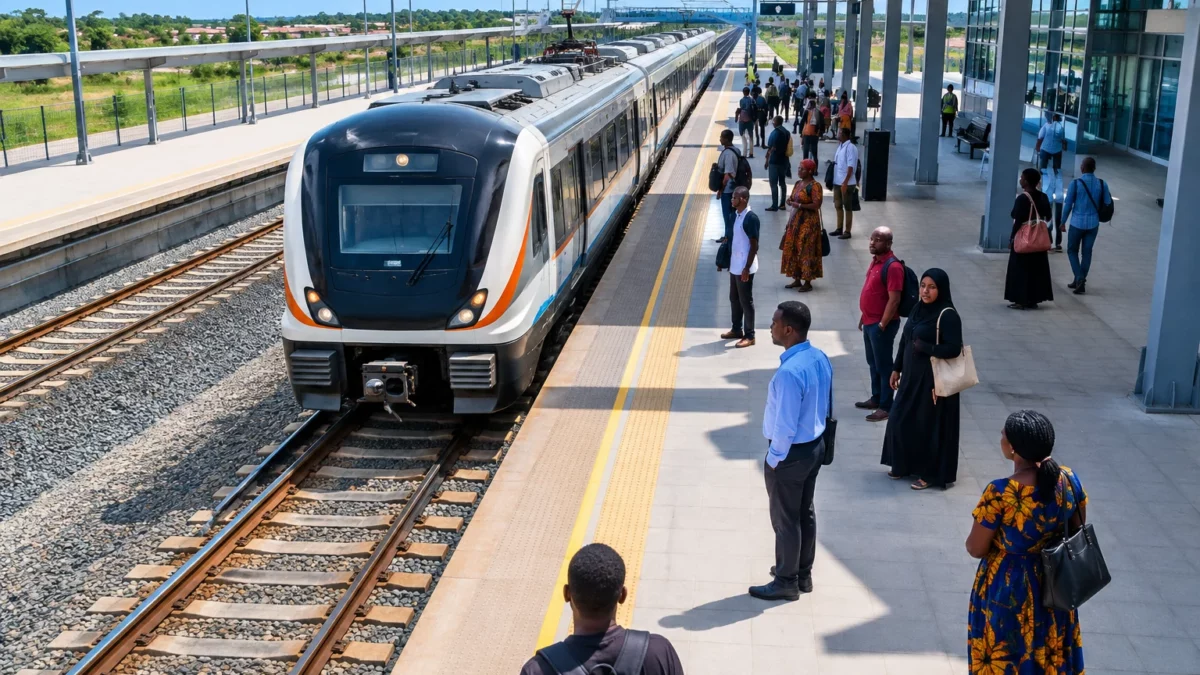
For East Africa’s landlocked countries, having a nearby port is not enough: goods must also be transported at competitive cost and within competitive timeframes. In Tanzania, the standard-gauge electric railway project — the SGR — is progressing with that promise, but its funding and timetable remain issues to watch.
A corridor looking west
Tanzania is seeking to strengthen the Dar es Salaam corridor, which links its main port to inland regions and, ultimately, neighbouring economies. This outlet is of particular interest to Burundi, Rwanda and the Democratic Republic of the Congo (DRC), whose external trade depends in part on the ports and transport networks of neighbouring countries.
The project is also part of a regional trend. The East African Community (EAC) brings together countries seeking to facilitate trade and cross-border travel. But a corridor does not work simply because a railway is built: it also depends on customs, logistics platforms, timetables, rolling stock and coordination between national networks.
Tanzania has already brought the first two sections of the SGR into service, between Dar es Salaam and Dodoma, its political and administrative capital. Extensions into the centre and west of the country are intended to bring the network closer to Mwanza and Kigoma, on the shores of Lake Tanganyika, and support planned regional links.
Funding announced, but still under discussion
On 12 November, in Antalya on the sidelines of COP31, Tanzanian Finance Minister Khamis Mussa Omar met Ali Guney, the general manager of Turkey’s Exim Bank. Tanzania’s finance ministry says negotiations are in their final phase for $280 million in funding for sections 3 and 4.
According to the ministry, the two sections represent a total investment of $1.6 billion. About $1.32 billion has reportedly already been secured, leaving $280 million to be found. Ali Guney said the bank’s board was due to consider the application during the month. At this stage, therefore, the funding is being sought; the disbursement of a loan has not been confirmed.
Public information does not, however, fully agree on distances. The ministry cites more than 700 kilometres for sections 3 and 4. Earlier government data describe Makutupora–Tabora as 368 kilometres and Tabora–Isaka as 165 kilometres, or 533 kilometres in total. Other information published in October 2026 instead gives 294 kilometres and 130 kilometres, or 424 kilometres of main line. These differences in scope or measurement are not explained in the documents consulted; a single figure should therefore not be presented as definitively established.
The project is also drawing on funding at another scale. On 4 November, the African Development Bank (AfDB) announced the signing of $1.2 billion in commercial financing for section 6, between Tabora and Kigoma. The AfDB is providing an $800 million partial credit guarantee to facilitate this funding from lenders.
The economic promise depends on operations
The railway could provide a means of transporting large volumes of goods between the port and the country’s interior. Farmers, mining companies and traders could benefit from lower logistics costs if trains run regularly and freight operations are efficient. The regions along the route could also benefit from activity generated first by construction and then by operations.
But the savings being cited are projections, not established results. In 2022, President Samia Suluhu Hassan said that transporting goods between Dar es Salaam and the DRC could cost about $4,000 per tonne by rail, compared with at least $6,000 per tonne. She also cited a journey of about 30 hours by train, compared with around 30 days by road. These estimates will depend on the route chosen, transhipments, tariffs and whether there is an effective connection to facilities across the border.
Rail transport will not necessarily replace road transport. It could primarily complement it for large volumes and long distances, while lorries continue to play a role in the last mile and in areas far from stations. The benefits will therefore not be the same for large companies, small traders, the towns served or rural communities away from the route.
Funding is another issue. The AfDB’s guarantee for section 6 and discussions with the Turkish bank show that Dodoma is combining several instruments and partners. This strategy could unlock substantial capital; it also requires close attention to the cost of debt, financing terms and the state’s capacity to complete construction while maintaining services.
Regional connections, the real test
The SGR will extend beyond Tanzanian territory only if cross-border links become viable. Extensions towards Burundi, Rwanda or the DRC will require agreements, compatible infrastructure and coordinated procedures. The AfDB describes the Tabora–Kigoma section as a strategic link for trade with eastern DRC, particularly via the ports on Lake Tanganyika; this connection will nevertheless depend on available logistics capacity and links.
For the EAC, the project is a reminder that a regional corridor is built as much at stations and border posts as on construction sites. The next steps to watch are the decision by the board of Turkey’s Exim Bank, the actual progress of construction and the commissioning of planned connections. Only under these conditions will Tanzania be able to turn a national railway investment into more reliable access to markets in East Africa and the Great Lakes region.