Algeria
 Egypt
 Libya
 Morocco
 Sudan
 Benin
 Burkina Faso
 Cabo Verde
 Côte d'Ivoire
 Ghana
 Guinea
 Guinea-Bissau
 Liberia
 Mali
 Mauritania
 Niger
 Nigeria
 Senegal
 Sierra Leone
 The Gambia
 Togo
 Cameroon
 Central African Republic
 Chad
 DR Congo
 Equatorial Guinea
 Gabon
 Republic of the Congo
 São Tomé and Príncipe
 Burundi
 Comoros
 Djibouti
 Eritrea
 Ethiopia
 Kenya
 Madagascar
 Malawi
 Mauritius
 Mozambique
 Rwanda
 Seychelles
 Somalia
 South Sudan
 Tanzania
 Uganda
 Angola
 Botswana
 Eswatini
 Lesotho
 Namibia
 South Africa
 Zambia
 Zimbabwe
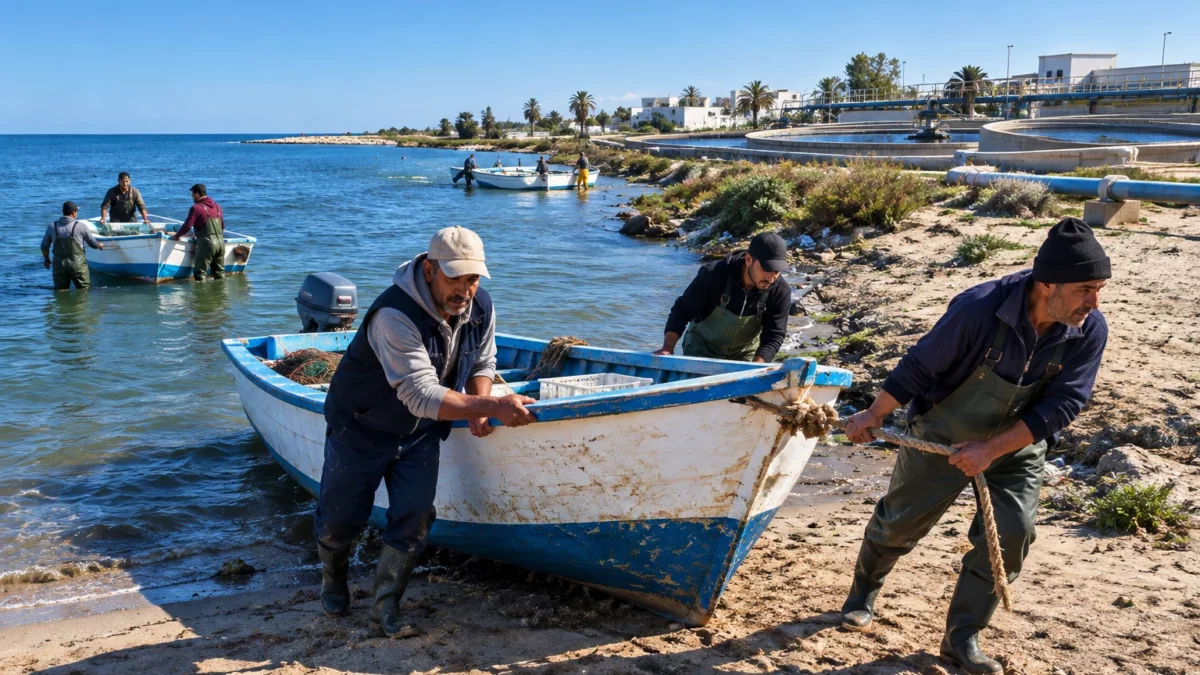
In the Gulf of Monastir, pollution is about more than water quality. It also affects fishers’ incomes, use of the coastline and the ability of public facilities to keep pace with human and industrial activity. In Ksibet el-Médiouni, residents and associations have for years been warning about discharges that, they say, are putting the bay under strain.
A bay at the centre of local and regional concerns
Located in Tunisia’s Sahel region, in the east of the country, the gulf stretches along about 31 kilometres of coast and borders several municipalities, including Monastir, Sayada, Lamta, Ksibet el-Médiouni, Téboulba and Bekalta. The proximity of populated areas, fishing activities, the textile industry and the sea makes the consequences of discharges particularly visible to coastal communities.
This is not a new issue. Citizen-led investigations and Tunisian reports have already documented difficulties at treatment plants and discharges linked to certain industrial activities in the region. The Monastir Governorate Atlas also records wastewater being discharged into the sea or waterways. These documents describe an infrastructure and oversight problem that extends beyond a single port or municipality.
Tunisia is not a member of ECOWAS, SADC or CEMAC. In North Africa, it belongs to the Arab Maghreb Union, while the African Union provides the continental framework. For the gulf, however, the immediate regional issue is also Mediterranean: coastal pollution can affect shared ecosystems, even if its causes and responses remain primarily local and national.
Facilities under pressure
Warnings have focused in particular on the Sayada-Lamta-Bouhjar wastewater treatment plant. Local stakeholders say it receives a volume of wastewater far greater than its original capacity. The reported figures do not fully match: the Tunisian Forum for Economic and Social Rights cites more than 9,000 cubic metres a day against a stated capacity of 1,680, while a report by Tunisian news agency TAP gives a capacity of 1,660 cubic metres and inflows of more than 6,000. These figures should therefore be attributed and verified by the relevant operators before being treated as official records.
Several sources agree on the broader diagnosis: treatment plants that are ageing or overwhelmed by the volumes they have to process, compounded by industrial effluent. In a region where textiles and washing and dyeing activities are economically important, connection to the public network is not enough to guarantee that industrial wastewater has been properly pre-treated. Monitoring discharges and ensuring the actual capacity of facilities are therefore two separate links in the chain.
Residents describe abundant algae, changes in water colour and marine animal deaths. In June 2025, Tunisia’s Ministry of Agriculture reported a microalgae bloom in the areas of Sayada, Lamta and Ksibet el-Médiouni, encouraged in particular by nutrients, waste, wastewater and rising temperatures. This alone does not make it possible to attribute every episode to a single cause or to describe all algae as toxic.
Fishing, health and coastal activities
For fishers, the reported deterioration means more difficult trips and the need to move to other areas. Some say they no longer find the abundance of fish near the shore that they once knew. Others describe having to maintain their boats more frequently. These accounts shed light on people’s lived experience, but do not replace regular scientific monitoring of stocks, water quality and catches.
The repercussions are not the same for everyone. Small-scale fishers, who have fewer means to change fishing grounds or absorb a fall in activity, are directly exposed. Textile workers and local businesses, meanwhile, depend on jobs and income that could be put at risk by a poorly planned transition. Authorities must therefore address protection of the bay, industrial compliance and economic continuity at the same time, without making coastal communities bear the cost of the response alone.
Pollution can also affect swimming, recreational activities and confidence in seafood. On 20 June 2026, a Tunisian crisis-management association recommended temporarily avoiding swimming and fishing in an area of about five nautical miles, from Sayada to near the old port of Monastir, following an alert about possible chemical pollution. The alert, reported by several Tunisian media outlets, does not in itself confirm the source of the phenomenon: the announced analyses were still expected to determine its nature.
Turning announcements into measurable works
Following a visit to Monastir in July 2025, President Kaïs Saïed denounced what he called an “environmental crime”. The political statement underscores the urgency, but the response will be judged above all by verifiable action: work begun, a public timetable, secured funding, effluent monitoring and accessible test results.
A wastewater treatment hub project for northern Monastir is being led by the National Sanitation Office, or ONAS, the public body responsible for wastewater networks and treatment. The African Development Bank has published documents relating to the project, which aims in particular to reduce pollution of the coastline and water resources. Its existence does not, however, mean that the works have been completed or that current discharges have already fallen.
In the short term, residents are calling for emergency solutions when treatment plants become overwhelmed. In the medium term, the region needs facilities sized to handle the volumes actually received, monitoring of industrial discharges at source and independent environmental monitoring. Regularly publishing treatment capacity, incoming volumes and the quality of discharged water would make it possible to distinguish progress from announcements.
A test of environmental governance
The Gulf of Monastir brings into focus a question facing other Tunisian coastlines: how can productive activities, jobs, sanitation and protection of marine environments be reconciled? The case also shows that climate change and rising temperatures can exacerbate some blooms, without erasing the responsibility for discharges or the shortcomings of infrastructure.
The next step will be to check whether the announced projects have funding, a timetable and public indicators, and whether authorities publish the results of water tests. For residents of Ksibet el-Médiouni and neighbouring municipalities, the issue is not limited to the state of the sea during a dramatic episode: it is about being able to fish, work and live beside a bay whose health must be measured over time.