Algeria
 Egypt
 Libya
 Morocco
 Sudan
 Tunisia
 Benin
 Burkina Faso
 Cabo Verde
 Côte d'Ivoire
 Ghana
 Guinea
 Guinea-Bissau
 Liberia
 Mali
 Mauritania
 Niger
 Nigeria
 Senegal
 Sierra Leone
 The Gambia
 Togo
 Cameroon
 Central African Republic
 Chad
 DR Congo
 Equatorial Guinea
 Gabon
 Republic of the Congo
 São Tomé and Príncipe
 Burundi
 Comoros
 Djibouti
 Eritrea
 Kenya
 Madagascar
 Malawi
 Mauritius
 Mozambique
 Rwanda
 Seychelles
 Somalia
 South Sudan
 Tanzania
 Uganda
 Angola
 Botswana
 Eswatini
 Lesotho
 Namibia
 South Africa
 Zambia
 Zimbabwe
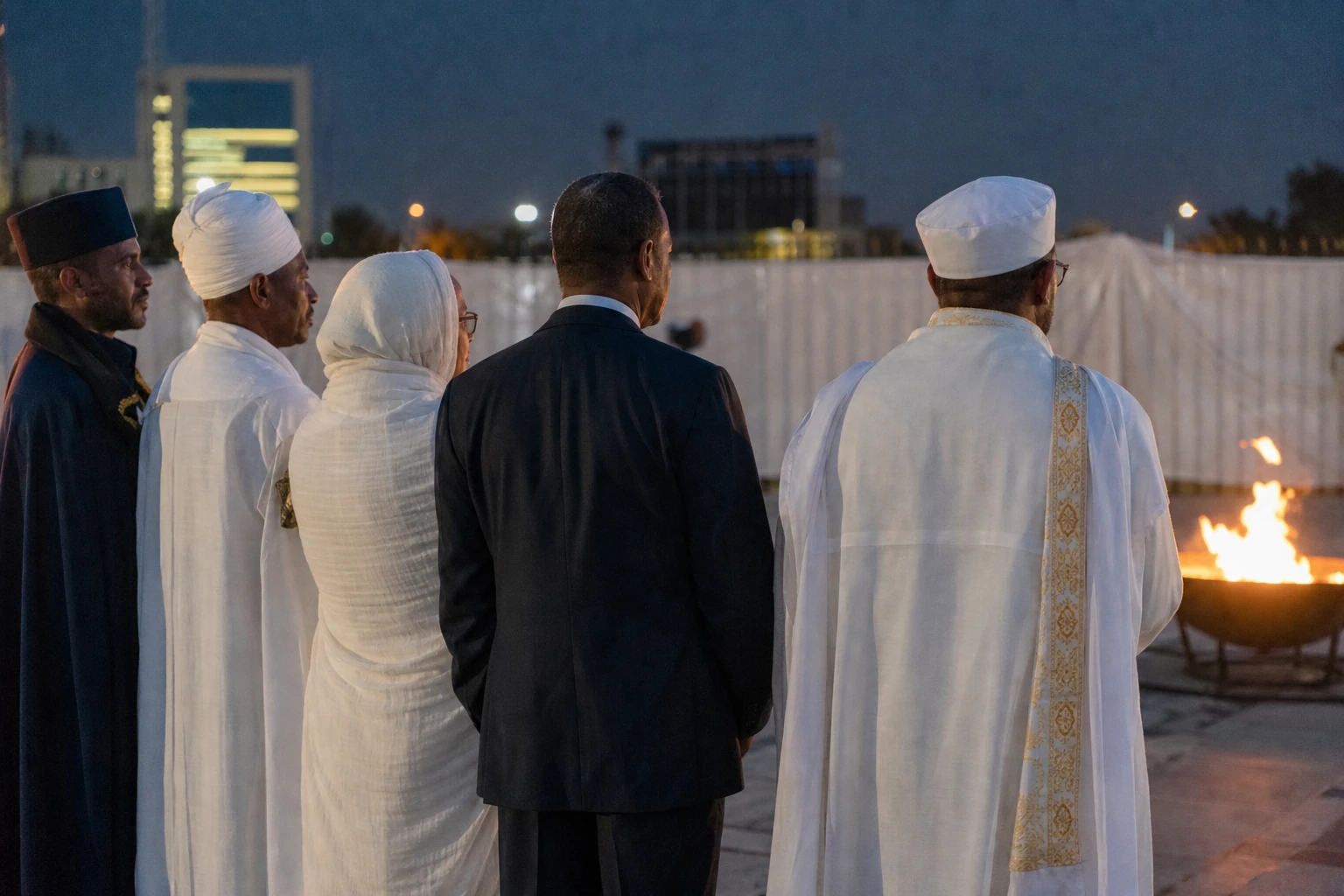
In Addis Ababa, smoke from the great Meskel bonfire rose over an Ethiopia still seeking a lasting way out of war. On 27 September 2023, Orthodox chants offered a moment of collective respite. At the same time, violence continued to destabilise the north of the country.
A national festival in a country under strain
As night fell, thousands of worshippers gathered in Meskel Square, the Ethiopian capital’s large central square. Dressed in white, they watched the Demera ceremony, the bonfire lit on the eve of Meskel.
This festival of the Ethiopian Orthodox Church commemorates the discovery of the True Cross. It holds a major place in the country’s religious and cultural calendar. The 2023 celebration, however, took on particular significance. Many participants saw it as a moment for reflection during a period marked by conflict and uncertainty.
A student in Addis Ababa summed up this mood with a simple wish: “We want peace for our country”. Other worshippers said they wanted to use the ceremony to pray in churches, neighbourhoods and families, away from political tensions.
The message displayed on a young participant’s placard — “Peace for all” — reflected a widely shared aspiration. It was not a structured political slogan, but an appeal to all the parties to the conflict.
The north still bears the consequences of war
The ceremony came less than a year after the agreement signed in Pretoria, South Africa, on 2 November 2022. The text brought an end to the main operations in the Tigray war, which had pitted Ethiopia’s federal government against the Tigray People’s Liberation Front (TPLF) since November 2020.
The agreement, negotiated under the auspices of the African Union, provided for a permanent cessation of hostilities, the gradual disarmament of Tigrayan forces and the restoration of public services. It was also intended to pave the way for the return of displaced people, reconstruction and a transitional justice process.
Yet the end of major offensives did not resolve political and territorial disputes. In Tigray, the question of disputed territories remains sensitive. The return of displaced people is still incomplete. Humanitarian access and economic recovery are progressing unevenly.
In September 2023, experts mandated by the United Nations said serious human rights violations were continuing despite the peace agreement. They cited more than 10,000 survivors of conflict-related sexual violence. This figure, attributed to international investigators, illustrates the scale of the wounds that remain open.
The situation was not confined to Tigray. Since the summer of 2023, the Amhara region had also seen violent clashes between federal forces and local militias, particularly groups known as Fano. The state of emergency declared by the federal authorities had heightened concerns over civil liberties and the protection of civilians.
Fighting extends beyond the Tigray question
The renewed violence in the north was therefore part of a wider crisis. The federal government was seeking to reassert its authority over several regions. Armed groups and local officials, meanwhile, were challenging some decisions made in Addis Ababa.
Reform of the security apparatus was one source of tension. The federal authorities wanted to integrate or disarm regional special forces, created over the years to protect local territories. In several regions, these units had become essential instruments of power. Their dismantling therefore threatened already fragile political and military balances.
Civilians are bearing the direct effects of this confrontation. In rural areas, travel becomes difficult when roads are cut off or fighting draws closer. Markets slow down. Schools and health centres may close. In cities, fear translates into movement restrictions, arrests and growing distrust of the authorities.
The consequences also vary according to social circumstances. Employees in the formal economy can sometimes leave exposed areas. Farmers, traders and day labourers have less room to manoeuvre. An interruption of just a few days can be enough to jeopardise a harvest, an income or a family’s supplies.
Addis Ababa, the capital, remains relatively far from the front lines. Yet it is a focal point for political tensions, displaced families and debate about the country’s direction. Meskel brought together citizens with different experiences: some came from the north, while others had lived in the capital for several years.
Pretoria agreement faces a decisive test
For the African Union, the Pretoria agreement remains the central framework for peace in Ethiopia. The African Commission on Human and Peoples’ Rights has called on the parties to respect and fully implement its commitments.
Implementation, however, depends on concrete decisions. The return of displaced people must be made safe, the status of disputed territories clarified and humanitarian access guaranteed. Crimes committed during the war must also be addressed without turning justice into a new instrument of confrontation.
The process must ultimately include the affected communities. A peace negotiated among leaders is not enough if people regain neither security, public services nor livelihoods. Reconciliation cannot be reduced to an official ceremony or a political declaration.
The regional dimension is important. Ethiopia is a major actor in the Horn of Africa and hosts the African Union headquarters in Addis Ababa. Its internal crises affect relations with Eritrea, Sudan and Somalia. They can also disrupt trade routes and refugee movements in a region already deeply destabilised.
At Meskel Square, worshippers thus celebrated an ancient tradition while voicing a very current concern. The bonfire illuminated an evening of prayer. It did not dispel the causes of conflict. The next step will depend on the ability of the federal authorities, regional leaders and armed groups to preserve the truce, resume dialogue and make peace visible in Ethiopians’ daily lives.