Algeria
 Egypt
 Libya
 Morocco
 Sudan
 Tunisia
 Benin
 Burkina Faso
 Cabo Verde
 Côte d'Ivoire
 Ghana
 Guinea
 Guinea-Bissau
 Liberia
 Mali
 Mauritania
 Niger
 Nigeria
 Senegal
 Sierra Leone
 The Gambia
 Togo
 Cameroon
 Central African Republic
 Chad
 DR Congo
 Equatorial Guinea
 Gabon
 Republic of the Congo
 São Tomé and Príncipe
 Burundi
 Comoros
 Djibouti
 Eritrea
 Kenya
 Madagascar
 Malawi
 Mauritius
 Mozambique
 Rwanda
 Seychelles
 Somalia
 South Sudan
 Tanzania
 Uganda
 Angola
 Botswana
 Eswatini
 Lesotho
 Namibia
 South Africa
 Zambia
 Zimbabwe
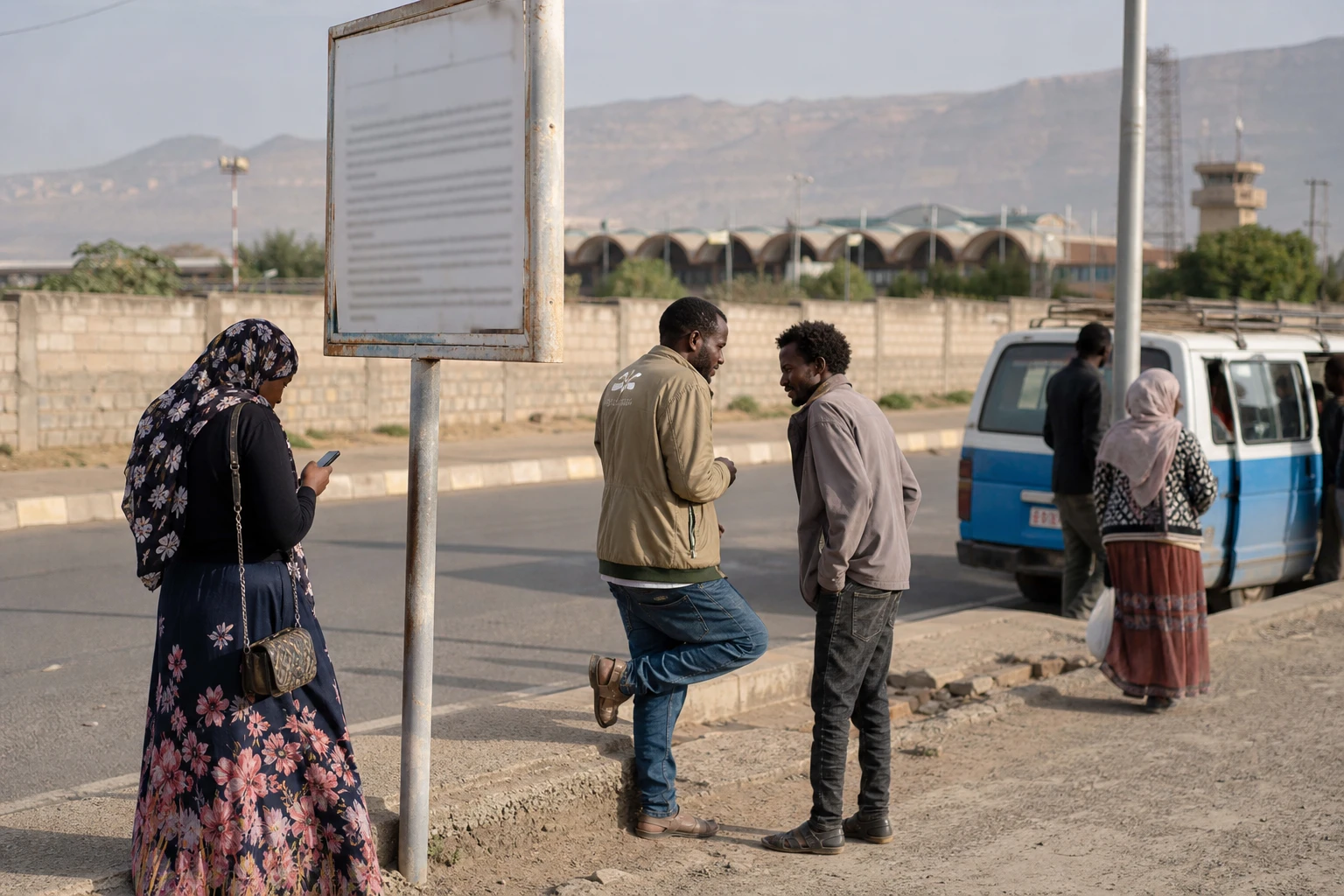
Control of Alula Aba Nega airport in Mekelle has become a key indicator of how the conflict in Tigray is evolving. Located about 10 kilometres from the city centre, the facility links the regional capital to the rest of Ethiopia. It also serves as a logistical base in an area where communications and travel remain severely disrupted.
On 2 October 2026, the Tigray Peace Forces (TPF), a Tigrayan armed group that supports the federal government, said they had retaken the airport. Their announcement, posted on the social media platform X, was not accompanied by an independent account of the fighting or immediate confirmation from federal or regional authorities.
Infrastructure at the heart of the battle for Mekelle
In their statement, the TPF said they had taken “full control of Alula Aba Nega airport”. Images posted by the group showed fighters aboard a truck heading towards Mekelle. The TPF later said they were continuing their advance towards the city.
This account follows conflicting reports about control of the airport. On 23 September, forces loyal to the Tigray People’s Liberation Front, the TPLF, had already announced that they had taken several airport facilities in the region. Ethiopian Airlines then suspended flights to Mekelle, Axum and Shire.
An Associated Press dispatch reported that fighters linked to the TPLF were occupying Mekelle airport, which had previously been under federal control. A dispatch from Agence France-Presse carried by NAMPA subsequently reported the TPF’s claim on 2 October. The succession of announcements illustrates how difficult it is to verify changes of position in northern Ethiopia in real time.
The airport is nevertheless an obvious strategic target. It can facilitate the movement of personnel, equipment and humanitarian aid. Control of it can also restrict the movement of opposing forces and influence links between Mekelle, Addis Ababa and other cities in Tigray.
Tigray slides back into open confrontation
The announced recapture of the airport comes after several days of fighting in southern Tigray. The TPF have also said they retook towns such as Alamata, about 200 kilometres from Mekelle. These claims, too, must be distinguished from facts confirmed by independent observers.
The TPLF remains the federal government’s main political and military adversary in the region. The movement led the former Ethiopian People’s Revolutionary Democratic Front, the coalition that dominated national politics for nearly three decades before Abiy Ahmed came to power in 2018.
The 2020–2022 war pitted the federal government against Tigrayan forces. It ended with the Pretoria Agreement, signed in November 2022 under African mediation. The agreement provided for a cessation of hostilities and a process of political and security reintegration. However, several issues remained contentious, including the status of disputed territories, disarmament and the composition of the regional administration.
In September 2026, seven opposition movements announced the formation of an alliance aimed at challenging Prime Minister Abiy Ahmed’s government. The TPLF is among the main actors in this coalition. This coordination increases the risk of confrontation on several fronts, as other armed groups are active in Oromia, Amhara and areas near Tigray.
Abiy Ahmed’s message and uncertainty over de-escalation
A few hours before the TPF’s claim, Ethiopian Prime Minister Abiy Ahmed had sent an indirect message to armed groups opposed to his government. Without naming the TPLF, he said the door would remain open to those who chose peace.
The statement combines a political opening with a warning. The federal government seeks to portray the conflict as a rebellion against the state. Tigrayan forces, for their part, accuse Addis Ababa of breaking the commitments made under the Pretoria Agreement and carrying out operations against their region.
Accusations are also mounting between Ethiopia, Eritrea and Tigrayan groups. Ethiopian authorities recently accused Asmara of supporting hostile forces. Eritrea rejects the allegations. On 1 October, Addis Ababa ordered ten Eritrean diplomats to leave the country and announced the closure of its embassy in Asmara, triggering a fresh rupture between the neighbours.
This regional dimension complicates any mediation effort. Eritrea supported federal forces during the 2020–2022 war. It shares a border with Tigray and remains directly affected by any military developments around Mekelle. Sudan, too, could be affected if the fighting spreads towards border areas.
Immediate consequences for residents
For residents of Mekelle, the battle over the airport is about more than the military question. The suspension of flights restricts access to healthcare, administrative services and trade with Addis Ababa. Humanitarian organisations may also face greater difficulties moving their teams and supplies.
The effects vary from one area to another. In the regional capital, restrictions affect transport, banks and supplies. In rural areas of southern Tigray, fighting can disrupt markets, harvests and access to essential services. Informal-economy workers are particularly exposed, as their incomes depend on daily travel and fragile local networks.
Families displaced by the previous war also remain vulnerable. Any new offensive could force more people to flee, while reception capacity and humanitarian access remain limited in several parts of Tigray.
A warning for the Horn of Africa
The situation in Tigray is testing the Pretoria Agreement and African conflict-prevention mechanisms. The African Union, headquartered in Addis Ababa, played a central role in the 2022 negotiations. It now faces the risk of renewed conflict in a country that remains one of the Horn of Africa’s main political and economic centres.
The Intergovernmental Authority on Development, or IGAD, the regional organisation for East Africa, is also concerned. A lasting deterioration in Tigray could affect trade corridors, relations between Ethiopia and Eritrea, and security in border areas with Sudan.
The immediate priority will be to verify who actually controls Alula Aba Nega airport and the approaches to Mekelle. The resumption of flights, population movements and any openings for dialogue will then need to be monitored. Until military announcements are confirmed by independent sources, none of the parties can be considered to have lasting control of Tigray’s capital.