Algeria
 Egypt
 Libya
 Morocco
 Sudan
 Tunisia
 Benin
 Burkina Faso
 Cabo Verde
 Côte d'Ivoire
 Ghana
 Guinea
 Guinea-Bissau
 Liberia
 Mali
 Mauritania
 Niger
 Nigeria
 Senegal
 Sierra Leone
 The Gambia
 Togo
 Cameroon
 Central African Republic
 Chad
 DR Congo
 Equatorial Guinea
 Gabon
 Republic of the Congo
 São Tomé and Príncipe
 Burundi
 Comoros
 Djibouti
 Eritrea
 Ethiopia
 Kenya
 Madagascar
 Malawi
 Mozambique
 Rwanda
 Seychelles
 Somalia
 South Sudan
 Tanzania
 Uganda
 Angola
 Botswana
 Eswatini
 Lesotho
 Namibia
 South Africa
 Zambia
 Zimbabwe
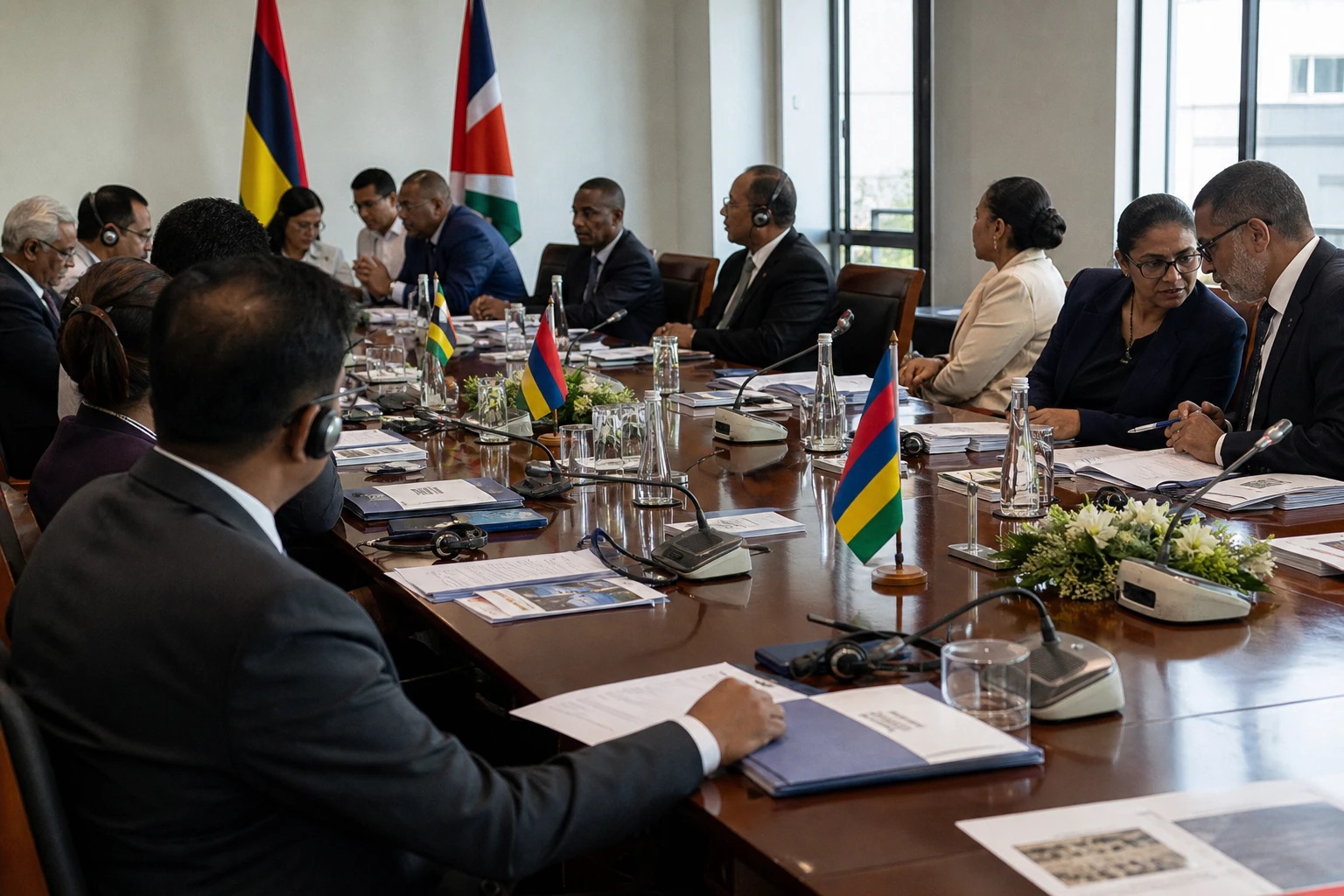
Two islands, one shared goal: turning cooperation into results
In the Indian Ocean, small island states know that agreements are only worthwhile if they move quickly between ministries, ports, universities and businesses. For Mauritius and Seychelles, the challenge is clear: to turn their geographical proximity into an economic asset rather than a mere diplomatic symbol. The two countries already have longstanding ties, but now want to translate them into visible projects in fisheries, education, services and investment. This approach also reflects a broader regional perspective, in which the island states of the Indian Ocean region are seeking greater influence in the blue economy and climate resilience.
The institutional framework is already in place. Mauritius and Seychelles have for years worked through structured bilateral forums, notably the Joint Commission for Cooperation, and regional bodies such as the Indian Ocean Commission, which also brings together the Comoros, Madagascar and Réunion. There is also a strategic issue: the joint management of the Mascarene Plateau, a maritime area where the two capitals have chosen to pool their interests rather than set them against each other. In August 2026, the Seychelles government again approved a new phase with Mauritius for seismic data collection in the common maritime zone, showing that this dialogue goes well beyond statements of principle.
From March commitments to September projects
The latest phase began with Seychelles President Patrick Herminie’s state visit to Mauritius from 11 to 14 March 2026. Seven agreements were announced on that occasion and presented as practical tools for strengthening institutional cooperation. The agreements cover arts and culture, agriculture, sanitary and phytosanitary matters, fisheries, statistics, fire and rescue services, as well as training and capacity-building. The Seychelles authorities also announced the opening of a resident diplomatic mission in Mauritius, a sign that relations between Port Louis and Victoria are intended to become more regular and more operational.
Nine months later, the two governments sought to move from protocol to implementation. On 11 September 2026, following the 14th session of their Joint Commission, they expressed their determination to speed up implementation of the agreements signed in March. According to available official information, priorities include investment, fisheries, agriculture, services, education and skills mobility. This is significant because it shows that the two states are not seeking merely to multiply signings, but to establish a follow-up timetable. For small economies, the real challenge is not making announcements, but having the administrative capacity to turn an agreement into tangible activity.
In education, the two sides want to strengthen exchanges between institutions and make human capital a driver of economic transformation. This is no small matter. Seychelles, with its small population and an economy still exposed to external shocks, needs local expertise in administration, maritime affairs, tourism and services. Mauritius, for its part, is seeking to consolidate its position as a regional services hub. Closer educational ties therefore serve both agendas: providing more training locally, reducing dependence and ensuring that the most strategic sectors do not rely solely on ad hoc recruitment or scattered partnerships.
Fisheries and the blue economy are central. Both countries have vast maritime areas and share the same vulnerabilities: dependence on food imports, exposure to fuel-price fluctuations, pressure on fish stocks and the need to protect ecosystems. The issue is also political. In the Indian Ocean, maritime sovereignty, monitoring exclusive economic zones and the sustainable management of fish stocks have become matters of economic sovereignty as much as diplomacy. Mauritius and Seychelles’ cooperation in this area reflects a determination to gain greater influence in negotiations over resources, rather than be exposed to competition from large fleets or external markets.
The same logic applies to investment. The two countries want to expand opportunities for economic cooperation and follow up on avenues already identified. For Mauritius, this also means opening up new markets for its companies, services and expertise. For Seychelles, the aim is to attract more capital and diversify the drivers of growth beyond tourism. But the gap between announcements and actual flows remains clear. Trade in goods is still modest relative to the size of the two economies. In 2024, Mauritian exports to Seychelles reached about $21.48 million, compared with $2.25 million in Seychellois exports to Mauritius, according to available international trade data.
These figures say a great deal. They show that the relationship is imbalanced, but also that it remains far from its potential. Current trade reflects exchanges on a small scale, not deep interdependence. In other words, bilateral cooperation cannot be limited to traded goods. It must also extend to services, training, air and maritime transport, the joint management of resources and direct investment. That is where Mauritius-Seychelles ties can create value: not through massive volumes of goods, but through shorter decision-making chains and targeted projects.
What this acceleration says about the Indian Ocean
Ultimately, this acceleration illustrates a broader trend across the Indian Ocean region: small island states are seeking greater clout by pooling their capabilities. The Indian Ocean Commission, maritime cooperation frameworks and initiatives on fisheries and marine conservation form parts of the same puzzle. Mauritius and Seychelles have a particular role in this effort, combining relative institutional stability, diplomatic ambition and strong dependence on the ocean. Their choices therefore matter well beyond their respective capitals, from Port Louis to Victoria.
What happens next will depend on the approach. If joint commissions remain review meetings without a public timetable, momentum will quickly fade. If, by contrast, the two states publish deadlines, name those responsible and launch pilot projects in fisheries, training and services, bilateral relations could move to a new level. For now, the message sent in September 2026 is clear: Mauritius and Seychelles no longer want merely to maintain friendly relations. They want to make them an instrument of development, economic sovereignty and regional influence.