Algeria
 Egypt
 Libya
 Morocco
 Sudan
 Tunisia
 Benin
 Burkina Faso
 Cabo Verde
 Côte d'Ivoire
 Ghana
 Guinea
 Guinea-Bissau
 Liberia
 Mali
 Mauritania
 Niger
 Nigeria
 Senegal
 Sierra Leone
 The Gambia
 Togo
 Cameroon
 Central African Republic
 Chad
 DR Congo
 Equatorial Guinea
 Gabon
 Republic of the Congo
 São Tomé and Príncipe
 Burundi
 Comoros
 Djibouti
 Eritrea
 Ethiopia
 Kenya
 Malawi
 Mauritius
 Mozambique
 Rwanda
 Seychelles
 Somalia
 South Sudan
 Tanzania
 Uganda
 Angola
 Botswana
 Eswatini
 Lesotho
 Namibia
 South Africa
 Zambia
 Zimbabwe
A year after his arrest, the case of Mamy Ravatomanga remains split between two timetables: that of the financial investigation and that of hearings on his detention. For Mauritius, the stakes go beyond the fate of a Malagasy businessman. They also concern the island’s ability to address suspicions of cross-border financial flows without confusing accusation with guilt.
A Mauritian case with Malagasy ramifications
Mauritius, whose capital is Port Louis, is an Indian Ocean financial centre and a member of the Southern African Development Community (SADC), a regional cooperation organisation. Its role in regional trade and financial services makes the monitoring of capital particularly sensitive: investigators must establish the origin of funds, while the courts must safeguard the rights of the person concerned.
The case also comes amid a period of political upheaval in Madagascar. Mamy Ravatomanga, a businessman close to former president Andry Rajoelina, arrived in Mauritius in October 2025, against the backdrop of a political crisis in Madagascar. The Financial Crimes Commission (FCC), Mauritius’s financial crime investigation agency, has opened several strands of investigation.
The case thus illustrates a regional reality: investigations involving people, companies and assets spread across several countries require judicial cooperation, as well as separate national proceedings. Mauritian investigations do not amount to a judgement on the facts, and proceedings in Madagascar or France do not replace decisions by the courts of Mauritius.
Prolonged detention, with no trial announced
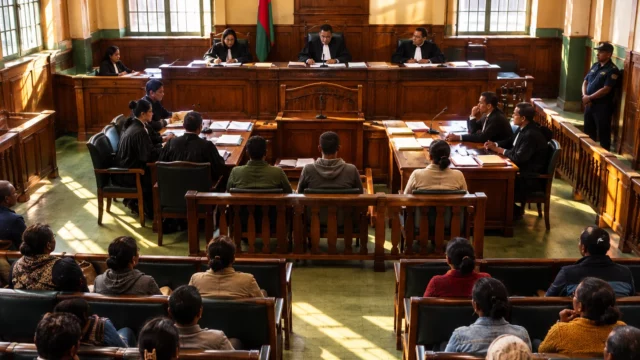
Arrested on 24 October 2025, Ravatomanga remains in detention a year later. On 13 October 2026, the Bail and Remand Court, which deals in particular with applications for release on bail, rejected a fresh application for his release. He remains the subject of two provisional charges of money laundering and one charge of conspiracy linked to possible influence peddling. These charges do not amount to a conviction.
The recent decision concerns pre-trial detention, not the final verdict. The court examined, among other things, the risks cited in the case, including the possibility of flight or interference with the investigation. The defence challenges his continued detention and the way the proceedings are progressing. In May 2026, the Supreme Court had already dismissed an appeal against the refusal of bail issued at the end of the previous year.
The proceedings, however, have reached milestones in some strands of the case. In February 2026, the FCC told the court that its investigation into the influence-peddling charge was complete and that the file was to be referred to the Director of Public Prosecutions, who is responsible for considering criminal proceedings. This step does not mean that all financial investigations are closed, nor that a trial on the merits has been scheduled.
Investigators are focusing in particular on transactions involving Boeing aircraft sold to Iran, as well as funds held in personal accounts and linked to companies. The FCC has obtained an order to seize and freeze assets valued at about 7.3 billion Mauritian rupees. Subject to appeals, the interim measure prevents the disposal of these assets while the case is examined; on its own, it does not prove that they are the proceeds of criminal activity.
Appeals and investigations beyond the island
The defence had said it intended to challenge the detention in the Supreme Court and had raised, as a last resort, the possibility of taking the matter to the British Privy Council, which remains an appellate body for Mauritius in certain cases. Separate proceedings concern a challenge to the asset-freezing order. The appeals are therefore pursuing several avenues with different aims: liberty, seizure of assets and examination of the charges.
France is also interested in some of the financial evidence. Investigators from the National Financial Prosecutor’s Office have travelled to Mauritius as part of their inquiries. This cooperation underlines the international dimension of the case, but does not in itself allow any conclusion that an offence has been committed. Each authority must act within its remit, and the evidence gathered must be examined by the courts.
The length of the detention puts the balance between two requirements in the foreground. The authorities may cite the need to preserve the investigation and prevent risks. The defence, for its part, challenges prolonged detention before trial. This balance bears directly on judicial safeguards in Mauritius, as well as on confidence in efforts to combat illicit financial flows in the region.
What the October anniversary changes — and what it does not
A year after the arrest, no trial on the merits has been announced in the information available. The latest known decision keeps Ravatomanga in detention, while investigations and appeals continue. The anniversary therefore represents neither an automatic judicial deadline nor a conclusion about his guilt.
For Mauritians, the case raises a concrete institutional question: how can assets suspected of being linked to offences be immobilised while ensuring judicial review within a reasonable time? For Madagascar, it unfolds after a period of serious political instability and involves a figure associated with the former government. For SADC and the countries of the Indian Ocean, it is a reminder that financial networks and judicial proceedings cross borders, while decisions remain in the hands of national courts.
The next steps to watch are decisions on the detention and the asset freeze, as well as what follows from the file referred to the prosecuting authorities. Until the charges have been tried, the case remains an investigation and a series of proceedings — not a verdict.