Algeria
 Egypt
 Libya
 Morocco
 Sudan
 Tunisia
 Benin
 Burkina Faso
 Cabo Verde
 Côte d'Ivoire
 Ghana
 Guinea
 Guinea-Bissau
 Liberia
 Mali
 Mauritania
 Niger
 Nigeria
 Senegal
 Sierra Leone
 The Gambia
 Togo
 Cameroon
 Central African Republic
 Chad
 DR Congo
 Equatorial Guinea
 Gabon
 Republic of the Congo
 São Tomé and Príncipe
 Burundi
 Comoros
 Djibouti
 Eritrea
 Ethiopia
 Kenya
 Madagascar
 Malawi
 Mozambique
 Rwanda
 Seychelles
 Somalia
 South Sudan
 Tanzania
 Uganda
 Angola
 Botswana
 Eswatini
 Lesotho
 Namibia
 South Africa
 Zambia
 Zimbabwe
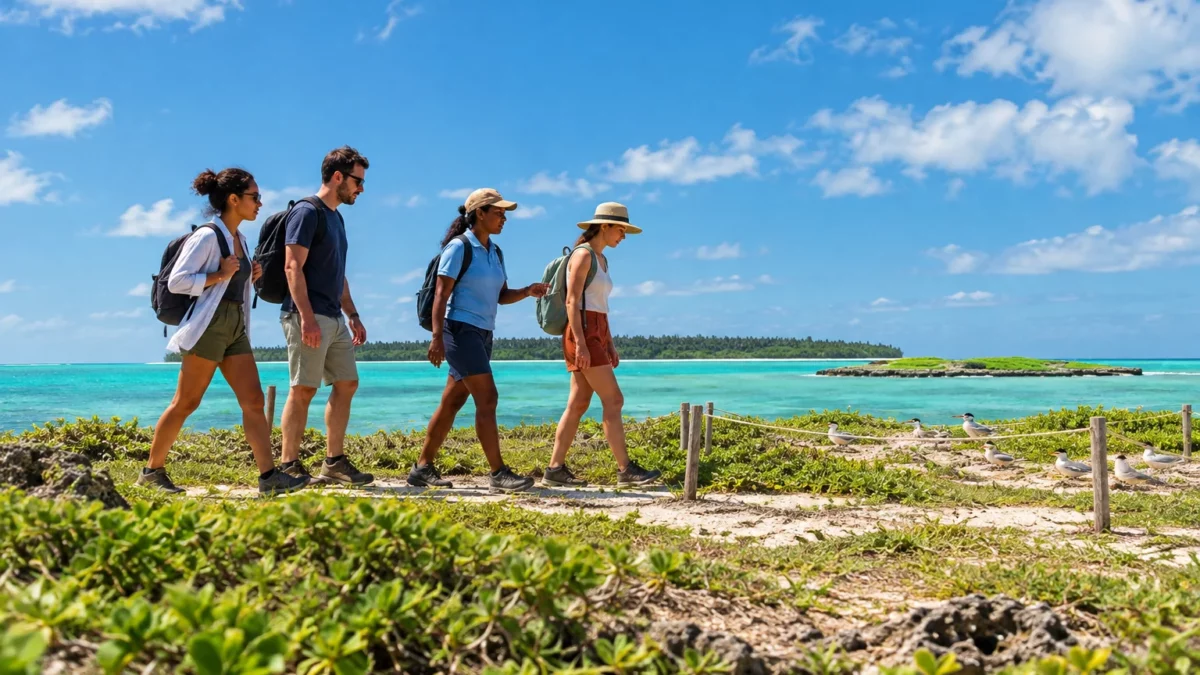
Four kilometres from Rodrigues, Île aux Cocos welcomes birds each year as they arrive to nest in the lagoon. But protecting their colonies while opening the site to visitors raises a practical question: how can conservation and tourism coexist on a fragile islet?
A protected islet in the Rodrigues lagoon
Île aux Cocos lies off Rodrigues, an autonomous island territory belonging to the Republic of Mauritius, in the south-west Indian Ocean. It is uninhabited and designated a nature reserve. Nearby Île aux Sables has the same status. Both islets are known for their seabird populations and coastal environments.
The institutional framework is unusual. The Rodrigues Regional Assembly has its own powers under the law governing its operations. In October 2025, a Mauritian minister told parliament that the islets were covered by the nature reserve regime and that their management in Rodrigues was handled by the local Forestry Service, in accordance with that law. The Mauritian Wildlife Foundation, a conservation organisation based in Mauritius, provides monitoring and ecological advice.
This division of responsibilities links the site’s protection to management choices in Rodrigues, rather than solely to the promotion of a destination. It matters to residents and local stakeholders: tourism can support the island’s economy, while visitor rules determine the pressure placed on habitats.
Colonies that require precise rules
The islet is a nesting site for several seabirds. The Mauritian Wildlife Foundation names the brown noddy, lesser noddy, white tern and sooty tern in particular. The species present and their abundance vary over time. It is therefore more accurate to describe the site as an important refuge than to give a fixed number of birds without a dated survey.
Protection depends on more than legal status. Visitors must avoid approaching the birds, touching nests or leaving litter. Signs on site explain which species are nesting and outline restoration work. Some areas are also closed to visitors to limit disturbance. Controlled access is intended to make visits compatible with colony breeding.
There are also ecological threats. In its 2024 annual report, the Mauritian Wildlife Foundation says vegetation on the islets has been altered by plantations and introduced plants. It also cites coastal erosion and the effects of poorly managed visitor numbers. These factors can reduce the quality of nesting sites, even when the island remains officially protected.
The report also discusses bird deaths observed in February 2023. It says more than 1,000 young lesser noddies were found dead on Île aux Cocos, and about 176 on Île aux Sables. The foundation reports that the regional veterinary service cited several possibilities, including ecosystem disruption, malnutrition or a heavy tick infestation. These explanations are attributed to the report: on their own, they do not establish a single cause. The foundation says its teams conducted four surveys in 2024.
Local tourism and day-to-day conservation
Île aux Cocos attracts visitors for its birds, lagoon and coastal scenery. Boat trips contribute to Rodrigues’s tourism offering, alongside activities such as hiking and exploring local heritage. For operators, the site offers a distinctive experience. For those responsible for the reserve, however, every landing means managing noise, movement and waste.
The distinction matters: a natural site is not automatically preserved because it is remote or uninhabited. The Mauritian Wildlife Foundation notes that human activity has already altered some habitats. It also highlights the risks posed by introduced plants and animals. Ecological restoration, bird monitoring and visitor information are therefore ongoing work: less visible than an excursion, but essential to its long-term viability.
In 2024, the foundation said the renovation of the visitor centre had been completed. It also reported that regulatory signs were due to be installed in 2025. These facilities can help explain the rules and guide visitors. Their effectiveness will nevertheless depend on their maintenance, access controls and coordination among regional services, tourism organisations and conservation stakeholders.
An issue that goes beyond the excursion
In Rodrigues, protecting Île aux Cocos is part of a wider challenge: reconciling tourism, the island economy and the preservation of marine environments. The main island depends on its coastal resources and the quality of its landscapes, but the benefits and constraints are not always distributed equally. Operators and businesses may benefit from tourism, while public services and field teams take on some of the monitoring and impact management.
The reserve also serves as a reminder that Mauritius is not limited to its main island or Port Louis, its capital. Rodrigues has its own institutions and priorities, within a regional Indian Ocean context where island environments share challenges related to biodiversity and coastal management. At a continental level, the case illustrates the importance of giving local authorities and organisations a role in conservation decisions.
What happens next will be measured less by the site’s popularity than by the condition of the colonies, the regularity of monitoring and compliance with protected-area rules. Surveys, habitat restoration and the implementation of regulations will provide concrete indicators of whether welcoming visitors remains compatible with the islet’s role as a refuge.