Algeria
 Egypt
 Libya
 Morocco
 Sudan
 Tunisia
 Benin
 Burkina Faso
 Cabo Verde
 Côte d'Ivoire
 Ghana
 Guinea
 Guinea-Bissau
 Liberia
 Mali
 Niger
 Nigeria
 Senegal
 Sierra Leone
 The Gambia
 Togo
 Cameroon
 Central African Republic
 Chad
 DR Congo
 Equatorial Guinea
 Gabon
 Republic of the Congo
 São Tomé and Príncipe
 Burundi
 Comoros
 Djibouti
 Eritrea
 Ethiopia
 Kenya
 Madagascar
 Malawi
 Mauritius
 Mozambique
 Rwanda
 Seychelles
 Somalia
 South Sudan
 Tanzania
 Uganda
 Angola
 Botswana
 Eswatini
 Lesotho
 Namibia
 South Africa
 Zambia
 Zimbabwe
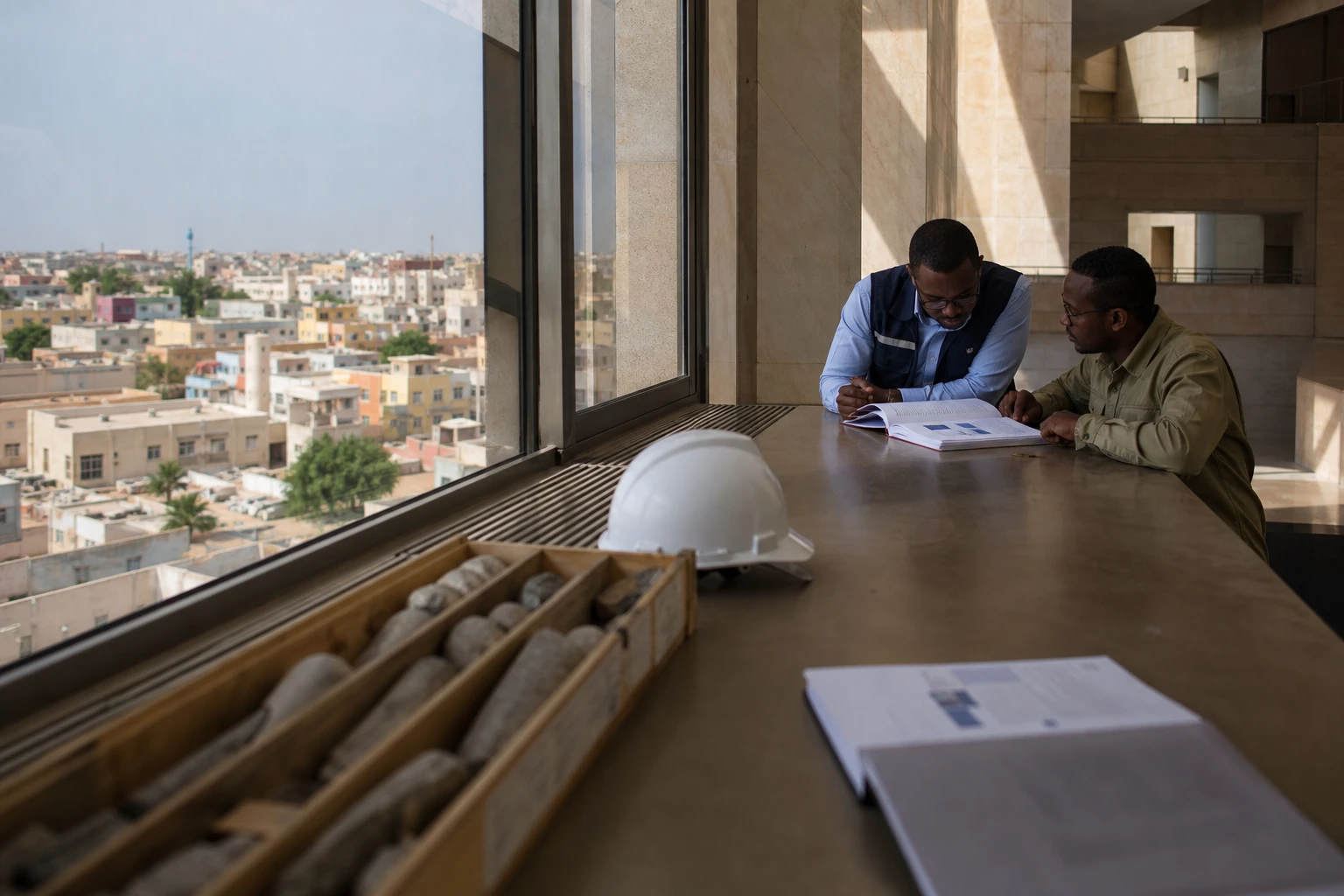
In Mauritania’s far north-east, the Tiris project is entering a decisive phase. Construction of the future uranium mine no longer depends solely on technical studies. It now hinges on funding, industrial validation of the process and the operator’s ability to turn in-principle commitments into firm decisions.
A project in Mauritania’s mining north
Tiris is located in the Tiris Zemmour region, about 1,450 kilometres from Nouakchott. The project is based on shallow mineralisation. According to data published by the operator, the ore could be extracted without blasting in several areas. This feature should reduce operational complexity, but it does not eliminate the logistical constraints of a site far from major urban centres.
The project forms part of a mining trajectory that is already structurally important to Mauritania. The country has extensive experience in iron ore and is seeking to broaden its production base. Tiris would therefore add a new sector to the national extractive economy, with specific requirements related to safety, tailings management and the control of nuclear materials.
Mauritania is not a member of the Economic Community of West African States (ECOWAS), the regional organisation comprising 15 West African countries. It is, however, a member of the Arab Maghreb Union and maintains economic ties with the Sahel region. The project should therefore be viewed both in a national context and within the mining corridors linking the Sahara, the Sahel and international markets.
Timetable still hinges on several decisions
As of 1 October 2026, Aura Energy is still targeting a final investment decision by the end of the year. This decision, often referred to by the acronym FID, authorises the shift from a project under study to one that is actually financed and built. Construction could begin in the fourth quarter of 2026 if financing conditions are met.
The start of production, once envisaged as early as 2027, remains conditional. Aura Energy must first complete a bankable feasibility study. This document serves as a reference for lenders and investors because it details costs, risks, the timetable and expected revenues with greater precision than preliminary studies.
The Australian company said an advanced version of the study had been sent to financiers and strategic partners in July 2026. It was expected to be finalised in September. In parallel, a pilot plant is to test the treatment process selected for Tiris at industrial scale. Aura Energy was expecting the facility to start operating in October 2026.
This step is important. It is intended to verify that the treatment scheme works with the different types of ore found at the site. It should also reduce technical uncertainty before work begins. Until the pilot results and financial parameters are consolidated, the production date remains a target rather than a confirmed deadline.
Financing package still taking shape
The announced construction cost is about $230 million. Aura Energy is discussing a loan of between $150 million and $170 million with the Development Finance Corporation, the US agency that finances certain private-sector projects considered strategic or conducive to development.
The company has also reported a non-binding memorandum of understanding with a major international group in the nuclear industry. The document potentially covers an equity stake, the future purchase of part of the output and technical cooperation. However, the agreement is not yet definitive financing. A binding commitment is being sought by the end of 2026.
A US investment fund is also said to have submitted a fully funded but non-binding proposal. The identity of the fund and that of the nuclear partner have not been made public. For now, this confidentiality makes it difficult to assess the parties’ actual level of commitment.
For Mauritania, financing is not merely an accounting issue. It will determine the pace of work, the project’s local content and when the first direct jobs could be created. In an area far from Nouakchott, the impact will also depend on infrastructure: roads, power, water, telecommunications and services for workers.
State participation provided for under mining framework
Mining agreements signed in 2023 established a stability framework for the project and provide for a stake of up to 20% for the Mauritanian state. Documents available on Tiris also indicate an initial split of 85% for Aura Energy and 15% for the Mauritanian side, through the national agency responsible for geological research and the mining heritage.
The project has mining permits and environmental and social approvals. An authorisation to build and operate a uranium mine was also granted in 2024, according to environmental documents published by the Development Finance Corporation. These approvals are important milestones, but they do not replace the investment decision or the controls that will accompany operations.
Environmental issues will be closely monitored. Operations will have to manage water use, dust dispersal, tailings storage and the rehabilitation of mined areas. In an arid region, water consumption and the protection of local uses will be particularly important in the project’s assessment.
Future output draws global market interest
Aura Energy is forecasting average production of about 2 million pounds of uranium a year, or nearly 907 tonnes, over an announced mine life of 25 years. Capacity could then rise to 3.5 million pounds a year or more, depending on the results of studies and exploration.
These volumes remain project targets. They will have to be confirmed by the bankable feasibility study, pilot plant tests and financing conditions. Mining estimates always involve different confidence levels depending on the resources assessed. Some earlier projections were based in particular on inferred resources, which require further work before they can support definitive planning.
Across Africa, Tiris is advancing as several countries seek to strengthen their position in strategic mineral value chains. Uranium remains a highly regulated sector, however. The project’s success will therefore depend as much on its competitiveness as on confidence in its safety arrangements, governance and commitments to the communities concerned.
The next milestones are now clear: the pilot plant is scheduled to begin operating in October 2026, the bankable feasibility study must be completed, financing agreements may be concluded and a final investment decision is due before 31 December 2026. This sequence, more than the announcement of a future mine, will show whether Tiris can really become Mauritania’s first industrial uranium mine.