Algeria
 Egypt
 Libya
 Morocco
 Sudan
 Tunisia
 Benin
 Burkina Faso
 Cabo Verde
 Côte d'Ivoire
 Ghana
 Guinea
 Guinea-Bissau
 Liberia
 Mali
 Niger
 Nigeria
 Senegal
 Sierra Leone
 The Gambia
 Togo
 Cameroon
 Central African Republic
 Chad
 DR Congo
 Equatorial Guinea
 Gabon
 Republic of the Congo
 São Tomé and Príncipe
 Burundi
 Comoros
 Djibouti
 Eritrea
 Ethiopia
 Kenya
 Madagascar
 Malawi
 Mauritius
 Mozambique
 Rwanda
 Seychelles
 Somalia
 South Sudan
 Tanzania
 Uganda
 Angola
 Botswana
 Eswatini
 Lesotho
 Namibia
 South Africa
 Zambia
 Zimbabwe
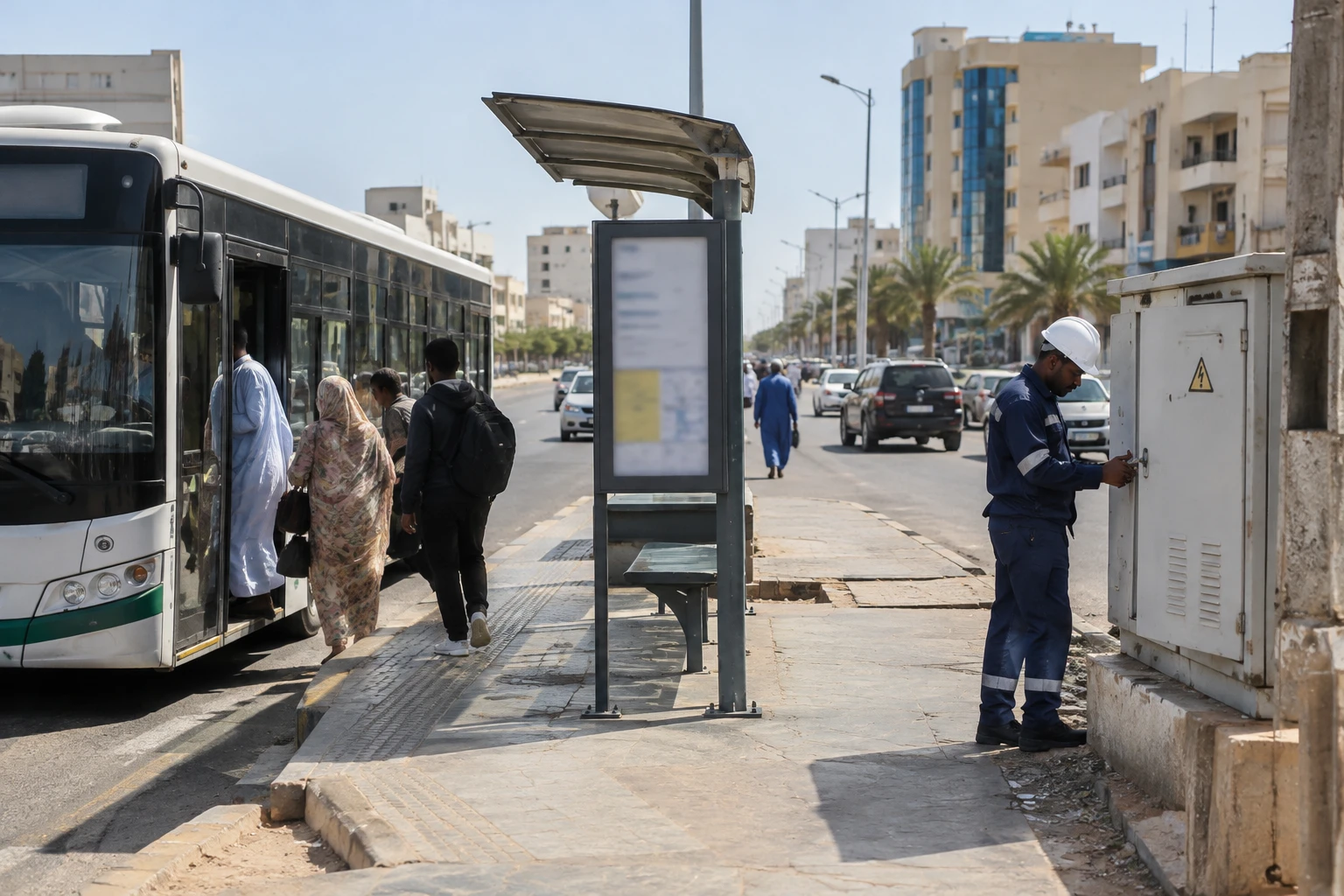
In Nouakchott, a fire at a power substation does more than damage equipment: it can leave neighbourhoods without electricity and disrupt essential services. In Mauritania, the prime minister’s return to office comes as an inquiry into two fires raises a broader question: who is accountable for decisions concerning public infrastructure?
A power crisis becomes an issue of accountability
On 21 and 22 August 2026, fires affected two substations operated by the Mauritanian Electricity Company (Somelec) in Nouakchott-Nord and Nouakchott-Ouest. These installations connect the electricity network to the neighbourhoods and facilities it serves. The resulting outages affected several parts of the capital. Somelec later announced a gradual restoration of capacity, with repairs carried out urgently.
The government had announced the creation of an independent commission to establish the circumstances of the fires and determine any possible responsibility. The final report was made public on 8 October. Mauritanian media reports point to irregularities and failures in the awarding of contracts, the execution of works and technical oversight. The commission notably recommends strengthening the security of installations and the management of the state-owned company.
These findings concern administrative and technical responsibilities. They do not, by themselves, constitute a court ruling. Any possible legal proceedings and measures actually taken must therefore be distinguished from the report’s findings.
Prime minister reappointed, government resigns
On Friday 9 October, El Moctar Ould Djay submitted his government’s resignation to President Mohamed Ould Cheikh El Ghazouani. On the same day, the head of state reappointed him as prime minister and tasked him with forming a new team. Announcements from the presidency, reported by the Mauritanian News Agency, establish the chronology of the decisions.
The timing of this sequence, so close to the report’s publication, has fuelled political questions. But official announcements do not present the resignation as a sanction linked to the fires. It is therefore important not to assert a causal link that has not been publicly established. The reappointment of the head of government ensures continuity at the head of the executive; the composition of the new team, meanwhile, may signal the president’s priorities.
In the days after the fires, the authorities also spoke of the need to restore the installations and maintain supplies to essential services, including hospitals and water provision. This gives the case a tangible dimension: the reliability of the network affects households, but also economic activity and public facilities.
From report to action: the test of implementation
For residents of the affected neighbourhoods, the immediate concern is a stable electricity supply. For shopkeepers, workshops and small businesses, an outage can cause losses or slow activity. Healthcare facilities and water services, for their part, need reliable installations and backup systems. The impact is therefore not distributed equally among households, businesses and public services.
The report also focuses on the decision-making chain: the choice of contractors, monitoring of works, inspections and acceptance of equipment. An inquiry alone does not make the network safer. It will be necessary to see whether its recommendations lead to technical improvements, greater transparency in contracts and more robust inspection procedures. Any sanctions, if pursued, must follow the prescribed administrative or judicial channels.
The crisis also raises questions about the relationship between political and individual responsibility. A cabinet’s resignation can open a period of government reshuffling, but it does not replace the precise establishment of the facts or an examination of each actor’s responsibility. The commission has published its findings; the authorities must now specify what measures will be implemented and on what timetable.
A Mauritanian issue with regional resonance
Mauritania is a member of the African Union and the Arab Maghreb Union (AMU), a framework for cooperation among Maghreb countries. It is not a member of ECOWAS, the West African economic organisation. Its electricity network and public services remain subject first and foremost to national decisions, but energy continuity also matters for trade, investment and cooperation with its West African and Sahelian neighbours.
For the new government team, the issue therefore combines the repair of equipment, the governance of state-owned companies and confidence in essential services. The next indicator will not simply be the formation of the cabinet. It will be the publication of the follow-up to the report: safety works, contract monitoring and clarification of responsibilities, without prejudging the outcome of any proceedings.
The official announcement of the prime minister’s appointment confirms that El Moctar Ould Djay was tasked with forming a new government on 9 October. The publication of the inquiry report on the Somelec fires is dated 8 October. Details of the inquiry’s findings were also reported by the Mauritanian outlet Madar and by Le360 Afrique.