Algeria
 Egypt
 Libya
 Morocco
 Sudan
 Tunisia
 Benin
 Burkina Faso
 Cabo Verde
 Côte d'Ivoire
 Ghana
 Guinea
 Guinea-Bissau
 Liberia
 Mauritania
 Niger
 Nigeria
 Senegal
 Sierra Leone
 The Gambia
 Togo
 Cameroon
 Central African Republic
 Chad
 DR Congo
 Equatorial Guinea
 Gabon
 Republic of the Congo
 São Tomé and Príncipe
 Burundi
 Comoros
 Djibouti
 Eritrea
 Ethiopia
 Kenya
 Madagascar
 Malawi
 Mauritius
 Mozambique
 Rwanda
 Seychelles
 Somalia
 South Sudan
 Tanzania
 Uganda
 Angola
 Botswana
 Eswatini
 Lesotho
 Namibia
 South Africa
 Zambia
 Zimbabwe
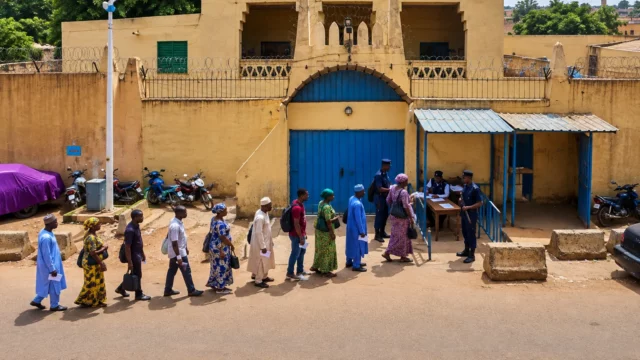
In Kidal, captives are both an instrument of war and a concern for families
In northern Mali, the war is no longer being fought only on the ground. It is also waged through images, announcements and psychological pressure. The release of a video showing Malian soldiers taken prisoner is a reminder that, in this crisis, the battle for control of territory is accompanied by a battle to control the narrative.
This footage comes as Mali remains riven by several fault lines: the fight against armed groups, the reshaping of military alliances around Bamako, and regional isolation after the country’s effective withdrawal from ECOWAS, the Economic Community of West African States, on 29 January 2025. At the same time, the Confederation of the Alliance of Sahel States (AES), which brings together Mali, Burkina Faso and Niger, has become the reference political and security framework for the transitional authorities.
A video, names and a war of restraint
The footage released on 31 July shows more than 200 Malian soldiers presented as being held by the Azawad Liberation Front, or FLA. The group says they are 208 prisoners captured in Kidal in late April, then during July’s fighting around Anéfis and an ambush near Tabrichat. Several men give their names and service numbers, according to details visible in the video.
The FLA also maintains that some prisoners do not appear on screen because they are being treated elsewhere. This cannot be independently verified at this stage. The strategy, however, is clear: to give families signs of life while reminding them that the captives remain leverage in a conflict in which each side seeks to impose its version of events.
The immediate context explains the significance of the footage. On 18 July, an ambush at Tabrichat was followed by the executions of soldiers who had surrendered, according to the UN, Amnesty International and several accounts corroborated by the press. The UN High Commissioner for Human Rights called for an independent investigation on 23 July, while Amnesty described the executions as war crimes on 29 July.
The central issue is this: the detention of combatants is not just a military matter; it is a question of humanitarian law. Once a combatant is hors de combat, they must be treated as such. It is precisely on this point that the reported executions at Tabrichat prompted international reactions.
What this case says about Bamako, Kidal and the region
For the Malian authorities, the footage comes at the worst possible moment. The army is seeking to show that it still holds ground in the north, with the support of its Russian partners in Africa Corps, even as July’s fighting demonstrated armed groups’ ability to strike deep inside the country. Official statements tout operations against “gatherings” affiliated with JNIM and the FLA, but effective control of the routes remains contested.
For families, the issue is simpler and more pressing: knowing whether a son, brother or husband is alive. A video may confirm that someone is safe, but it is no substitute for a system of visits, a prisoner exchange or credible mediation. In a context where information often circulates through armed groups, families are among the few audiences directly targeted by these staged appearances.
The war in northern Mali is also taking a toll on civilians. Drone strikes reported in late July in the Kidal region were condemned by a local human rights organisation, which reported deaths and injuries among Nigeriens, Chadians and gold miners. The government, meanwhile, said terrorist targets had been destroyed near Tessalit. Here again, the accounts differ, and casualty figures remain difficult to establish without independent access to the area.
Ultimately, the episode illustrates how the conflict in Mali is changing. Fighting is no longer confined to columns, camps and towns such as Kidal, Anéfis or Tabrichat. It is also waged through drones, videos, filmed executions and announcements of detention. In this fragmented landscape, each side seeks to prove that it controls the territory, the people and the political timetable.
A signal to watch across the Sahel
This case extends beyond Mali. The movement of fighters, drones and alliances between the FLA, JNIM and Bamako’s forces shows that the Sahel remains a connected theatre of war, where a local defeat can have rapid regional consequences. Neighbouring Niger and Burkina Faso, along with the Malian authorities, are following the case closely, as routes in northern Mali directly affect cross-border movements.
The next point to watch is what happens to the allegations over the Tabrichat executions. If a credible investigation is not opened, violence around prisoners could intensify further. Conversely, an exchange, local mediation or humanitarian channel could curb a new escalation. For now, there is no sign that such a path is visibly under way.
Mali is now a revealing example of a wider trend in West Africa: the weakening of traditional regional frameworks, the rise of alternative security arrangements and the growing role of non-state armed actors in shaping information. In this region, war is not won by force alone. It is also fought through the ability to uphold the law, protect captives and keep a political channel open.