Algeria
 Egypt
 Libya
 Morocco
 Sudan
 Tunisia
 Benin
 Burkina Faso
 Cabo Verde
 Côte d'Ivoire
 Ghana
 Guinea
 Guinea-Bissau
 Liberia
 Mauritania
 Niger
 Nigeria
 Senegal
 Sierra Leone
 The Gambia
 Togo
 Cameroon
 Central African Republic
 Chad
 DR Congo
 Equatorial Guinea
 Gabon
 Republic of the Congo
 São Tomé and Príncipe
 Burundi
 Comoros
 Djibouti
 Eritrea
 Ethiopia
 Kenya
 Madagascar
 Malawi
 Mauritius
 Mozambique
 Rwanda
 Seychelles
 Somalia
 South Sudan
 Tanzania
 Uganda
 Angola
 Botswana
 Eswatini
 Lesotho
 Namibia
 South Africa
 Zambia
 Zimbabwe
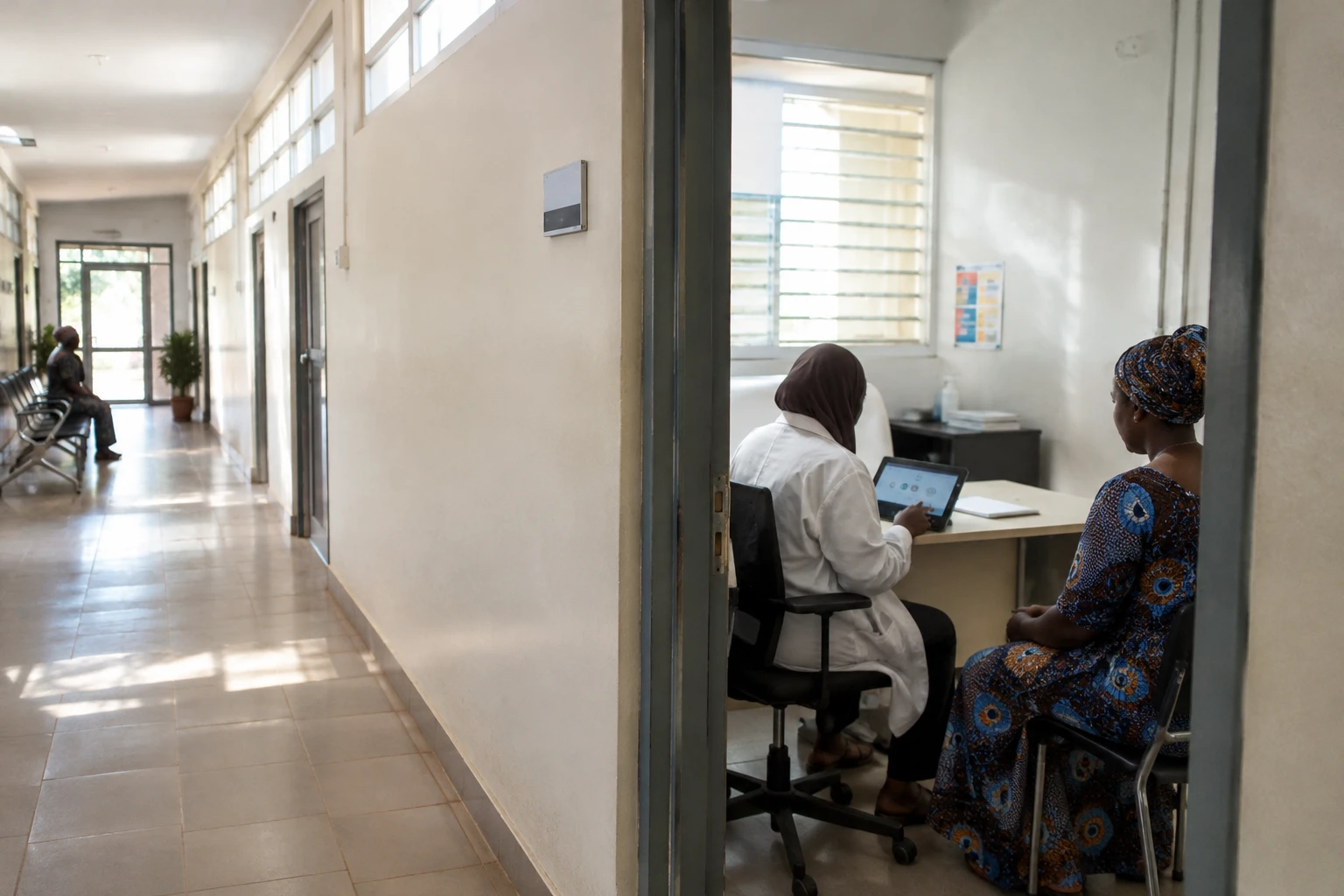
In a health centre far from Bamako, a modest internet connection can bring a patient closer to a specialist. In Mali, that promise is already a reality in teledermatology. But for digital technology to transform healthcare in the long term, the tools still need to be connected and medical data better organised.
Tools designed for realities on the ground
Mali’s digital health sector has developed in response to a central constraint: how can health workers far from specialists be supported despite limited infrastructure? Cheick Oumar Bagayoko, a professor at the University of Science, Techniques and Technologies of Bamako and director of Digi-santé Mali, describes an evolution driven by mobile phones and solutions adapted to local conditions. Innovation, he stresses, does not need to be sophisticated to be useful.
This approach took shape with TelederMali, a network that enables health teams to seek dermatologists’ opinions remotely. The Centre for Expertise and Research in Telemedicine and e-Health (CERTES) says the system had 102 sites in 2024. A study published on a pilot programme in Mali also documents the use of teledermatology in primary care centres. These findings confirm the system’s existence and development, although the number of sites may change as it expands.
For patients in the regions, the stakes are tangible: obtaining a specialist opinion without having to travel to the capital as a matter of course. Local health workers can also receive support in assessing a case and deciding on treatment. This does not replace either a clinical examination or in-person consultations. However, remote specialist advice can help direct patients more effectively and bring scarce expertise into play earlier.
Telemedicine as a tool for health surveillance
Bagayoko reports that a case of Mpox in Mali was reportedly identified through a dermatology teleconsultation. A Malian medical publication from September 2026 also describes a diagnosis raised during a remote consultation and subsequently confirmed by sampling and a PCR test. This corroboration confirms telemedicine’s role in guiding the diagnosis of this case. However, it is not enough on its own to establish that the system prevented transmission on public transport, as the professor claims.
This distinction matters. A digital tool can speed up access to expertise and help a health worker recognise a suspected case. Confirmation of an infectious disease then depends on tests and health procedures. Telemedicine therefore strengthens surveillance and referral; it does not replace laboratories, public health teams or treatment resources.
Mali now has a National Strategic Plan for Digital Health for 2024-2028. The Ministry of Health includes among its aims improving health information and telemedicine. The task therefore goes beyond standalone applications: it concerns coordination between professionals, data security and the ability of systems to communicate with one another.
The decisive challenge: tracking a patient’s journey
Bagayoko points to a fundamental weakness: consultations and diagnoses are not always linked to a single medical identity. A patient seen at several facilities may therefore appear in the statistics as several distinct cases. The data then become less reliable, complicating individual follow-up and service planning.
For patients, this fragmentation can mean repeated tests and information that does not follow them from one centre to another. For professionals, it makes continuity of care more difficult. For health authorities, it obscures epidemiological trends and the allocation of resources. Digitisation does not automatically solve these problems: it can also reproduce them if tools do not share common rules and teams are not trained.
Patient identification also raises confidentiality concerns. A more connected system must protect medical information, restrict access to authorised people and clarify how data are used. Trust among patients and health workers is a practical condition for deployment, not a technical detail.
Preparing for artificial intelligence without importing its blind spots
Ambitions for artificial intelligence depend on the quality of the available data. If records are incomplete, scattered or difficult to compare, diagnostic support and health management tools risk producing unreliable results. And if their training data do not adequately represent Malian patients, their recommendations may be less relevant to local teams.
Dermatology illustrates this risk: the signs of a skin condition can vary according to skin tone. A tool trained mainly on images from other populations should therefore not be assumed to be reliable in every context. Its performance must be assessed using data relevant to the patients concerned, local professionals must be involved in its design, and medical decisions must remain in human hands.
This requirement is linked to a question of health sovereignty: who collects the data, who hosts them and who decides whether they can be reused? For Mali, building representative databases and governance rules is just as important as acquiring software. The 2024-2028 national plan provides a framework; its impact will depend on how it is implemented in health facilities, from major cities to remote areas.
A Malian challenge with West African implications
On 15 October 2026, the Observatory for e-Health in the Global South (ODESS) marked ten years of work monitoring and supporting digital projects. This milestone comes as Mali and its Sahel neighbours reorganise their regional relations: Mali, Burkina Faso and Niger’s withdrawal from ECOWAS took effect on 29 January 2025. Health cooperation and the sharing of expertise remain essential, particularly in the face of diseases that do not stop at borders.
Mali’s experience is a reminder that digital health should not be measured by the number of applications launched. It should be judged by a patient’s ability to access the right care, a health worker’s ability to obtain useful advice, and the quality of the information guiding public decisions. The next step will be to turn concrete initiatives such as TelederMali into sustainable, interoperable services adapted to the needs expressed in health facilities.
Further information: ODESS’s tenth-anniversary conference ; Mali’s National Strategic Plan for Digital Health 2024-2028 ; CERTES data on TelederMali ; Malian medical publication on the diagnosis of Mpox ; ECOWAS statement on the effective date of the withdrawal.