Algeria
 Egypt
 Libya
 Morocco
 Sudan
 Tunisia
 Benin
 Burkina Faso
 Cabo Verde
 Côte d'Ivoire
 Ghana
 Guinea
 Guinea-Bissau
 Liberia
 Mauritania
 Niger
 Nigeria
 Senegal
 Sierra Leone
 The Gambia
 Togo
 Cameroon
 Central African Republic
 Chad
 DR Congo
 Equatorial Guinea
 Gabon
 Republic of the Congo
 São Tomé and Príncipe
 Burundi
 Comoros
 Djibouti
 Eritrea
 Ethiopia
 Kenya
 Madagascar
 Malawi
 Mauritius
 Mozambique
 Rwanda
 Seychelles
 Somalia
 South Sudan
 Tanzania
 Uganda
 Angola
 Botswana
 Eswatini
 Lesotho
 Namibia
 South Africa
 Zambia
 Zimbabwe
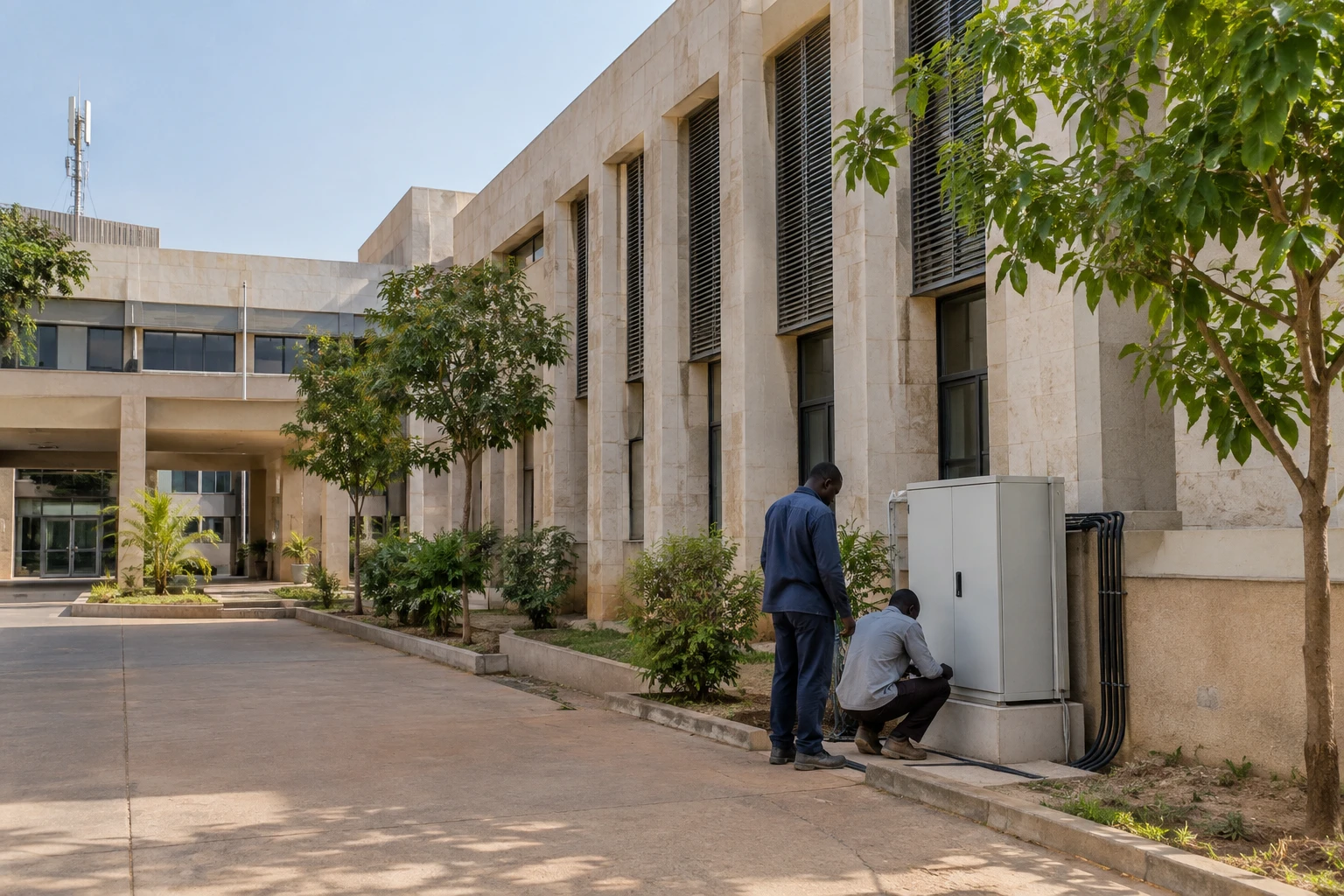
For internet users in Bamako and businesses in the regions alike, an additional international link does not yet guarantee stable access. Rather, it offers a new route for data, whose impact will depend on the strength of Mali’s network and the access terms available to operators.
A new link between Mali and Senegal
On 5 October 2026, the Société malienne de transmission et de diffusion (SMTD-SA) and Sénégal Numérique SA inaugurated the interconnection of their fibre-optic networks at the border, between Diboli and Kidira. The Senegalese Press Agency and Malian media confirmed the date and the connection. These backbone networks carry data over long distances before it is distributed by operators and internet service providers.
According to the Malian authorities, the new connection allows traffic to reach undersea cables accessible from Senegal, via routes that include Cape Verde and Portugal. It adds a route to those that already connect Mali, a landlocked country, to international networks through several neighbouring countries.
The link is part of the West African Network of National Backbones (ROA-BN), which aims to interconnect the public infrastructure of several countries. An agreement between the two companies was signed in April 2026, according to the Malian outlet Journal du Mali. The aim is to increase the number of possible routes and facilitate the flow of data across the region.
For Mali, diversifying routes can reduce dependence on a single corridor. If one link is interrupted or congested, another can help keep traffic flowing. But this redundancy remains a potential benefit: it depends on agreements between operators and on whether the new capacity is actually used. Published information does not yet specify the available bandwidth, wholesale prices or which operators will use it.
Domestic network quality remains crucial
A more direct international connection does not resolve the challenges of carrying data within the country. To reach users, data must travel over the national network and then pass through mobile masts, transmission equipment and sufficiently reliable power infrastructure.
The World Bank’s digital economy diagnostic for Mali found that 29 of 57 cercles and 130 of 704 secondary administrative towns were not connected to the backbone. It also reported frequent outages on some sections of SMTD’s fibre network, as well as obstacles to maintenance, including difficult roads, security constraints and limited logistical resources. These figures describe the situation examined in that diagnostic, not an updated count for 2026.
SMTD says it operates more than 3,500 kilometres of fibre-optic cable in Mali, according to information reported by the Malian press and the pan-African news agency APA. The length of the network is not, however, enough to measure its coverage or reliability: the condition of equipment, its maintenance and connections to individual communities also matter.
Recent usage data also call for a distinction between indicators. The 2024 report of the Malian Telecommunications and Postal Regulatory Authority (AMRTP) records 13.1 million internet subscriptions or customers at the end of the year, down 2% year on year. This total is not equivalent to the number of people connected: one person may hold several subscriptions. The World Bank, for its part, estimates that 36.8% of the population used the internet in 2024. The methods and scope differ, but these figures are a reminder that access remains unequal.
The digital divide operates on several levels. Users in remote areas rely more heavily on mobile coverage and backhaul links; businesses and public administrations need predictable connections for their daily communications. In Bamako, proximity to infrastructure can make access easier, without removing concerns about cost, quality or availability.
A test for regional digital co-operation
The Mali-Senegal link shows that West African public operators can connect their networks across borders. The ROA-BN aims to extend these interconnections to other countries in the region. Such co-operation can give operators more routes and strengthen service continuity, provided the networks are compatible and the access arrangements are practical.
For users, the outcome will not be measured by the inauguration alone. It will be necessary to monitor the link’s actual availability, the volumes of data it carries and its uptake by operators. In Mali, the challenge will also be to continue extending the domestic network, repair vulnerable sections and reach communities that remain unconnected.
The new connection opens an additional gateway to international networks. Its economic and social impact will depend on the ability to carry data from the border to homes, public services and local businesses.