Algeria
 Egypt
 Libya
 Morocco
 Sudan
 Tunisia
 Benin
 Burkina Faso
 Cabo Verde
 Côte d'Ivoire
 Ghana
 Guinea
 Guinea-Bissau
 Liberia
 Mauritania
 Niger
 Nigeria
 Senegal
 Sierra Leone
 The Gambia
 Togo
 Cameroon
 Central African Republic
 Chad
 DR Congo
 Equatorial Guinea
 Gabon
 Republic of the Congo
 São Tomé and Príncipe
 Burundi
 Comoros
 Djibouti
 Eritrea
 Ethiopia
 Kenya
 Madagascar
 Malawi
 Mauritius
 Mozambique
 Rwanda
 Seychelles
 Somalia
 South Sudan
 Tanzania
 Uganda
 Angola
 Botswana
 Eswatini
 Lesotho
 Namibia
 South Africa
 Zambia
 Zimbabwe
A democratic promise born in the streets, then forged in a conference hall
Mali’s recent political history is marked by a stark contrast: a country that opened a National Conference on 29 July 1991 to prepare the return to pluralism, and a country where political parties were dissolved in May 2025 by the transitional authorities. Between those two dates, the same question has repeatedly surfaced in Bamako: what becomes of democracy when its mechanisms of representation disappear?
This question goes beyond Mali alone. It also affects West Africa, whose balance has been shaken by Mali’s departure from ECOWAS, the Economic Community of West African States, which took effect on 29 January 2025. This rupture has shifted the country into a different regional political framework: the Alliance of Sahel States, alongside Burkina Faso and Niger.
1991, the founding moment of Mali’s pluralism
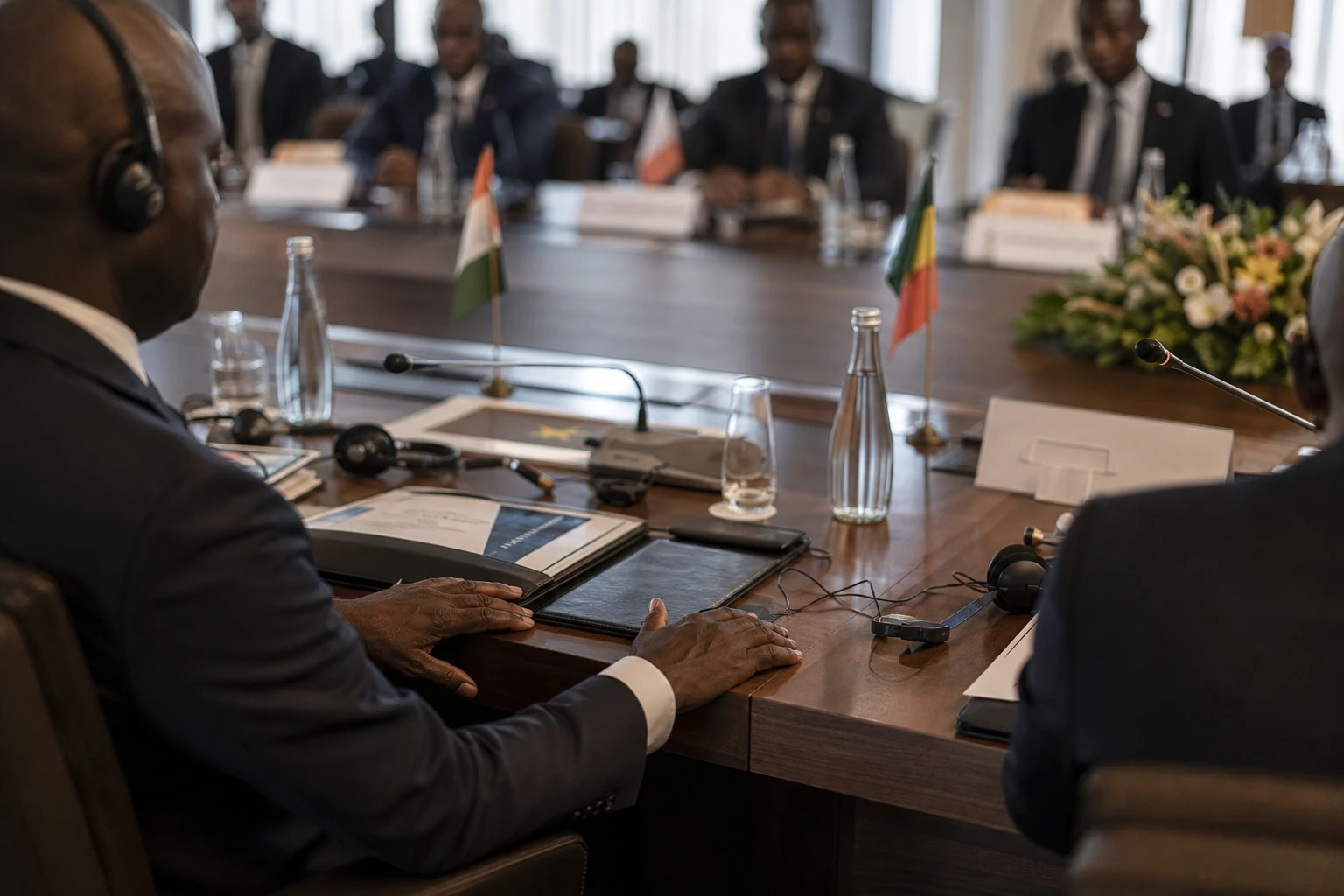
On 29 July 1991, the National Conference opened in Bamako under the authority of the Transitional Committee for the Salvation of the People, established after the fall of Moussa Traoré. Its objective was clear: to draft a constitution, an electoral code and a charter for political parties, bringing the authoritarian interlude to a close and preparing for a Third Republic. The Constitution was subsequently approved by referendum on 12 January 1992, before a lasting multiparty system emerged.
This moment matters in African political history because, in the early 1990s, it embodied a simple idea: change could be negotiated, regulated and made legal. Mali then served as a reference point for many observers across the continent. In Mali’s political memory, the National Conference long symbolised the beginning of electoral competition, public debate and the possibility of a change of power.
Since 2020, the transition has closed political space
The sequence was reversed after the coups of August 2020 and May 2021. The transitional authorities first extended the timetable for a return to constitutional order, then progressively tightened the political framework. In April 2025, a national consultation recommended dissolving the parties. On 13 May 2025, the authorities formally dissolved all political parties and organisations. The same period was also marked by the suspension of political activities and by cases of arrests or disappearances reported by families and opposition groups.
This hardening line was confirmed by other decisions taken in 2025. A text adopted by the transition paved the way for a renewable five-year term for the transitional head of state, while former political leaders filed legal challenges against the suspension of the parties. In June 2025, a call to resume political activity did not alter the authorities’ course.
At the same time, restrictions on public freedoms have become entrenched. In June 2026, human rights organisations denounced new arrests of journalists in Bamako, showing that the shrinking space for expression affects more than just political parties. Several opposition leaders have been imprisoned or placed under judicial pressure for their critical statements.
What the country loses when parties disappear
The dissolution of political parties is not a mere administrative act. First, it deprives citizens of a means of mediation between the state and society. In Bamako, that means fewer forums through which grievances can be raised. In the regions, it further weakens local voices, already exposed to insecurity, administrative isolation and fragile public services.
The paradox is all the sharper because the military authorities justify their actions in the name of stability and sovereignty. In practice, however, closing down the party system reduces checks and balances, concentrates decision-making and makes any organised change of power more difficult. The military gains political time; society loses a space for negotiation.
Mali also finds itself in a tense security environment. Jihadist attacks and offensives in the north continue to weigh on the economy, movement and daily life. Recent reports show that armed groups are also targeting roads and infrastructure, undermining domestic trade and exchanges with neighbouring countries. In this context, the democratic question cannot be separated from the security question: a state that is strong on paper may remain vulnerable on the ground.
An issue for Mali, but also for West Africa
The significance of this development extends beyond Bamako. With Mali’s withdrawal from ECOWAS taking effect on 29 January 2025, West Africa has reached a new stage of political fragmentation. The regional organisation has maintained a technical transition framework to manage the effects of the withdrawal, particularly on free movement and trade. But the message is clear: Mali is no longer part of the main regional space that for years served as a benchmark for democratic standards.
At continental level, the case of Mali raises questions about the resilience of military-led transitions when they are prolonged without a credible timetable. It also shows that even a founding national conference cannot safeguard democracy in the long term if parties, the press and checks and balances are later neutralised. In the Sahel, Mali, Burkina Faso and Niger are now pursuing a shared political course, but at considerable institutional cost.
Thirty-five years after the National Conference opened, Mali lacks more than just political parties. Above all, it lacks a framework in which dissent can be expressed without being treated as a threat. This is probably where the break lies between the legacy of 1991 and the current trajectory.