Algeria
 Egypt
 Libya
 Morocco
 Sudan
 Tunisia
 Benin
 Burkina Faso
 Cabo Verde
 Côte d'Ivoire
 Ghana
 Guinea
 Guinea-Bissau
 Liberia
 Mauritania
 Niger
 Nigeria
 Senegal
 Sierra Leone
 The Gambia
 Togo
 Cameroon
 Central African Republic
 Chad
 DR Congo
 Equatorial Guinea
 Gabon
 Republic of the Congo
 São Tomé and Príncipe
 Burundi
 Comoros
 Djibouti
 Eritrea
 Ethiopia
 Kenya
 Madagascar
 Malawi
 Mauritius
 Mozambique
 Rwanda
 Seychelles
 Somalia
 South Sudan
 Tanzania
 Uganda
 Angola
 Botswana
 Eswatini
 Lesotho
 Namibia
 South Africa
 Zambia
 Zimbabwe
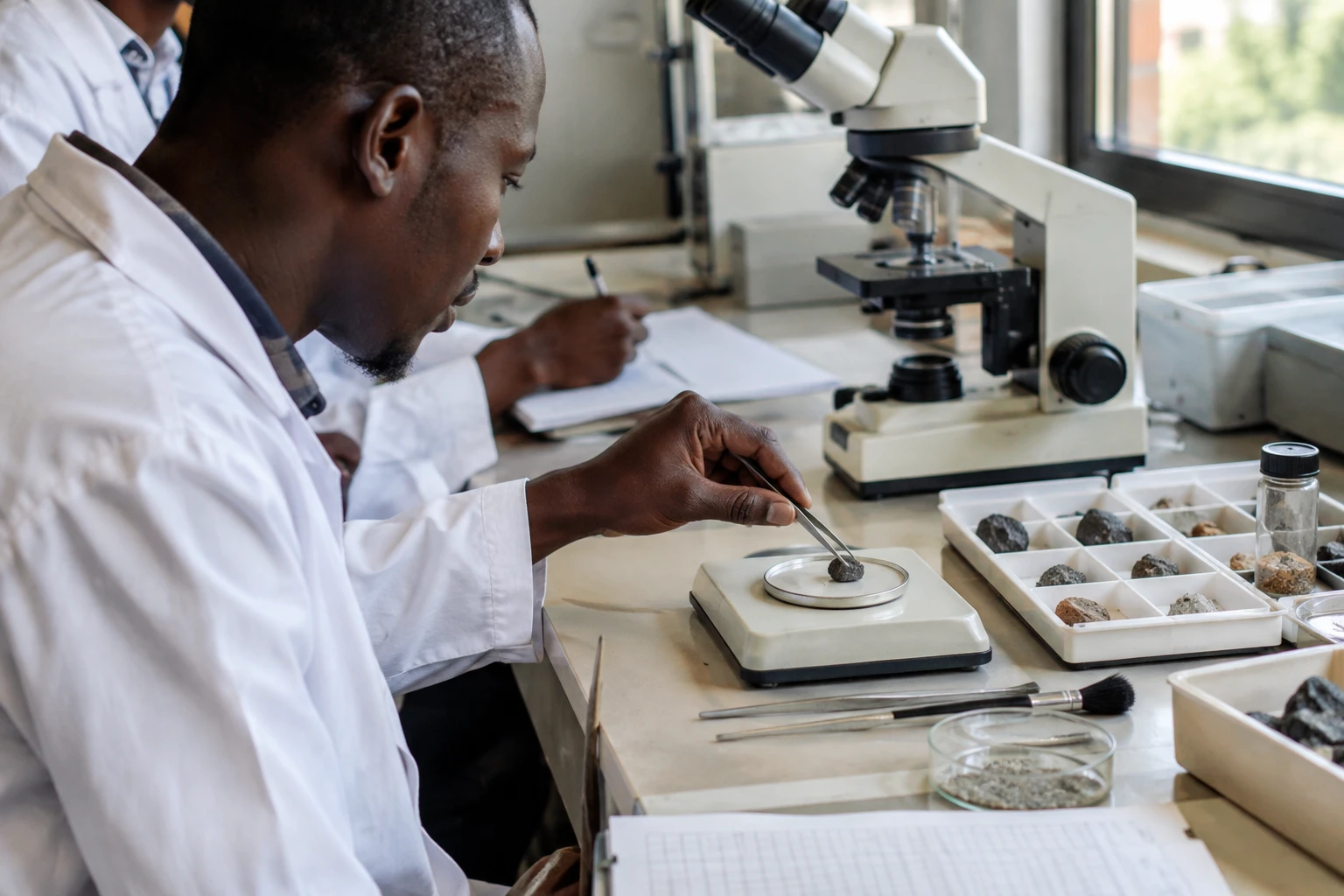
A rock found in northern Mali connects two very different stories: that of prospectors traversing the Sahara and that of a planet whose crust was forming more than four billion years ago. Named Teghaza 001, the meteorite gives scientists a rare sample of ancient Mars, but it also serves as a reminder that discoveries made on Malian soil later circulate through collections and laboratories abroad.
From the Malian Sahara to laboratories
Teghaza 001 was discovered in early September 2022, during a meteorite-hunting expedition north of the former salt-mining area of Taghaza, in northern Mali. The international meteorite database credits Saharan prospectors with its discovery. The rock weighs about 800 grams. Its Martian origin was established by analysing its composition, including its oxygen isotopes, which serve as a geochemical signature.
The name refers to Teghaza, an ancient salt-related site in the Malian Sahara, far from Bamako, the capital. Scientific identification does not, however, mean that the rock formed in Mali: it comes from Mars. An impact blasted it from the planet’s surface, after which it travelled through space before reaching Earth.
The first in-depth studies revealed its exceptional age. Analyses date it to at least 4.1 billion years ago, a period close to the formation of the Martian crust. Researchers presented it in the journal Science on 29 October 2026. Another study, published in June 2026 in Science Advances, focused on traces of water preserved in certain minerals.
An ancient rock, several clues
Most of the Martian meteorites studied are much younger than the oldest terrains on Mars. Teghaza 001 is therefore valuable not only for its age, but also for the variety of its minerals. Its texture and composition tell the story of the formation of igneous rocks, as magma cooled in the young crust. Scientists also identified signs that water altered the rock before it was ejected into space.
The work published in October 2026 dates this interaction with water to around 4.1 billion years ago. Mineral analysis reveals reactions between the rock and aqueous fluids. It also suggests that the sample comes from a Martian geological source different from those represented by several meteorites already known. Researchers cannot, however, identify a precise location on Mars: several areas have compatible characteristics.
The study of hydrogen isotopes provides further insight. These measurements indicate a mixture of water associated with magma and a component that retained the signature of an ancient Martian hydrosphere. Put simply, the rock preserves traces of exchanges between the interior of Mars and crustal materials transformed by water. This strengthens the view that water circulated beneath the surface of the early planet, without by itself proving the existence of long-lasting oceans or life.
This distinction matters. Evidence of alteration by water is evidence of geological processes, not proof of habitable conditions or organisms. The findings must be considered alongside observations by rovers and orbiting probes, which study Martian terrain on a large scale. The meteorite, by contrast, allows detailed laboratory measurements, but represents only an isolated fragment, blasted from a location that remains uncertain.
What the sample cannot tell us on its own
The discovery also helps address a scientific field marked by the scarcity of very ancient Martian material. Available meteorites do not provide a complete inventory of the planet: their ejection by impacts, journey to Earth and preservation favour certain types of rock. Teghaza 001 therefore broadens the sample, without replacing direct study of the Martian terrain.
Researchers use isotopic dating methods to establish the age of minerals. In this rock, cross-analysis of isotopic systems and the study of crystals make it possible to distinguish the history of its formation from that of later transformations. Some techniques use an infinitesimal amount of material, helping to preserve a rare sample for other teams and future analyses.
Access to specimens also merits attention. Fragments of Teghaza 001 are held in scientific and museum collections in the United States, where teams can examine them and lend them to laboratories. The published research helps us better understand the rock, but the available information does not specify all the conditions under which the fragments were collected, sold or distributed. It would therefore be unwise to draw conclusions about local benefits for Malian communities or prospectors.
A scientific issue that crosses borders
For Mali, the discovery matters both because of its geographical origin and because of the country’s role in the search for meteorites in the Sahara. Arid areas can make it easier to spot and preserve rocks that have fallen from the sky. But identifying a meteorite requires specialised analyses, exchanges between institutions and sample traceability. This journey links the Malian field site to an international scientific network, without making the country the sole source of the resulting knowledge.
At regional level, Teghaza 001 is a reminder that objects discovered in the Sahara can provide data useful to planetary science worldwide. This reach should not obscure practical questions about the provenance and circulation of specimens. These are distinct from the scientific value of the study, but form part of the context in which geological resources become research objects.
What happens next will depend on work on the fragments already available and, in the longer term, on missions capable of collecting rocks directly on Mars and bringing them back to Earth. An on-site sample would reveal its precise geological context, unlike a meteorite whose point of origin remains uncertain. In the meantime, Teghaza 001 offers a rare window onto a very ancient Mars: a planet where magma, crust and water were already interacting.