Algeria
 Egypt
 Libya
 Morocco
 Sudan
 Tunisia
 Benin
 Burkina Faso
 Cabo Verde
 Côte d'Ivoire
 Ghana
 Guinea
 Guinea-Bissau
 Liberia
 Mauritania
 Niger
 Nigeria
 Senegal
 Sierra Leone
 The Gambia
 Togo
 Cameroon
 Central African Republic
 Chad
 DR Congo
 Equatorial Guinea
 Gabon
 Republic of the Congo
 São Tomé and Príncipe
 Burundi
 Comoros
 Djibouti
 Eritrea
 Ethiopia
 Kenya
 Madagascar
 Malawi
 Mauritius
 Mozambique
 Rwanda
 Seychelles
 Somalia
 South Sudan
 Tanzania
 Uganda
 Angola
 Botswana
 Eswatini
 Lesotho
 Namibia
 South Africa
 Zambia
 Zimbabwe
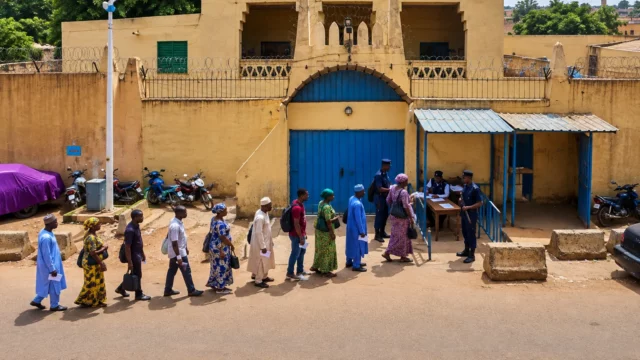
Retaking a city is not enough to restore a lasting presence. In northern Mali, the army’s return to Kidal has mainly shifted the question: how far can Bamako advance without further exposing its troops, supply lines and the inhabitants of the areas in question?
A restored presence, but still limited
On 6 October 2026, the Malian Armed Forces (FAMa), accompanied by Russian Africa Corps fighters and allied groups, entered Kidal after the Azawad Liberation Front (FLA) withdrew. The FLA had taken the city during its 25 April offensive. The return of Malian forces five months later is a political and symbolic success for the transitional authorities. It does not, however, mean that the whole north-east has come back under their control.
Malian forces and their partners also hold Anéfis and Aguelhoc. Their presence has not, however, extended to Tessalit or Tinzaouatène, near the Algerian border. The authorities have presented the return to Kidal as a consolidation operation. The government has not announced a detailed timetable for an advance further north. The Malian government’s statement on consolidating its presence in Kidal describes an operation combining ground and air assets.
The redeployment of the administration and the return of services remain indicators as important as military positions. A local polio vaccination campaign was launched on 25 October at Kidal regional hospital, according to the Malian Armed Forces. The initiative signals the resumption of some public activities, but on its own does not show how many residents have returned or whether services are operating regularly. The FAMa announcement on the vaccination campaign in Kidal gives no figures for the number of people reached.
Air pressure rather than a new offensive
Since retaking the city, the army has continued strikes in the region, including towards Tessalit and Talhandak. In its statements, the general staff says it is targeting armed groups. The FLA, for its part, has reported civilian casualties and damage to infrastructure. These opposing claims have not been independently established in the information available and should therefore remain attributed to their respective sources.
On 5 November, the FLA said it had carried out drone strikes against FAMa and Africa Corps positions in Anéfis. This claim is not independent confirmation of the attack or its effects. It nevertheless serves as a reminder that the movement’s fighters remain active in the region, even after withdrawing from Kidal.
One factor weighs on the military calculation: the memory of Tinzaouatène. In the summer of 2024, fighting near this border town inflicted heavy losses on Malian forces and their Russian allies. The precise toll remains disputed, with the highest figures put forward by rebel groups. The episode nevertheless showed the cost of a ground advance in an area far from bases and difficult to supply. Available reports on the July 2024 fighting in Tinzaouatène cite conflicting claims about the toll.
An advance towards the border would force convoys to travel longer distances while protecting routes and positions already taken. A force can occupy an urban centre without exercising lasting control over roads, surrounding settlements or border crossings. In this context, air strikes allow pressure to be maintained without immediately committing another ground column. But they guarantee neither control of the territory nor the safety of civilians.
One front among several
The Kidal region is not the only theatre to which Bamako must commit resources. The FLA is also present in other parts of the north, while the al-Qaeda affiliate Group for the Support of Islam and Muslims (JNIM) operates in several parts of the country. Malian forces must therefore weigh the protection of newly retaken positions against securing routes and responding to attacks elsewhere. The stalemate around Kidal may also reflect this dispersal of resources.
The situation forms part of a recent pattern of successive changes in control. The Malian army retook Kidal in November 2023, with support then attributed to Wagner. The FLA seized it during its April 2026 offensive, before withdrawing as government forces approached in October. This sequence highlights the difference between a one-off victory and an administrative and security presence that lasts. The Malian press account of the FAMa’s entry into Kidal confirms the date of 6 October and the FLA’s withdrawal.
The issue also has a regional dimension. The Algerian border is close to areas where fighters retreat and where Malian forces conduct operations. Any advance could therefore affect relations between Bamako and Algiers, which have already been sensitive in recent years. Military reconquest does not resolve these diplomatic issues, which matter for border monitoring and the room for manoeuvre of armed actors.
The next test: hold, administer and protect
For the transitional authorities, the retaking of Kidal strengthens the narrative of the restoration of state authority. For residents, the stakes are more tangible: safe travel, access to healthcare, the return of schools and the presence of public services. The vaccination campaign is a one-off sign, not yet proof of a full return to civilian life. Information on the number of residents who have returned and the continuity of services remains limited.
Across West Africa, this sequence is also of interest to Mali’s neighbours and ECOWAS, the regional organisation whose institutions the country left in 2025 alongside Burkina Faso and Niger. The security consequences extend beyond national borders, as Sahelian authorities have strengthened co-operation within the Alliance of Sahel States. But the regional significance of the recapture will depend less on its symbolism than on the ability to stabilise routes without causing new displacement or fuelling cross-border tensions.
Over the coming weeks, three developments will show how solid the return is: the effective installation of the administration in Kidal, the continuity of services for residents and changes in positions around Tessalit and Tinzaouatène. Until these signs are in place, the recapture of the city will remain an important but limited advance.