Algeria
 Egypt
 Libya
 Morocco
 Sudan
 Tunisia
 Benin
 Burkina Faso
 Cabo Verde
 Côte d'Ivoire
 Ghana
 Guinea
 Guinea-Bissau
 Liberia
 Mauritania
 Niger
 Nigeria
 Senegal
 Sierra Leone
 The Gambia
 Togo
 Cameroon
 Central African Republic
 Chad
 DR Congo
 Equatorial Guinea
 Gabon
 Republic of the Congo
 São Tomé and Príncipe
 Burundi
 Comoros
 Djibouti
 Eritrea
 Ethiopia
 Kenya
 Madagascar
 Malawi
 Mauritius
 Mozambique
 Rwanda
 Seychelles
 Somalia
 South Sudan
 Tanzania
 Uganda
 Angola
 Botswana
 Eswatini
 Lesotho
 Namibia
 South Africa
 Zambia
 Zimbabwe
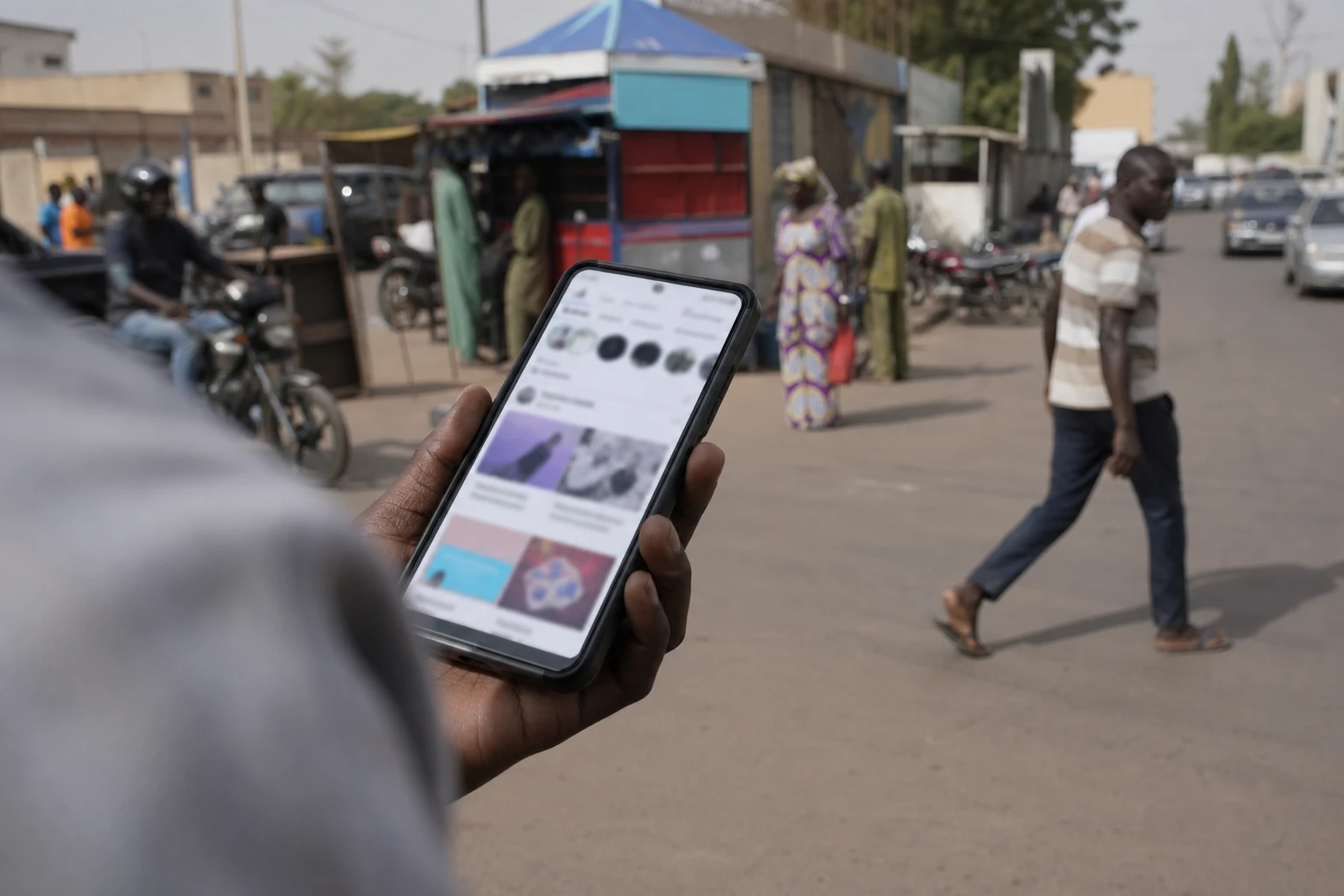
When the battle is also fought on screens
In Mali, the battlefield is no longer confined to roads, military bases or contested towns. It also extends to TikTok feeds, Telegram groups and pages that look like ordinary media outlets. In this landscape, generative artificial intelligence is not just used to create convincing images. It is now helping to accelerate the battle of narratives, multiply fake expressions of support and obscure the origin of messages. A report published by the Timbuktu Institute in September 2026 describes this shift in detail, noting that different actors, from JNIM to pro-FLA networks and Russia-linked operations, are using the technology to varying degrees.
This shift is taking place in a Mali already undergoing profound political and security realignment. Bamako remains under military transition, while the country has moved away from ECOWAS, following the withdrawal of Mali, Burkina Faso and Niger, which took effect on 29 January 2025. At the same time, the three states have strengthened cooperation within the Alliance of Sahel States, now a central political and security framework for understanding Mali’s choices.
Different uses, one goal: shaping reality
The central finding is straightforward. AI is not transforming all actors at the same pace. For JNIM, an al-Qaeda affiliate, the technology still supplements more traditional propaganda. Around the Azawad Liberation Front, the report notes content that is harder to attribute, particularly on social media, where synthetic figures can create the illusion of spontaneous popular support. In Russia-linked influence networks, by contrast, AI is already part of a more structured production and amplification chain.
On 25 April 2026, international media reported, citing SITE Intelligence Group, that JNIM had claimed coordinated attacks with the FLA in several parts of Mali. Reuters could not independently verify the claims, but the episode confirmed that groups with very different agendas could cooperate temporarily on the battlefield. This cooperation says nothing about lasting ideological convergence. It mainly shows the fluidity of a conflict in which alliances form and dissolve according to the interests of the moment.
In this context, information warfare is becoming a direct extension of warfare itself. Claiming victory, staging a presence, exaggerating support, discrediting an adversary: all these operations now count as much as capturing a strategic point. AI cuts their cost and speeds up their circulation. It can produce text, a voice, an image or a video in minutes, then adapt them for several platforms and languages. In 2024 and 2025, OpenAI also documented Russian-origin influence operations that used its models to write articles, generate comments, create fictional identities and turn content into formats suited to social media.
Mali in a regional disinformation economy
Mali is not an isolated case. In 2024, the Africa Center for Strategic Studies estimated that West Africa accounted for nearly 40% of documented disinformation campaigns on the continent, and that Russia had launched 19 campaigns targeting Mali, Burkina Faso and Niger since 2018. Other research has confirmed the scale of the phenomenon in the Sahel, where pro-Russian, anti-French and anti-Western narratives have circulated widely for several years. AI did not create the problem. It has changed its scale and speed.
This backdrop helps explain the role of Russian influence organisations. African Initiative, established in Moscow in 2023, presents itself as an agency focused on Africa and claims to build an information bridge between Russia and the continent. French and German institutional documents also describe a broader digital ecosystem, ranging from websites to networks of inauthentic accounts, with content tailored to multiple languages and audiences. The Timbuktu Institute report fits into this pattern: it suggests that Mali is serving as a testing ground for increasingly industrialised narratives.
The environment is particularly sensitive because information about the war spreads quickly, often without immediate independent verification. In a country where fighting affects the capital, logistical routes, the north and the centre, the slightest video can be interpreted as proof of control, a tactical advance or a show of force. For the authorities in Bamako, the issue is one of legitimacy and control over the national narrative. For the population, the stakes are more tangible: knowing what is really happening, where it is safe to travel, whom to trust and how to distinguish a useful warning from manipulation.
What AI really changes in the conflict in Mali
The Timbuktu Institute report highlights an essential distinction between technical sophistication and actual influence. A network can produce more without being more persuasive. AI certainly gives an obvious advantage to those who already have distribution channels, propaganda teams or relay pages. But real effectiveness still depends on the credibility of the messenger, conditions on the ground and public trust. In other words, the machine speeds up the message without guaranteeing its acceptance.
The deepest risk lies elsewhere. When faces, voices or photographs can be fabricated, even an authentic document can end up being suspected. Confusion then becomes a weapon in its own right. The aim is no longer only to make people believe one version of events. It is to erode the very possibility of distinguishing truth from falsehood. In a Malian environment already saturated with competing narratives, this erosion of trust complicates the work of journalists, fact-checkers and ordinary citizens.
For the Sahel, the implications extend beyond Mali. ECOWAS’s withdrawal, the rise of the Alliance of Sahel States and Russia’s growing foothold in the Sahel are creating an environment in which strategic communications matter as much as security alliances. Mali is thus becoming a laboratory for contemporary information competition, where insecurity, asserted sovereignty, diplomatic realignment and the industrialisation of propaganda intersect. What is unfolding there points to a broader question for West Africa: how can public debate be protected when fabricating falsehoods becomes fast, cheap and seemingly credible?