Algeria
 Egypt
 Libya
 Morocco
 Sudan
 Tunisia
 Benin
 Burkina Faso
 Cabo Verde
 Côte d'Ivoire
 Ghana
 Guinea
 Guinea-Bissau
 Liberia
 Mali
 Mauritania
 Niger
 Nigeria
 Senegal
 Sierra Leone
 The Gambia
 Togo
 Cameroon
 Central African Republic
 Chad
 DR Congo
 Equatorial Guinea
 Gabon
 Republic of the Congo
 São Tomé and Príncipe
 Burundi
 Comoros
 Djibouti
 Eritrea
 Ethiopia
 Kenya
 Madagascar
 Mauritius
 Mozambique
 Rwanda
 Seychelles
 Somalia
 South Sudan
 Tanzania
 Uganda
 Angola
 Botswana
 Eswatini
 Lesotho
 Namibia
 South Africa
 Zambia
 Zimbabwe

When the subsoil becomes a development strategy
In Lilongwe, the debate is no longer just about deposits. It is now about Malawi’s ability to turn geological wealth into jobs, exports and sustainable public revenue. In a country where growth remains fragile and economic diversification is slow, so-called “critical” minerals are taking on new significance in official discourse and in investors’ calculations.
Malawi is a member of the Southern African Development Community (SADC), a region where several states are seeking to capture more value in mining and industrial supply chains. This ambition is also part of a wider continental trend: the African Mining Vision, which advocates more transparent extraction that contributes more to local development. The issue therefore goes beyond mining permits: it concerns Malawi’s place in the new value chains emerging from the energy transition.
A roadmap to turn mining hopes into an economic project
On 21 September 2026, Malawi’s Minister of Mines, Thoko Tembo, held talks with a World Bank delegation on the next stage of the roadmap for energy-transition minerals. According to information published by public and multilateral partners, the roadmap was developed with World Bank support and is intended to provide a framework for scaling up the mining sector. The reference document estimates that the sector’s export potential could reach $30bn between 2026 and 2040, with a more favourable scenario of up to $43bn.
The World Bank does not, however, present mining as a silver bullet. It emphasises a range of reforms: improving geological data, strengthening governance, attracting private capital, securing reliable and affordable electricity, streamlining transport, developing local processing and better managing social and environmental impacts. The document also links the strategy to the national vision, Malawi 2063, showing that mining is now being treated as a long-term economic policy lever rather than simply a sectoral undertaking.
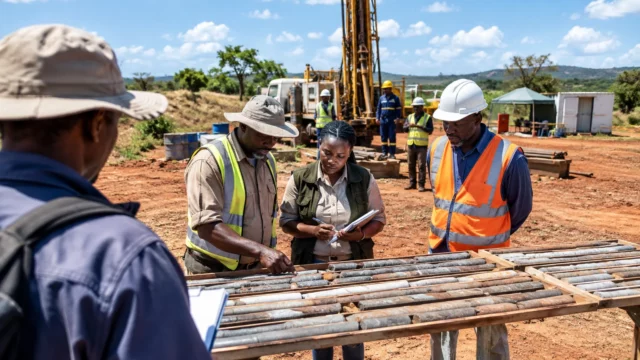
At the same time, the Malawian authorities say they are already ready to act. The 2026 budget provides for support for the Songwe Rare Earth and Kanyika Niobium projects, as well as intensified geological mapping and stronger laboratory capacity. The government has also announced a comprehensive review of exploration and mining contracts, to better protect the national interest. In other words, Lilongwe wants to put things in order before speeding up.
What minerals change, and for whom
Malawi has real, but limited, room for manoeuvre. The World Bank notes that the economy remains vulnerable, with growth of just 1.8% in 2024, below the population growth rate, and inflation still high. It also says that 5.7 million people, or 28% of the population, were expected to face crisis-level food insecurity between October 2024 and March 2025. In this context, critical minerals are not a strategic luxury; for the authorities, they are one of the few ways to rebalance the external accounts.
But the promise will matter only if it changes the structure of the economy. The familiar risk is exporting raw ore, importing technology and allowing most of the added value to leave the country. The World Bank and the Malawian authorities instead talk of local processing, skills, jobs and better tax revenue collection. That is where the difference lies between mining rents and industrial policy.
Infrastructure remains the key challenge. The mining sector’s energy needs are estimated at around 120 MW of additional capacity by 2032, while the investment required runs into billions of dollars. Private finance is expected to cover most of the cost, placing banks, funds and international partners at the heart of the effort. This is also why Thoko Tembo is now urging Malawian banks to finance the mining sector and its wider ecosystem, beyond extraction alone.
For communities near future projects, the stakes are even more tangible. The Kangankunde, Songwe Hill and Kasiya mines are the focus of high expectations, but they also entail choices over land use, the environment, possible displacement of farming activities and the local distribution of benefits. The government is now talking about community partnerships, environmental assessments and social programmes. This is an important signal. In a country where most households still depend on precarious incomes, the success of a mining project will also be measured by its ability to protect existing livelihoods.
A Malawian issue, but also a regional and continental one
Malawi is not developing this strategy in isolation. The World Bank document explicitly refers to coordinated investment with the country’s neighbours. Across SADC, several states are seeking to better align extraction, energy, logistics and industrialisation. For Lilongwe, the challenge is therefore not to remain a mere supplier of raw materials, but to become part of a stronger regional framework for processing and exports.
At the African level, the significance is clear. Malawi’s case reflects a broader trend: states want to benefit from global demand for the minerals needed for batteries, electric vehicles and low-carbon technologies. But experience shows that resources alone are not enough. Without clear rules, reliable energy, transport, transparency and local value addition, mineral wealth remains underused potential. Malawi is trying precisely to avoid this trap.
What happens next will depend on three very concrete points: the publication of an implementation timetable, the ability to attract the private sector without weakening the public interest, and the quality of oversight frameworks. If progress is made on these fronts, the country will be able to turn a mining promise into a development policy. Otherwise, the roadmap will remain just another document about a resource coveted by all, but which few manage to turn into shared prosperity.