Algeria
 Egypt
 Libya
 Morocco
 Sudan
 Tunisia
 Benin
 Burkina Faso
 Cabo Verde
 Côte d'Ivoire
 Ghana
 Guinea
 Guinea-Bissau
 Liberia
 Mali
 Mauritania
 Niger
 Nigeria
 Senegal
 Sierra Leone
 The Gambia
 Togo
 Cameroon
 Central African Republic
 Chad
 DR Congo
 Equatorial Guinea
 Gabon
 Republic of the Congo
 São Tomé and Príncipe
 Burundi
 Comoros
 Djibouti
 Eritrea
 Ethiopia
 Kenya
 Madagascar
 Mauritius
 Mozambique
 Rwanda
 Seychelles
 Somalia
 South Sudan
 Tanzania
 Uganda
 Angola
 Botswana
 Eswatini
 Lesotho
 Namibia
 South Africa
 Zambia
 Zimbabwe
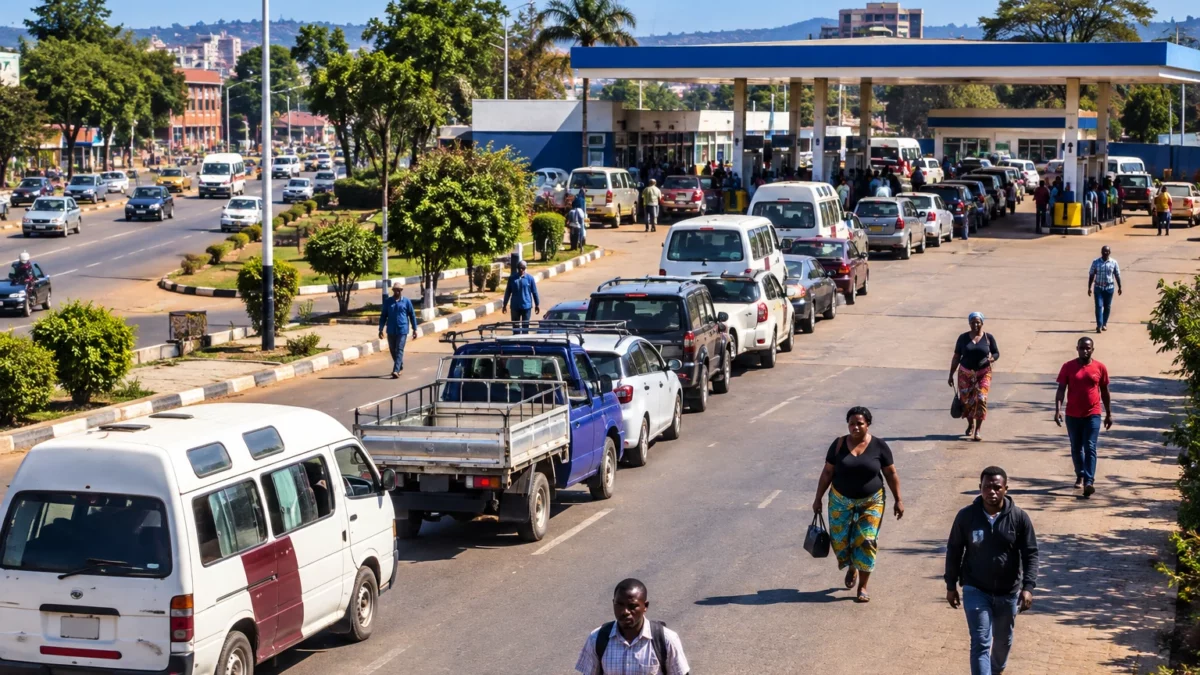
In Lilongwe, finding petrol can now take hours, sometimes an entire night. For Malawians, the shortage does not stop at the pump: it threatens travel, small businesses and the transport of goods.
A shortage extending beyond the capital
The crisis is affecting several cities, although conditions vary by station and day. In late October, the Malawian daily Nyasa Times reported stations without petrol or diesel in Lilongwe, Blantyre, Mangochi, Liwonde and Salima. Motorists sometimes travel from one outlet to another without knowing where a lorry has just unloaded.
On 3 November, the Human Rights Defenders Coalition (HRDC) announced demonstrations planned for 17 November in Lilongwe, Zomba and Mzuzu. It denounced the queues and power cuts, and called for the energy minister to resign. This demand reflects the political pressure, but does not sum up the economic and logistical causes of the crisis.
At some stations, limited sales amount to de facto rationing. This does not mean that a uniform national rule has been announced: available quantities and practices differ from one outlet to another. The government and regulator must therefore clarify the volumes being distributed and the criteria for prioritisation.
High prices, but comparisons need caution
International comparisons place Malawi among the African countries where a litre of petrol costs the most. But this ranking depends on the date chosen, the exchange rate used and the official price converted into dollars. On its own, it is not enough to explain why stations are running short of fuel.
The Malawian finance ministry’s 2026 economic report says that in October 2025 the regulated price per litre rose to 3,499 kwacha for petrol and 3,500 kwacha for diesel. It says the automatic pricing mechanism takes supply costs and the exchange rate into account. These official figures describe the price at that date, and not necessarily the price in force in November 2026.
The distinction matters: a high price does not guarantee that the product is available. And when official supply dwindles, households able to pay more sometimes find fuel outside ordinary channels, while minibus drivers, small traders and motorcyclists have less room to absorb the extra cost.
The crux: foreign currency, debts and delivery
Malawi imports its petroleum products and must mobilise foreign currency, mainly US dollars, to pay for purchases and transport. The landlocked country also relies on its neighbours’ overland corridors to move cargo. A payment problem, logistical delay or debt to suppliers can therefore reduce deliveries to stations.
The World Bank links recurring shortages to foreign currency scarcity, payment delays and logistical difficulties. It also estimates that administered prices set too low relative to import and transport costs have contributed to importers’ losses and the accumulation of arrears. The National Oil Company of Malawi, a state-owned company responsible for a large share of supply, must therefore contend with financial constraints that undermine the entire chain.
This diagnosis highlights a dilemma for the authorities. Keeping prices low temporarily protects consumers who manage to refuel, but can make imports and deliveries harder to finance. Raising prices brings the official price closer to costs, but increases household spending and business costs. A rise also does not instantly create stocks if foreign currency and supply routes remain blocked.
Different effects across sectors and regions
In Lilongwe and other urban centres, long queues leave vehicles and drivers idle. Public transport may reduce the number of trips or pass fuel costs on through fares. Employees who depend on a minibus and small vendors, whose income often depends on the number of journeys made, then face a double constraint: getting around costs more and takes longer.
In rural areas, the distance to stations makes access even more difficult. Farmers and traders need fuel to transport harvests, deliver inputs and reach markets. Fishers on the shores of Lake Malawi also depend on fuel to go out by boat. A supply disruption can therefore reduce the availability of fish or agricultural produce in markets, without its effects always being visible in the prices displayed at the pump.
Power cuts compound the problem. Businesses and some services rely on generators to keep operating. When fuel is scarce, production, the preservation of goods and services can be disrupted. The consequences are therefore not the same for a motorist who can wait as for a transporter, trader or essential service that loses hours of activity.
An issue for southern Africa
Malawi is a member of the Southern African Development Community (SADC), which brings together countries committed to regional co-operation. For a landlocked country, energy security depends in practice on trade relations and cross-border transport routes. The shortage is a reminder that access to fuel depends as much on the ability to pay and manage stocks as on the global availability of oil.
The Malawian authorities had announced plans to stabilise supplies, but the difficulties reported after the 20 October deadline fuelled protests. Monitoring deliveries, payment commitments to suppliers and transparency over stocks will show whether the announcements lead to a lasting improvement. For Malawians, the test will be tangible: shorter waits, more predictable journeys and goods moving again between towns and the countryside.