Algeria
 Egypt
 Libya
 Morocco
 Sudan
 Tunisia
 Benin
 Burkina Faso
 Cabo Verde
 Côte d'Ivoire
 Ghana
 Guinea
 Guinea-Bissau
 Liberia
 Mali
 Mauritania
 Niger
 Nigeria
 Senegal
 Sierra Leone
 The Gambia
 Togo
 Cameroon
 Central African Republic
 Chad
 DR Congo
 Equatorial Guinea
 Gabon
 Republic of the Congo
 São Tomé and Príncipe
 Burundi
 Comoros
 Djibouti
 Eritrea
 Ethiopia
 Madagascar
 Malawi
 Mauritius
 Mozambique
 Rwanda
 Seychelles
 Somalia
 South Sudan
 Tanzania
 Uganda
 Angola
 Botswana
 Eswatini
 Lesotho
 Namibia
 South Africa
 Zambia
 Zimbabwe
A song born between cities, ports and studios
Some songs outgrow their authors. They cross borders, change hands, then end up belonging to several memories at once. Malaika is one of those songs, born amid the urban exchanges of East and Central Africa, at a time when regional capitals were becoming places of recording, transit and musical reinvention.
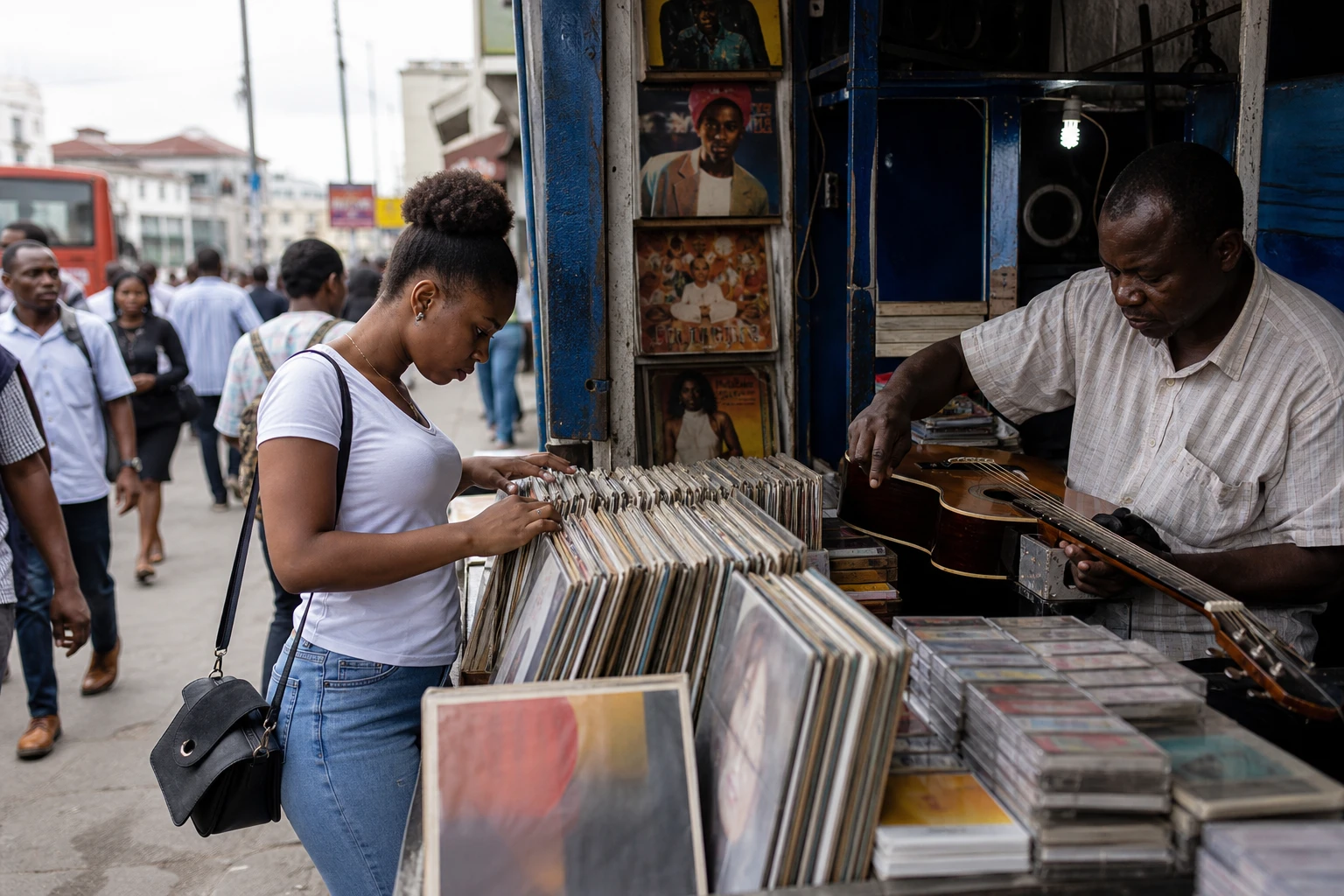
In the 1950s and 1960s, Nairobi emerged as a major recording hub. Record labels, studios and an expanding commercial radio sector drew musicians from across the region. Music In Africa notes that the city was then developing a recording industry centred on Equator Sound Studios, where artists from Kenya, Uganda, Zambia and the Congo worked together.
At the other end of the corridor, Lubumbashi, in the south-east of the Democratic Republic of the Congo, lived to the rhythm of copper, mining companies and working-class cultures. Africanews notes that the city was long home to a distinctive miners’ music, shaped by exchanges with neighbouring regions, particularly Zambia. This geography helps explain why the same melodies, rhythms and sometimes lyrics travelled from one city to another.
An East African standard, several African memories
The heart of the debate is not simply who wrote the song. It also speaks to how urban Africa in the mid-20th century created its repertoire. In Kenya, several sources attribute Malaika to Fadhili Williams, often described as the first person to record it. Music In Africa says the song is counted among the Kenyan music industry’s greatest hits and has been covered over the years by Miriam Makeba, Boney M. and Angélique Kidjo.
In Tanzania, other accounts link the song to Adam Salim, showing that its history cannot be confined to a single national version. Tanzanian newspapers also note that, for many listeners in the region, Malaika belongs first and foremost to a shared Swahili heritage, beyond the borders inherited from colonial rule.
The Congo is part of this story too. Several studies of Katangan music describe a region where the guitar, Swahili idioms and workers’ movements already linked Lubumbashi to East African cities. Africanews notes that Lubumbashi’s musicians also drew inspiration from neighbouring rhythms, while local ensembles sustained a distinctly urban performance culture. In this context, guitarists such as Édouard Masengo Katiti and Jean-Bosco Mwenda have often been cited in oral accounts of the song.
How Miriam Makeba changed its reach
What gave Malaika its continental reach was Miriam Makeba’s interpretation. Music In Africa notes that the South African singer, born in Johannesburg in 1932 and who died in 2008, was both an artist and an activist. UNESCO also highlights how her life was shaped by the anti-apartheid struggle and exile, a condition that greatly influenced her international career.
Makeba does more than cover a popular song. She slows it down, shifts it and gives it new depth. She turns it into a ballad that is both intimate and political, carried by a voice that speaks to very different audiences: East African urban communities, the Black diaspora and, later, international stages. In Music In Africa’s archive, Malaika features among her signature songs, alongside Pata Pata and The Click Song.
Her role in taking the song to a global audience is all the more significant because it accompanied a clearly defined activist journey. UNESCO notes that she used her fame to denounce apartheid and to bring an independent African voice to major stages. In this context, Malaika becomes more than a love song. It becomes a bridge between several Africas, linking the continent’s east, south and centre.
What this journey really tells us
Perhaps the most interesting thing about the history of Malaika is not settling the competing versions once and for all. It is understanding what they reveal. They show an already well-connected African space, where musicians travelled faster than official narratives and cities played a decisive role in shaping musical styles. Nairobi provided studios and distribution. Lubumbashi contributed guitar technique and an urban sensibility. Dar es Salaam, Mombasa and other Swahili ports fuelled the back-and-forth of musical repertoires.
This kind of history still matters today. It is a reminder that African cultural industries did not emerge in the shadow of a single centre, but in several interconnected regional hubs. It also reminds us that a song’s ownership can be legal, rooted in memory, commercial and emotional all at once. In practice, Malaika now belongs to a shared heritage, even as musicians, families and countries continue to claim its original source.
That is where its pan-African significance lies. A song born in the urban spaces of East Africa travelled to stages around the world through a South African artist in exile. This journey says something about the continent’s modern history: cultural exchanges often preceded political narratives of unity, while also nourishing them. That is also why Malaika continues to resonate, well beyond nostalgia. It tells the story of an Africa that exchanges, composes, borrows and transforms.