Algeria
 Egypt
 Libya
 Morocco
 Sudan
 Tunisia
 Benin
 Burkina Faso
 Cabo Verde
 Côte d'Ivoire
 Ghana
 Guinea
 Guinea-Bissau
 Liberia
 Mali
 Mauritania
 Niger
 Nigeria
 Senegal
 Sierra Leone
 The Gambia
 Togo
 Cameroon
 Central African Republic
 Chad
 DR Congo
 Equatorial Guinea
 Gabon
 Republic of the Congo
 São Tomé and Príncipe
 Burundi
 Comoros
 Djibouti
 Eritrea
 Ethiopia
 Kenya
 Malawi
 Mauritius
 Mozambique
 Rwanda
 Seychelles
 Somalia
 South Sudan
 Tanzania
 Uganda
 Angola
 Botswana
 Eswatini
 Lesotho
 Namibia
 South Africa
 Zambia
 Zimbabwe

In Madagascar, the Volobe Amont project has returned to the centre of energy discussions after a decade of preparation. On 30 September 2026, the Malagasy state and the partners in the hydroelectric plant formalised an agreement on six measures intended to make the project more viable. This step does not yet amount to financial close. It is, however, intended to unlock the conditions that are still holding up construction.
A project linked to the structural electricity crisis
Volobe Amont is to be built on the Ivondro River in eastern Madagascar. Its planned capacity is 120 megawatts. The plant is expected to produce around 750 gigawatt-hours a year, according to information provided by EDF Renewables and the project partners.
The stakes therefore go beyond the construction of a dam. They include grid stability, the cost of generation and the ability of JIRAMA, Madagascar’s state-owned electricity and water utility, to serve households and businesses.
The World Bank estimates that only 36 % of Madagascar’s population currently has reliable access to electricity. The institution links this situation to several factors: reliance on diesel generators, technical and commercial losses on the grid, and tariffs that do not always cover the cost of service. These difficulties directly affect economic activity, as well as households forced to cope with an irregular power supply.
In this context, steady hydroelectric generation could reduce reliance on thermal power plants. It will not, however, be enough on its own. Electricity transmission, grid maintenance and JIRAMA’s financial position will remain decisive.
Six measures to bring the project closer to financing
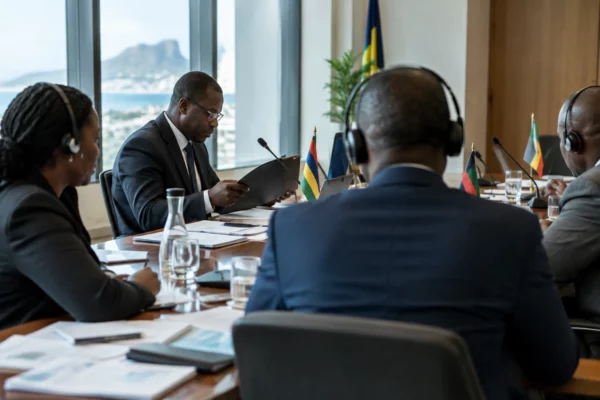
The agreement signed at the Iavoloha State Palace follows a round table held in August 2026. Technical and institutional workshops subsequently examined the options selected in greater depth. A statement by the Volobe General Hydroelectric Company describes these six measures as a common framework for continuing the project’s development.
The discussions concern, in particular, the state’s equity participation, applicable tax arrangements, commercial terms, financing and associated infrastructure. They must also clarify the responsibilities of each party before the construction phase gets fully under way.
The planned public stake represents 20 % of the project company at financial close. The current structure brings together AXIAN Energy, with 37.5 %, EDF Renewables, with 37.5 %, and Africa50, with 25 %. This breakdown was confirmed when EDF joined the consortium in April 2025, as Africa50 recalls.
The choice of a shareholding structure combining a pan-African group, a Malagasy company and an international operator reflects a desire to bring together different areas of expertise. Africa50 brings experience in financing African infrastructure. AXIAN knows the Malagasy market. EDF Renewables is expected to contribute technical expertise and manage the future facility.
The electricity sales contract nevertheless remains a central issue. JIRAMA will have to buy Volobe’s output at a price compatible with its financial capacity. The final tariff must also enable investors to cover their costs and repay financing. This balance is essential: a price that is too high would increase the state-owned company’s deficit, while one that is too low could undermine the financing structure.
Infrastructure awaited by households and businesses
The developers say the plant will be capable of supplying more than two million Malagasy people. They also estimate that it could increase national generation capacity by around 20 %. These projections still need to be considered against the actual state of the grid and the growth in demand, particularly in Antananarivo, Toamasina and industrial areas.
The benefits will not be the same in every region. Urban centres could benefit sooner from improved power availability, as they are already connected to the main grids. Rural areas, by contrast, will depend on the extension of power lines and decentralised solutions such as solar mini-grids or small hybrid systems.
The construction project could also create jobs. Africa50 cites up to 1 000 direct jobs. Local benefits will, however, depend on the contracts awarded to Malagasy companies, the training provided and the infrastructure built around the site.
The project will also have to meet environmental and social requirements. A hydroelectric development changes how water is used and can affect communities living near the watercourse. Transparency around impact assessments, compensation and grievance mechanisms will therefore be as important as financing.
A test of Madagascar’s economic credibility
Volobe’s timetable falls during a politically and economically sensitive period. The transition led by Michaël Randrianirina is seeking to maintain major investment projects while reassuring external partners. The energy project is being closely followed in this context, particularly since discussions on Volobe during the Malagasy head of state’s European mission in September 2026, reported by the Malagasy outlet Newsmada.
For investors, the next step will be to put the six measures into practice. The electricity purchase tariff will have to be confirmed, the state’s commitments finalised, guarantees secured and the financing plan agreed. The selection of companies responsible for engineering, procurement and construction will then have to fit into this timetable.
At the regional level, Volobe is also of interest to Southern Africa. Madagascar is a member of SADC, the Southern African Development Community, which encourages grid interconnection and energy cooperation among its member states. The project is primarily intended for the Malagasy market, but its success would strengthen the island’s position in regional discussions on renewable energy.
The project’s continental significance lies above all in its model. Madagascar has considerable hydroelectric potential, but still struggles to turn this resource into operational capacity. Volobe will show whether a partnership bringing together African capital, private-sector expertise and public participation can deliver more reliable electricity without worsening the national utility’s financial imbalances.
The project has therefore reached a political and contractual milestone, but not the final financial one. The next indicator will be the conclusion of the commercial agreements and guarantees. That is when the ambition to produce lower-cost energy can be tested against the realities of the grid, the public budget and Malagasy demand.