Algeria
 Egypt
 Libya
 Morocco
 Sudan
 Tunisia
 Benin
 Burkina Faso
 Cabo Verde
 Côte d'Ivoire
 Ghana
 Guinea
 Guinea-Bissau
 Liberia
 Mali
 Mauritania
 Niger
 Nigeria
 Senegal
 Sierra Leone
 The Gambia
 Togo
 Cameroon
 Central African Republic
 Chad
 DR Congo
 Equatorial Guinea
 Gabon
 Republic of the Congo
 São Tomé and Príncipe
 Burundi
 Comoros
 Djibouti
 Eritrea
 Ethiopia
 Kenya
 Malawi
 Mauritius
 Mozambique
 Rwanda
 Seychelles
 Somalia
 South Sudan
 Tanzania
 Uganda
 Angola
 Botswana
 Eswatini
 Lesotho
 Namibia
 South Africa
 Zambia
 Zimbabwe
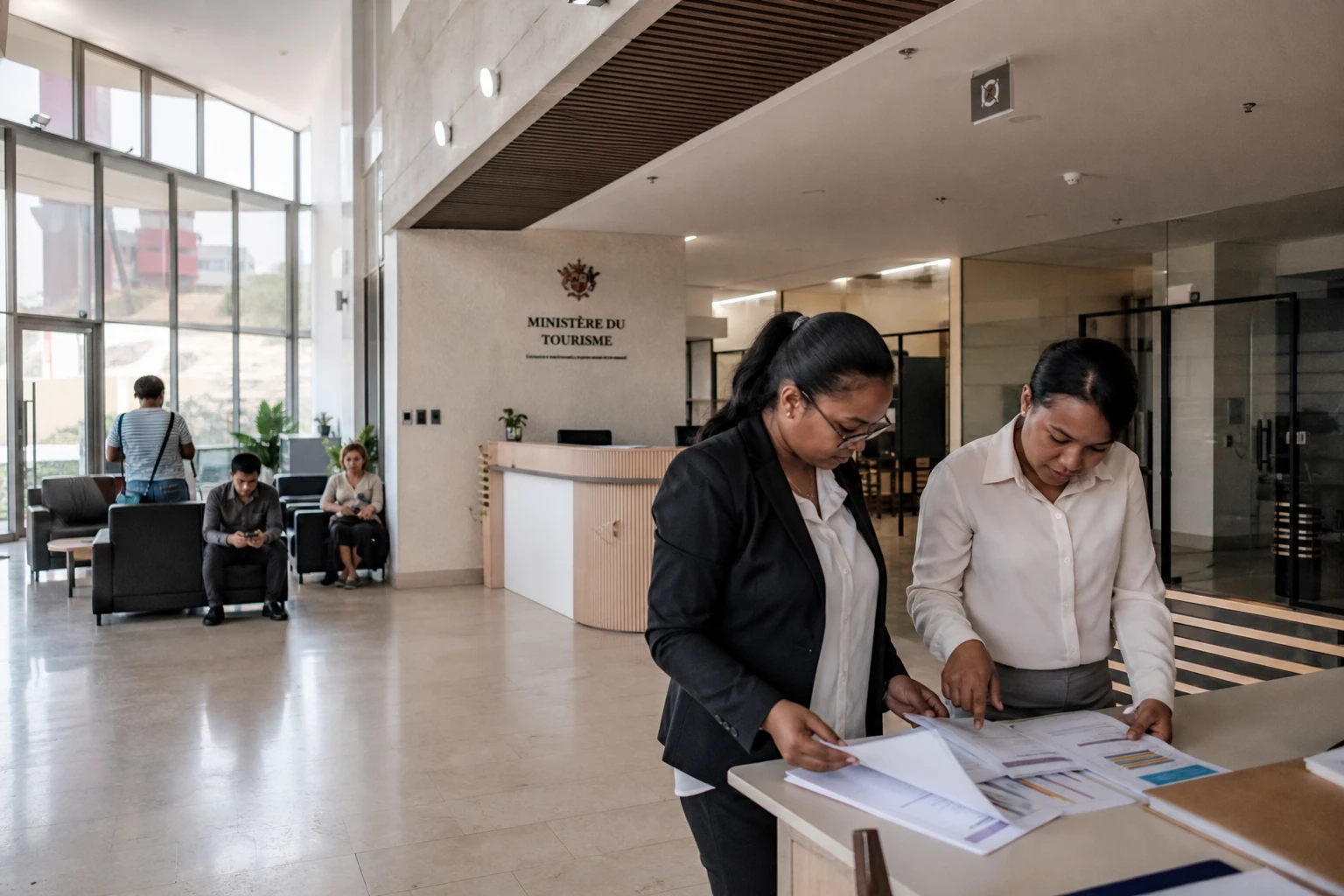
A sector recovering, but under close watch
In Antananarivo, tourism is measured by more than plane arrivals. It also depends on confidence, air links and the country’s ability to reassure travellers who have become more cautious. On the Great Island, every recovery matters because it sustains hotels, guides, transport, restaurants and crafts.
Madagascar is seeking to consolidate that recovery in a regional environment where mobility remains sensitive. The country belongs to SADC, the Southern African Development Community, a region where trade, ports, maritime routes and air connections weigh heavily on economic activity. In this context, tourism is more than a showcase: it is a source of revenue and jobs for areas often far from the capital.
Provisional figures confirm the recovery
Provisional data published by Madagascar’s Ministry of Tourism and Crafts show that tourism continued to recover in 2026. In the first half of the year, Madagascar welcomed 151,532 international visitors, compared with 150,757 over the same period in 2025, an increase of about 0.5%, according to figures reported by the local press based on the official data.
For the first three months of 2026, the ministry had already reported 71,190 arrivals, with 30,469 visitors in January, 22,877 in February and 17,844 in March. This quarterly picture points to a stronger start to the year than in 2025, although seasonality remains pronounced. In the Indian Ocean, Madagascar remains exposed to climate hazards, transport schedules and pressures on air traffic.
The return of cruise passengers to some coastal areas is another closely watched signal for operators. In recent months, the country has announced several revival measures, including promotional initiatives, visibility campaigns and stronger cooperation with airlines. Emirates, for example, increased its services to Antananarivo in 2025, improving connectivity to the destination.
After political upheaval, the sector had to rebuild confidence
The recovery is not automatic. The sector went through a period of slowdown linked to recent political unrest and air travel disruption. Tourism professionals know that a destination can quickly lose its place on international itineraries when a country appears unstable or difficult to reach.
In Madagascar, recovery is therefore first and foremost a task of restoring the country’s image. The authorities highlight the stability of major tourist sites, the organisation of services and the continuity of routes. The ministry has also launched or promoted several initiatives in 2026, while the national tourism board is stepping up visibility campaigns targeting foreign markets and the diaspora.
The strategy has a clear goal: to turn renewed interest into sustained visitor flows. The challenge is not simply to attract more visitors. It is also to extend their stays, spread the benefits across regions and support small local businesses. In a country as vast as Madagascar, a visitor to Nosy Be, Toamasina or the south has a different impact from one passing through Antananarivo. Tourism generates value only if it reaches communities across the country.
Those most dependent on the sector are also the most vulnerable. Hoteliers, guides, drivers, craftspeople and small guesthouses feel the shocks quickly, but they are also the first to benefit from a recovery. In major cities, activity picks up faster thanks to transport links and trade fairs. In more isolated areas, the recovery takes longer to spread.
What Madagascar has at stake in the Indian Ocean
Madagascar’s trajectory is of interest beyond the Great Island itself. The country is seeking to establish itself as a destination in southern Africa and the Indian Ocean that can combine nature, culture and beach tourism. It is also a question of regional competitiveness against neighbours that are better connected or have greater exposure to major source markets.
The recovery in tourist traffic in 2026 is part of this battle for position. It shows that a country can bounce back after a political shock, provided it protects its infrastructure, secures mobility and maintains a consistent message about welcoming visitors. It also underlines that tourism is not a peripheral sector. In Madagascar, it depends on transport, the country’s image, institutional stability and regional links through SADC.
What happens next will depend on the authorities’ ability to stay the course through the high season and turn provisional figures into a lasting trend. The country will also need to monitor the reliability of its air links, service quality and changes in the international environment, because a tourist market can be lost quickly but is rarely won back in a single season.