Algeria
 Egypt
 Libya
 Morocco
 Sudan
 Tunisia
 Benin
 Burkina Faso
 Cabo Verde
 Côte d'Ivoire
 Ghana
 Guinea
 Guinea-Bissau
 Liberia
 Mali
 Mauritania
 Niger
 Nigeria
 Senegal
 Sierra Leone
 The Gambia
 Togo
 Cameroon
 Central African Republic
 Chad
 DR Congo
 Equatorial Guinea
 Gabon
 Republic of the Congo
 São Tomé and Príncipe
 Burundi
 Comoros
 Djibouti
 Eritrea
 Ethiopia
 Kenya
 Malawi
 Mauritius
 Mozambique
 Rwanda
 Seychelles
 Somalia
 South Sudan
 Tanzania
 Uganda
 Angola
 Botswana
 Eswatini
 Lesotho
 Namibia
 South Africa
 Zambia
 Zimbabwe
A transition still seeking its point of balance
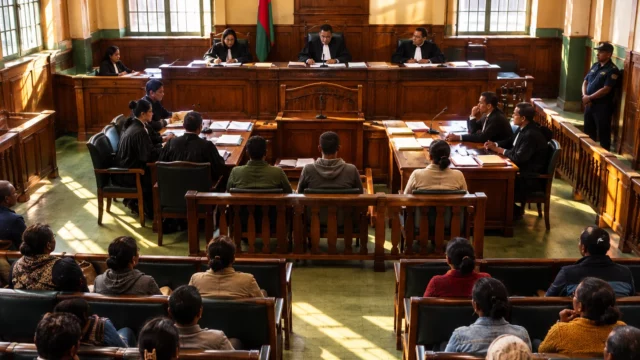
In Madagascar, the key question is no longer simply when the institutions will emerge from limbo. It is who, in practical terms, will give citizens’ voices weight at a time when political refoundation still has to prove its approach. The national dialogue, presented as an opportunity for Malagasy people to make their priorities heard, now spans an extended timetable, with an initial round of local and regional consultations followed by a national report expected in spring 2027.
On the island, this process is not taking place in a vacuum. It is part of a transition that began after the shift in power in autumn 2025, amid an institutional environment in which the legitimacy of the future constitutional framework remains central to discussions. The FFKM, Madagascar’s Council of Christian Churches, has emerged as one of the few players capable of bringing together differing perspectives, while the executive, the Independent National Electoral Commission and the High Constitutional Court seek to keep the political course within a clear institutional framework.
A timetable is now set, but expectations remain high
The FFKM has made public a three-stage schedule. First come preparations and training for debate facilitators. Next is the most substantial phase: grassroots discussions, scheduled from August 2026 to March 2027. Finally, a synthesis and follow-up phase will prepare for the next institutional stage. Local sources say the findings are due in March 2027, just before the major constitutional milestone that the authorities have set for between May and July 2027.
This sequencing matters. In the refoundation document submitted to SADC, the Malagasy authorities set an initial electoral or referendum deadline between May and July 2027, followed by further electoral events in the same year. The CENI, for its part, has referred to methodical preparations for the 2027-2028 electoral cycle, confirming that the country is working to a tight but still politically sensitive institutional timetable.
The most discussed element of this new phase is the confirmed inclusion of the Gen Z movement in the executive committee overseeing the dialogue. This matters. Since the 2025 protests, young people have forced public debate beyond its usual circles. Their inclusion in the steering structure means the process can no longer be solely a matter for institutions, churches and technocrats. It must also respond to calls for representation from the streets, campuses and social media.
The FFKM’s influence and the test of broader dialogue
The FFKM is acting here as a mediator, but also as a moral guarantor. The ministry responsible for refoundation itself explained that the dialogue aims to involve citizens, civil society, political players, religious authorities, experts and other stakeholders in defining the principles of a new Constitution, a new electoral code and the institutions that will follow. In Antananarivo, the authorities are therefore seeking not to improvise, but to provide a framework for a reform that must extend from the fokontany to the national level.
The churches’ role does not remove the tensions. The timetable published by the FFKM initially prompted questions about the process’s actual pace. It also exposed a deeper difficulty: the state wants to retain political control over the refoundation, while the churches are asserting a role in facilitating it that is more than merely decorative. Between them, civil society and youth groups are seeking guarantees on transparency, the place of the opposition and the integrity of the future rules of the game.
The announcement’s having been made in the presence of the prime minister, the president of the High Constitutional Court and the president of the CENI also signals a desire to bring all the major institutions into the same public framework. It is a way of saying that refoundation must not remain an abstract political promise. It must produce texts and procedures and, ultimately, elections considered credible.
A Malagasy issue, but also a regional one
Madagascar is not navigating this moment alone. SADC, the Southern African Development Community, explicitly welcomed the consultations conducted under its auspices and reaffirmed its support for the reform process, inclusive governance, human rights, citizen participation and a return to constitutional normality. In the same communiqué, heads of state and government reiterated that consolidating peace in Madagascar is among the region’s priorities.
For Antananarivo, this regional recognition is useful, but it also makes results essential. SADC is not offering political support alone. It is monitoring the country’s ability to turn a crisis of trust into an orderly process. In other words, the stability being sought is not simply a matter of timing. It depends on the quality of the compromises between public authorities, churches, organised youth and electoral institutions.
The continental significance is clear. In southern Africa, where several countries are reassessing their mechanisms for mediation and ending crises, Madagascar is becoming a test of approach: how can strong protest be translated into an accepted institutional framework without reducing debate to a mere political lockdown? The coming months will show whether the national dialogue produces a new common ground or remains one more exercise in an already protracted Malagasy transition. The most decisive phase will unfold by March 2027, followed by the submission of the draft Constitution to the country between May and July 2027.