Algeria
 Egypt
 Libya
 Morocco
 Sudan
 Tunisia
 Benin
 Burkina Faso
 Cabo Verde
 Côte d'Ivoire
 Ghana
 Guinea
 Guinea-Bissau
 Liberia
 Mali
 Mauritania
 Niger
 Nigeria
 Senegal
 Sierra Leone
 The Gambia
 Togo
 Cameroon
 Central African Republic
 Chad
 DR Congo
 Equatorial Guinea
 Gabon
 Republic of the Congo
 São Tomé and Príncipe
 Burundi
 Comoros
 Djibouti
 Eritrea
 Ethiopia
 Kenya
 Malawi
 Mauritius
 Mozambique
 Rwanda
 Seychelles
 Somalia
 South Sudan
 Tanzania
 Uganda
 Angola
 Botswana
 Eswatini
 Lesotho
 Namibia
 South Africa
 Zambia
 Zimbabwe
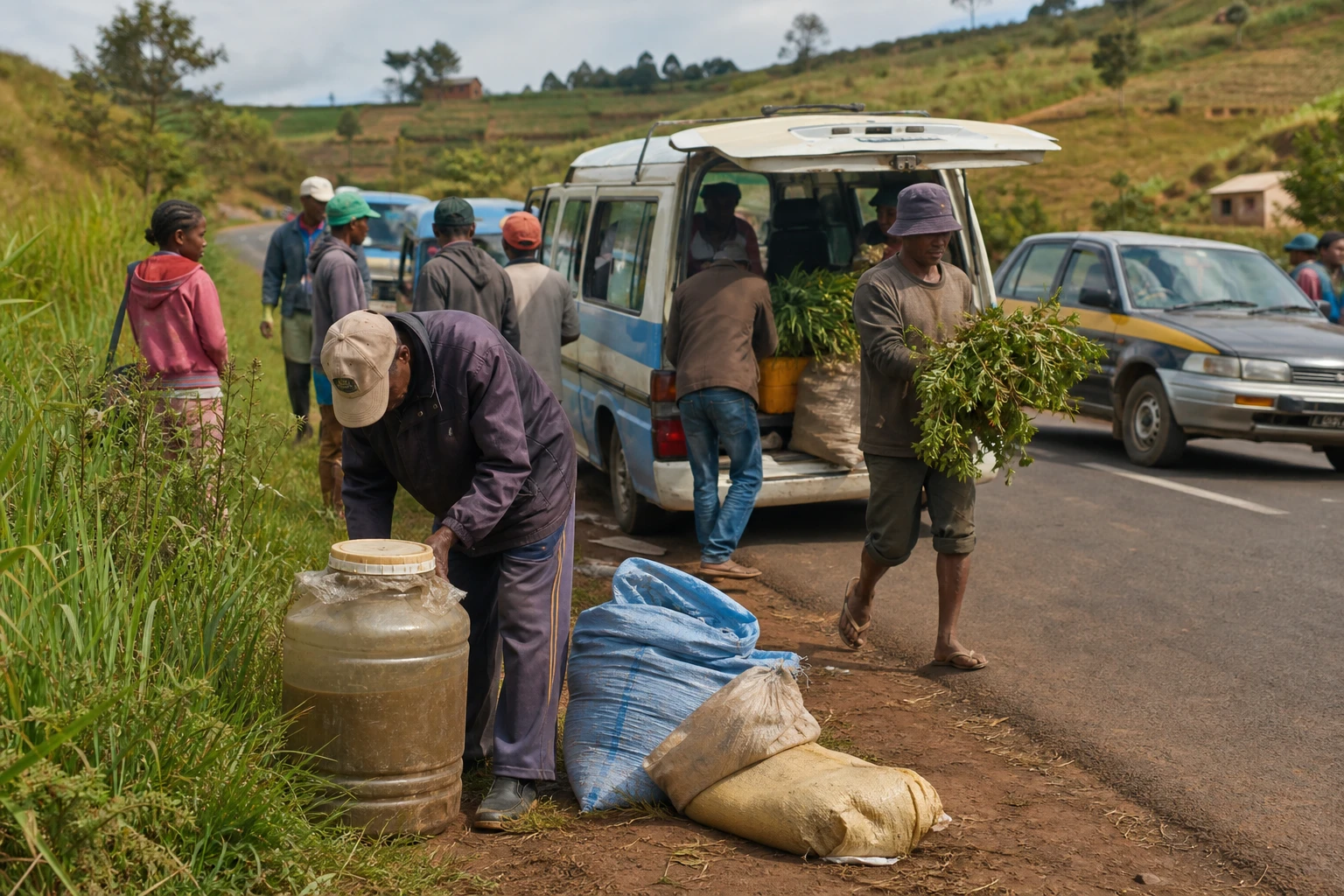
In Itasy, producing more does not simply mean growing more. It also means preserving land exposed to erosion, demographic pressure and rising input costs. In response, Malagasy farmers are making liquid fertiliser from resources available around their farms.
The method is based on a simple principle: putting local plants, manure and fermentation time at the heart of fertilisation. It does not claim to replace all existing practices. However, it offers an accessible solution for family farms seeking to reduce their dependence on purchased products.
In Itasy, soil fertility becomes an economic issue
Located in the central highlands, west of Antananarivo, the Itasy region is home to many small market-gardening farms. Producers supply local markets and, in some cases, sales networks linked to the capital.
This agriculture has to contend with fragile soils. Ferrallitic soils, common in Madagascar’s highlands, are often poor in organic matter and nutrients. Run-off further increases soil loss on sloping plots. Research by the University of Antananarivo and Cirad describes erosion as an important driver of degradation in several areas of Itasy.
Pressure on land makes a response more difficult. When plots are passed down among several heirs, their size shrinks. Farmers then have less space to leave land fallow or move crops. Fertility has to be maintained directly, season after season.
A study of the communes of Imerintsiatosika and Morarano has already highlighted the central role of organic and mineral inputs in farms’ economic performance. It also shows that producers combine different practices according to their means, crops and the availability of manure.
Fertiliser made from local resources
At Fabienne Razafindraibe’s farm, preparation starts with plants growing in the immediate surroundings, notably ambiaty and tanamasoandro. After being chopped, they are mixed with water and zebu manure.
The mixture is then left to stand in a basin exposed to the sun. It is stirred regularly. According to the method taught to farmers, fermentation takes about four weeks. The liquid is considered ready when it becomes homogeneous and the strong smells subside.
Other plants can be added. Comfrey and tephrosia are used, in particular, for their sought-after properties against certain pests. The resulting product is therefore presented not only as a source of nutrients. It is part of a broader approach to the biological management of crops.
This preparation requires neither sophisticated equipment nor a complex supply chain. Reused containers may be enough. This matters greatly in a region where access to imported fertilisers and plant-protection products remains uneven between villages, incomes and road conditions.
The principle is in line with research conducted in Madagascar on restoring soil fertility. Teams including FOFIFA, Cirad, the French National Research Institute for Sustainable Development and farmers’ organisations are testing solutions that take into account agronomic results, cost, transport and ease of use.
Yields reported to be higher, but needing long-term measurement
Under the Agriter programme, lead farmers have been trained to pass on the technique in their communities. Those in charge of the scheme say that about 15,000 producers in Itasy now use the liquid biofertiliser. They also report an average yield increase of 20%.
These figures should be attributed to the programme reporting them. They are not a uniform measure of all farms in the region. Results may vary according to the crop, the quality of the mixture, initial soil fertility, rainfall and associated practices.
Producers’ accounts nevertheless illustrate the economic benefits being sought. Jean-Patrick Ramanandraibe says his green bean production is believed to have risen from 150 to 250 or 300 kilogrammes on a plot of 100 square metres. He attributes this increase to using the liquid fertiliser and improving the health of his land.
For him, the benefit is not limited to the harvest sold. Additional income has enabled him to feed his pigs and poultry better, then invest in his livestock farming. This kind of diversification reduces a household’s dependence on a single crop. It can also cushion price fluctuations and poor seasons.
Malagasy research nevertheless cautions against drawing conclusions too quickly. The effects of an organic soil amendment depend on regular application and how it is combined with other practices: ground cover, crop rotation, compost, water management and erosion control.
A local model attracting regional research interest
In September 2025, producers and lead farmers from Itasy took part in workshops organised with FOFIFA, Agrisud and Cirad. The discussions were intended to lead to new trials during the 2025-2026 growing season, particularly involving beans.
This step shows that the spread of agricultural innovation does not rely solely on top-down training. Farmers assess for themselves how easy the preparation is, access to raw materials, transport, effects on pests and how soils respond. Their experience complements laboratory analyses.
The issue now extends beyond Itasy. Madagascar is a member of the Southern African Development Community (SADC), which encourages regional co-operation on food security, climate resilience and the sustainable management of resources. In several countries in the region, rising input prices and land degradation are also prompting producers to seek less costly solutions better suited to local conditions.
For the authorities and agricultural organisations, the next challenge will be to document results over several seasons. They will need to compare yields, production costs, soil quality and effects on incomes. They will also need to check that the method remains properly controlled as it spreads to new villages.
In Antananarivo and in the rural areas of Itasy, Malagasy agriculture faces the same challenge: feeding a growing population without exhausting the land on which it depends. Liquid biofertilisers are not a single solution. They do, however, show that agricultural innovation can draw on local resources, build on farmers’ knowledge and gradually strengthen farms’ self-reliance.