Algeria
 Egypt
 Libya
 Morocco
 Sudan
 Tunisia
 Benin
 Burkina Faso
 Cabo Verde
 Côte d'Ivoire
 Ghana
 Guinea
 Guinea-Bissau
 Liberia
 Mali
 Mauritania
 Niger
 Nigeria
 Senegal
 Sierra Leone
 The Gambia
 Togo
 Cameroon
 Central African Republic
 Chad
 DR Congo
 Equatorial Guinea
 Gabon
 Republic of the Congo
 São Tomé and Príncipe
 Burundi
 Comoros
 Djibouti
 Eritrea
 Ethiopia
 Kenya
 Malawi
 Mauritius
 Mozambique
 Rwanda
 Seychelles
 Somalia
 South Sudan
 Tanzania
 Uganda
 Angola
 Botswana
 Eswatini
 Lesotho
 Namibia
 South Africa
 Zambia
 Zimbabwe
When gold becomes an instrument of stability
In Madagascar, gold is no longer used only to supply workshops, trading posts and informal networks. It is also part of a broader monetary strategy designed to protect the ariary and strengthen the country’s foreign exchange reserves. The Banky Foiben’i Madagasikara now wants to capture more of the yellow metal within the country, at a time when central banks around the world have increased their gold purchases in recent years.
This is not an isolated move. Madagascar belongs to SADC, the Southern African Development Community, which brings together 16 member states and has a clear goal: to integrate regional economies further and support growth. In this context, the question of raw materials, their traceability and local value addition carries significance well beyond Madagascar’s borders.
The country has also already put legal foundations in place. The new mining code regulates gold trading posts, requires exports to pass through the single export window, and stipulates that gold sold must be weighed, analysed, melted and hallmarked by the Centrale de l’Or de Madagascar. The law also specifies that artisanal gold must be presented at the COM office in the place of extraction or the nearest one.
Four collection points to regain control
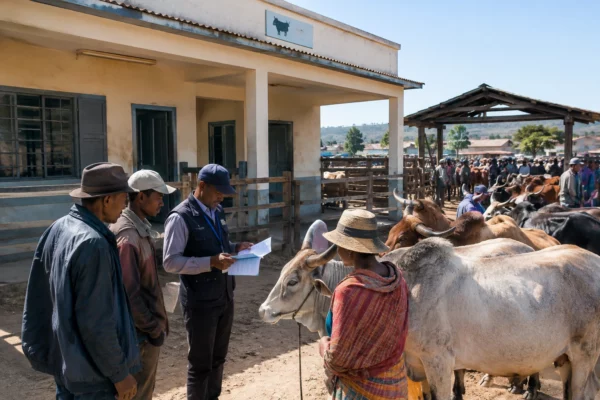
The central bank’s announced scheme is based on four areas known for gold: Ambilobe and Maevatanana in the north, Miandrivazo in the west, and Mananjary in the south-east. The plan is to set up collection points there to buy gold closer to production areas, reduce transaction costs and improve control over the metal’s origin. This approach follows a framework already advocated by the BFM in its work on gold marketing policy.
The central bank already holds an official stock of about one tonne of gold, and its domestic programme, launched in 2020, aims to strengthen and diversify foreign exchange reserves. The World Gold Council reports that the BFM set an initial target of one tonne, after which purchases may be suspended pending a review by the relevant committee. The IMF, for its part, noted that a programme to buy and refine one tonne of non-monetary gold had raised safeguards questions, particularly regarding the central bank’s autonomy and financial position.
This policy addresses a longstanding reality: Madagascar’s gold market remains largely informal. The World Gold Council describes an over-the-counter trade dominated by small-scale miners, collectors, trading posts and permit holders, with formal and informal players operating side by side along the supply chain. The same document says there is no export tax on gold, but mining operators pay royalties and other charges amounting to about 5% of the metal’s value.
Formalising without undermining small producers’ livelihoods
The public promise is twofold: to secure the state’s supply and improve the lives of those who extract gold. The project emphasises traceability, quality control and reduced mercury use, a substance at the heart of the health and environmental challenges associated with artisanal gold mining. Madagascar also takes part in international programmes dedicated to formalising artisanal mining and reducing mercury use.
On paper, the goal may seem simple. In practice, it will require convincing thousands of people who make a living on slim margins, often far from administrative centres, and who sell to the highest bidder. The legal framework is in place, but its effectiveness will depend on reliable payments, the ability to enforce controls on the ground and confidence in the prices offered by the central bank. The World Gold Council notes that the BFM adjusts its purchase price daily according to the London price, the exchange rate and the purity of doré, with deductions for refining, transport, royalties and foreign exchange risk.
The Malagasy government and mining authorities also have an interest in securing the supply chain, as smuggling is costly to the Treasury. An IMF report published in 2026 says gold taken out of the country through illegal channels deprives the state of crucial financial resources and reiterates that exports must pass through the single export window. Another document, cited by local media in 2024, reported an estimate of about one tonne of gold leaving the country clandestinely each month, a figure that should be treated as an order of magnitude rather than a definitive measure.
A Malagasy issue, but a regional signal
This policy matters to all of southern Africa. At a time when several central banks are seeking to diversify their reserves amid economic instability, Madagascar is trying to turn a resource often captured by parallel networks into a more transparent monetary asset. It is also a test of mining governance: if collection can secure better returns for producers while curbing the outflow of metal, the country will be able to show that an artisanal gold sector can be regulated without being stifled.
At SADC level, where Madagascar hosted the summit of heads of state and government in Antananarivo in 2025, the issue goes beyond the central bank. It concerns the movement of raw materials, the fight against cross-border trafficking and the credibility of regional formalisation mechanisms. If collection points do open in the four announced locations, the real test will then begin: can the authorities retain control over a sector long dominated by informal activity without driving small-scale miners out of the market?