Algeria
 Egypt
 Libya
 Morocco
 Sudan
 Tunisia
 Benin
 Burkina Faso
 Cabo Verde
 Côte d'Ivoire
 Ghana
 Guinea
 Guinea-Bissau
 Liberia
 Mali
 Mauritania
 Niger
 Nigeria
 Senegal
 Sierra Leone
 The Gambia
 Togo
 Cameroon
 Central African Republic
 Chad
 DR Congo
 Equatorial Guinea
 Gabon
 Republic of the Congo
 São Tomé and Príncipe
 Burundi
 Comoros
 Djibouti
 Eritrea
 Ethiopia
 Kenya
 Malawi
 Mauritius
 Mozambique
 Rwanda
 Seychelles
 Somalia
 South Sudan
 Tanzania
 Uganda
 Angola
 Botswana
 Eswatini
 Lesotho
 Namibia
 South Africa
 Zambia
 Zimbabwe

In Madagascar, an aviation case that reaches far beyond the hangars
When five aircraft supposed to serve a local project end up in Iran, the problem is no longer merely technical. In Madagascar, the case touches on the reliability of procedures, the reputation of civil aviation and the state’s ability to control its own documents. The trial opened this Tuesday, 22 September 2026, at the Anti-Corruption Court in Antananarivo therefore involves far more than provisional registrations. It calls into question the entire chain of decision-making, from the issuing of paperwork to the actual transfer of the aircraft.
The regional context also matters. Madagascar has been a member of SADC, the Southern African Development Community, since 2005, and Antananarivo hosted the summit of heads of state and government in August 2025. Governance, accountability and institutions have become regional issues, not just national ones. At the same time, Malagasy civil aviation had emerged from a safety audit conducted by the ICAO in January 2025, which the Civil Aviation Authority of Madagascar described as an important milestone for the country’s air safety.
The facts: five Boeing aircraft, provisional registration, then Iran
The core of the case has been known since July 2025. Five Boeing 777-200s were provisionally registered in Madagascar before being found in Iran, where they were linked to the fleet of Mahan Air, an Iranian airline subject to US sanctions for several years. Specialist sources and international media have described a route involving several Asian stopovers, with a particularly opaque sequence of re-registration and transfer.
In Madagascar, the case prompted an immediate response. The Ministry of Transport and Meteorology filed a complaint alleging forgery and use of forged documents, as well as endangering state security. Civil Aviation of Madagascar also backed the claim that documents had been falsified. Transport Minister Valéry Ramonjavelo was dismissed shortly afterwards. The investigation then took on an international dimension, with support from Interpol and the presence of FBI agents, brought in at Madagascar’s request, according to the country’s authorities.
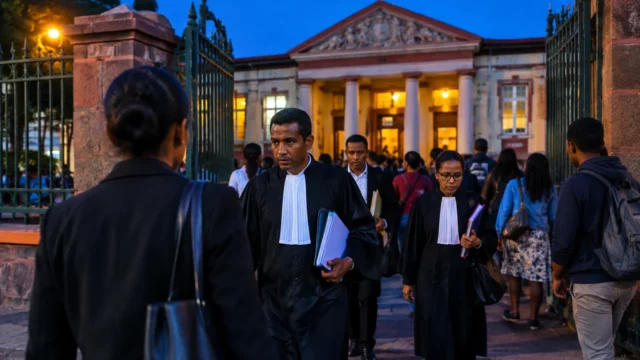
On 22 September 2026, the case enters a new judicial phase. Local media report that around 33 individuals and legal entities have been summoned to appear before the Anti-Corruption Court. Those named include civil aviation officials, business operators and several prominent figures in Madagascar’s business community. The charges cited in the publications consulted range from corruption to forgery and use of forged documents, as well as criminal conspiracy and offences related to national security.
What the trial says about the state, networks and public trust
In a case of this kind, administrative detail matters as much as the political image. A provisional registration is not just a sticker on an airframe. It involves a regulatory authority, registers, ownership checks, certificates and responsibilities at each stage. If documents have been falsified, as the Malagasy authorities claim, this means the failure did not occur at just one level. It affects at least the chain of validation, oversight and information flows.
The case is also sensitive because it brings together private interests, political relationships and transnational networks. Malagasy media consulted have named an Indian businessman and Malagasy economic actors, some of whom were placed in pre-trial detention as early as 2025. Other local sources point to responsibilities at several levels of the Civil Aviation Authority, explaining why the case remains under close scrutiny by anti-corruption prosecutors. For the public, the question is simple: whether air transport rules were circumvented through networks or favouritism.
For the Malagasy state, the impact goes beyond the legal proceedings. Aviation is a strategic sector for an island country such as Madagascar. It shapes trade, tourism, supplies and international reputation. A case of this magnitude can affect how partners, investors and foreign airlines view the country. It also requires the authorities to show that oversight institutions work, including when those institutions themselves are under scrutiny.
A reach beyond Madagascar
The case resonates beyond Antananarivo because it concerns a continental issue: the movement of goods, aircraft and documents across different legal jurisdictions. It shows how national loopholes can be exploited in international schemes, particularly when sanctions, shell companies and intermediaries in several countries are involved. This is a lesson that SADC, the African Union and aviation safety authorities cannot ignore as the region seeks to strengthen its institutional credibility.
In Madagascar, the trial will also serve as a test. The case will show whether prosecutions go all the way, whether responsibility is traced up the chain of command, and whether the justice system can deal with a technical scandal without reducing it to a mere political episode. In the short term, the next step to watch is the hearing before the Anti-Corruption Court and, if necessary, the resulting decisions on detentions, referrals and possible confrontations between defendants.