Algeria
 Egypt
 Libya
 Morocco
 Sudan
 Tunisia
 Benin
 Burkina Faso
 Cabo Verde
 Côte d'Ivoire
 Ghana
 Guinea
 Guinea-Bissau
 Liberia
 Mali
 Mauritania
 Niger
 Nigeria
 Sierra Leone
 The Gambia
 Togo
 Cameroon
 Central African Republic
 Chad
 DR Congo
 Equatorial Guinea
 Gabon
 Republic of the Congo
 São Tomé and Príncipe
 Burundi
 Comoros
 Djibouti
 Eritrea
 Ethiopia
 Kenya
 Madagascar
 Malawi
 Mauritius
 Mozambique
 Rwanda
 Seychelles
 Somalia
 South Sudan
 Tanzania
 Uganda
 Angola
 Botswana
 Eswatini
 Lesotho
 Namibia
 South Africa
 Zambia
 Zimbabwe
A brief visit with significant political weight
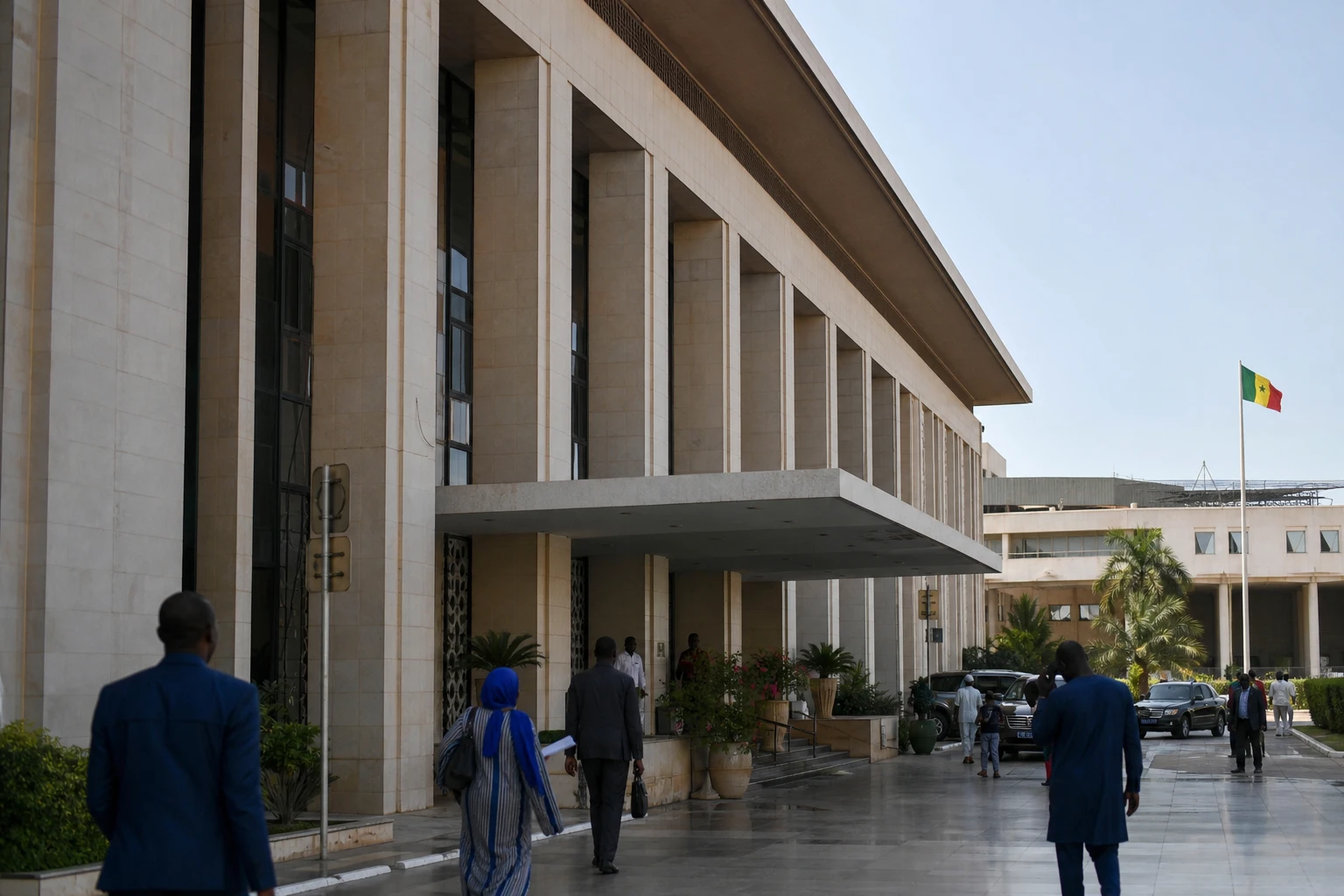
In Dakar, a round trip lasting just a few hours can be enough to reopen issues many thought had been settled. That is what happened when Macky Sall returned to the Senegalese capital, where the former head of state was greeted by supporters in Yoff before a meeting with Bassirou Diomaye Faye at the Palace of the Republic was announced. The episode immediately went beyond mere protocol. It was a reminder that, in Senegalese politics, symbolic gestures can carry as much weight as formal decisions.
Senegal enters this scene with its recent history still very much alive. Bassirou Diomaye Faye has led the country since his election in 2024, at the heart of a transition marked by a stated desire to turn the page on the tensions of previous years. At the same time, the Alliance for the Republic, or APR, remains Macky Sall’s political base. This dual reality explains the significance of the meeting: it brought a sitting president face to face with his predecessor, in a context in which the question of accountability continues to run through the country.
The facts: a round trip linked to the UN
Macky Sall announced that he would travel to Dakar on Friday 17 July 2026 for a brief visit, before leaving again that evening. According to publicly released information, he was due to be received by Bassirou Diomaye Faye after landing at Yoff military airport, where large numbers of his supporters were waiting. The African Press Agency and RTS confirmed the same itinerary, following the same logic of a brief visit.
The former president had not returned to Senegal since leaving office in April 2024. His July 2026 trip is part of his campaign for the post of United Nations secretary-general. The UN’s official website confirms that his nomination was put forward by Burundi on 2 March 2026, while the selection process was formally opened by the president of the General Assembly and the president of the Security Council in November 2025. In other words, Macky Sall’s candidacy is not a media speculation; it has been entered into the UN process.
This distinction matters. Under conventional diplomatic practice, a candidate is generally put forward by their country of origin. In this case, the nomination was submitted by Burundi, while Senegal has not officially backed the candidacy, according to the framing reported by Senegalese and African media. The visit to Dakar therefore also carried symbolic weight: showing that a former Senegalese president can rally his supporters while seeking to reassure people about his relationship with the government in office.
Why the episode still causes unease in Senegal
Macky Sall’s return does not take place in a political vacuum. In Senegal, the memory of political violence from 2021 to 2024 remains very present. Victims’ groups and civil society organisations have made repeated calls for independent investigations, truth and justice. Amnesty International and Human Rights Watch have also stressed that the amnesty adopted in 2024 should not obstruct efforts to establish responsibility for the most serious offences. The death tolls remain disputed, depending on the source, but the reality of deaths and mass arrests is no longer in question.
In this climate, the former president’s visit prompted reactions even within the presidential majority. A political adviser to Bassirou Diomaye Faye announced his resignation in protest at the meeting, citing Macky Sall’s responsibility for the recent unrest and the bereaved families’ demand for truth. Victims’ groups also denounced the return, arguing that no lasting normalisation can be built without judicial clarification. The opposition is therefore not merely partisan. It touches on how the Senegalese state deals with its own recent past.
The current government, for its part, has accused the previous administration of concealing weaknesses in public finances. The Court of Auditors’ final report on the period from 2019 to 31 March 2024 documented significant discrepancies in the state’s accounts, with total recorded debt of 15,691.05 billion CFA francs in the first quarter of 2024. The World Bank, meanwhile, announced in June 2025 $115 million in support for fiscal reforms and budget transparency in Senegal. The political battle therefore also involves financial credibility.
Beyond Dakar: a test for Senegal and West Africa
The meeting between Macky Sall and Bassirou Diomaye Faye says more than the rivalry between two men. It raises questions about how an African state balances institutional continuity, the demand for justice and international ambitions. For Senegal, a country often presented as a pillar of stability in West Africa and an important ECOWAS player, the challenge is to prove that a change of power need lead neither to revenge nor to amnesia.
For Macky Sall, the meeting with his successor was also a necessary step on the diplomatic stage. A former president seeking a UN post cannot avoid projecting an image of dialogue with his own country. But the equation is more complicated than it appears. His candidacy is backed by an African rationale, since Burundi put it forward, at a time when the African Union is seeking greater influence in global affairs. The message from Dakar is therefore twofold: the campaign is under way, but it remains dependent on how Senegalese people, African capitals and the major powers with influence in New York view it.
The continental significance of this episode ultimately comes down to a simple point. In Africa, political transitions are not played out only at the ballot box. They are also measured by the ability of new governments to deal with difficult legacies without breaking institutions or erasing victims. That is what Dakar is showing in its own way today. It is also what other capitals in the region are watching closely, as the sub-region continues to grapple with debates over justice, memory and political stability.