Algeria
 Egypt
 Libya
 Morocco
 Sudan
 Tunisia
 Benin
 Burkina Faso
 Cabo Verde
 Côte d'Ivoire
 Ghana
 Guinea
 Guinea-Bissau
 Liberia
 Mali
 Mauritania
 Niger
 Nigeria
 Senegal
 Sierra Leone
 The Gambia
 Togo
 Cameroon
 Central African Republic
 Chad
 DR Congo
 Equatorial Guinea
 Gabon
 Republic of the Congo
 São Tomé and Príncipe
 Burundi
 Comoros
 Djibouti
 Eritrea
 Ethiopia
 Kenya
 Madagascar
 Malawi
 Mauritius
 Mozambique
 Rwanda
 Seychelles
 Somalia
 Tanzania
 Uganda
 Angola
 Botswana
 Eswatini
 Lesotho
 Namibia
 South Africa
 Zambia
 Zimbabwe
In Juba, the trial of Riek Machar goes beyond the question of criminal responsibility for the clashes in Nasir. It also puts to the test a peace deal that still governs power-sharing in South Sudan. The way the justice system handles the case could affect trust between political camps and the country’s stability.
A trial at the heart of a fragile balance
South Sudan has been independent since 2011. After several years of civil war, President Salva Kiir and his rival Riek Machar signed the revitalised peace agreement on 12 September 2018. The deal reinstated Machar as first vice-president and provided for a transitional government shared among the main political forces.
The agreement helped reduce large-scale clashes, but its implementation has remained incomplete. Security arrangements, the sharing of responsibilities and preparations for elections have been delayed. In February 2025, the transition period was extended once again, underscoring the persistent difficulties in keeping to the political timetable.
The crisis also has a regional dimension. IGAD, the East African organisation that supported the peace negotiations, is monitoring implementation of the agreement. The African Union and the United Nations have also called on leaders to preserve dialogue. In April 2025, the UN had already warned that the political dispute between Kiir and Machar had turned into direct armed confrontation. The UN’s warning over the peace process crisis.
Machar disputes the charges in court
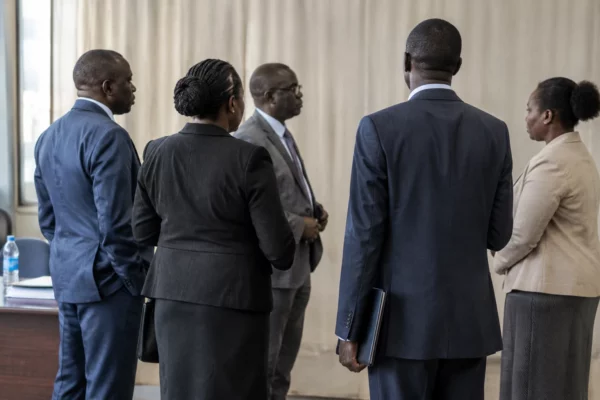
The trial of Machar and seven other officials opened in Juba on 23 September 2025. The charges concern the violence in March 2025 in Nasir, in Upper Nile State. Prosecutors accuse the defendants of involvement in crimes linked to an attack on a government garrison, including murder, treason and crimes against humanity. The charges remain to be established before the court. The UN report on the proceedings and their political stakes.
On 28 October 2026, at the 125th hearing, Machar continued giving evidence for the defence. He denied ordering White Army youth fighters to seize the Nasir barracks. He also disputed the account attributed to him by the prosecution. These details report his version before the court; they are neither a judicial ruling nor an independent finding on responsibility.
Machar describes the proceedings as a “political trial”. He has particularly criticised what he says is a prosecutor’s party affiliation. This is his allegation and must be distinguished from facts established by a court. The political sensitivity of the case nevertheless makes the court’s independence, the transparency of hearings and the parties’ ability to challenge the evidence presented essential.
Radio Tamazuj reported that the 28 October hearing was the 125th and that Machar was due to continue his testimony on Monday 2 November. An earlier report by Eye Radio said the 124th session had been held on 26 October and announced that proceedings would resume two days later. These local reports are consistent on the sequence of hearings; on their own, they cannot verify every statement made in private or before the court. Eye Radio’s report ahead of the 28 October hearing.
Nasir: between the courtroom account and political crisis
In his defence, Machar places the events in Nasir in the context of rising tensions between forces linked to the signatories of the agreement. He says he sought to calm the situation and describes the fighting as a sign of a possible return to war. This is the defendant’s account. It does not settle who gave orders or how the violence unfolded.
The death toll cited by the authorities must also be attributed. Official documents cited in available reports blame forces associated with the opposition and the White Army for the deaths of 257 South Sudanese soldiers. This figure is part of the investigation’s allegations; it should not be presented as a toll definitively established by a court ruling. The attack and its aftermath heightened tensions in Upper Nile, where civilians face displacement and insecurity when fighting resumes.
The trial’s significance therefore extends beyond Machar and the other defendants. For the authorities, it is a matter of holding those allegedly responsible for deadly attacks to account. For the opposition, the prosecutions raise questions about the fairness of the process and the future of power-sharing. For residents, particularly in areas affected by the fighting, the immediate concerns are security and the prospect of avoiding a fresh escalation.
The UN has noted that opposition leaders remain detained and are facing prosecution, while stressing the need for a fair trial. It has also recalled that implementing the peace agreement and preparing for the elections scheduled for December 2026 remain central issues. The UN statement on the trial and political transition.
A court date and a regional test
Machar’s testimony, due to continue on 2 November, is the next immediate step in the case. The court will have to examine the defence’s statements and the prosecution’s evidence before ruling. At this stage, no finding of guilt can be taken for granted.
At the same time, IGAD and the African Union will have to assess whether the political commitments made in 2018 can still support a negotiated transition. The trial will not replace discussions on security, power-sharing and elections. But the way it is conducted could strengthen, or conversely undermine, the trust those discussions require. In South Sudan, it is also this trust that will determine whether political competition remains within the institutions.