Algeria
 Egypt
 Libya
 Morocco
 Sudan
 Tunisia
 Benin
 Burkina Faso
 Cabo Verde
 Côte d'Ivoire
 Ghana
 Guinea
 Guinea-Bissau
 Liberia
 Mali
 Mauritania
 Niger
 Nigeria
 Senegal
 Sierra Leone
 The Gambia
 Togo
 Cameroon
 Central African Republic
 Chad
 Equatorial Guinea
 Gabon
 Republic of the Congo
 São Tomé and Príncipe
 Burundi
 Comoros
 Djibouti
 Eritrea
 Ethiopia
 Kenya
 Madagascar
 Malawi
 Mauritius
 Mozambique
 Rwanda
 Seychelles
 Somalia
 South Sudan
 Tanzania
 Uganda
 Angola
 Botswana
 Eswatini
 Lesotho
 Namibia
 South Africa
 Zambia
 Zimbabwe
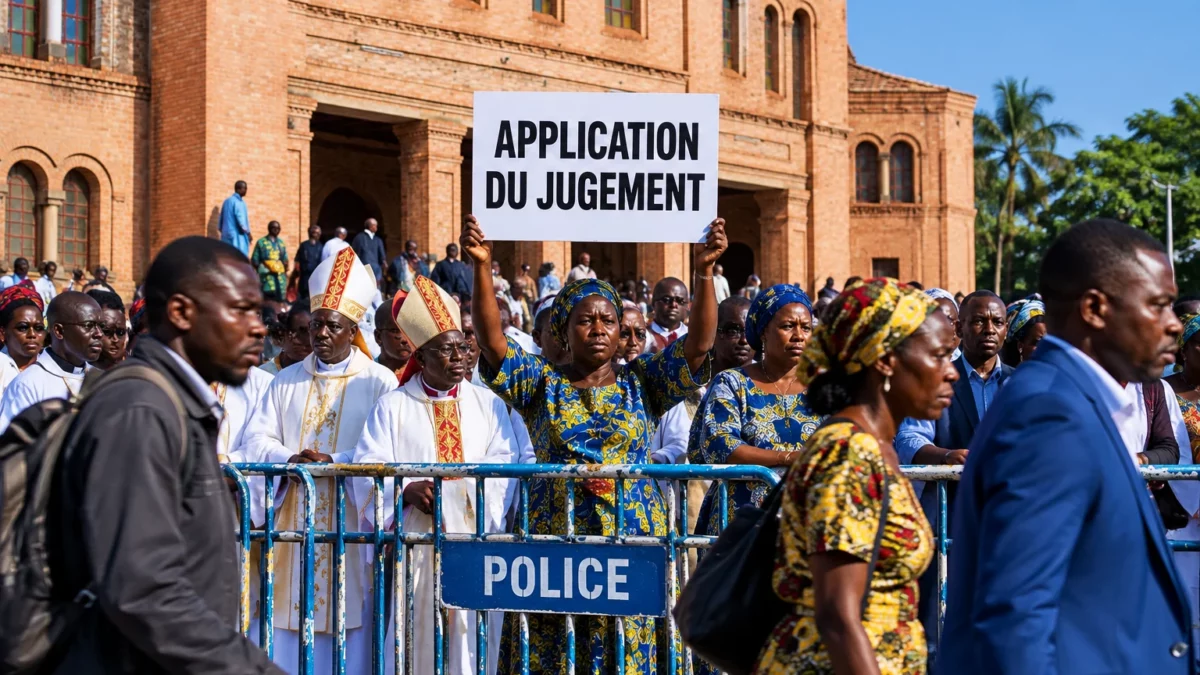
In Lubumbashi, a land dispute has taken on an institutional dimension. On Monday 23 November 2026, bishops and Catholic worshippers demanding enforcement of a court ruling were dispersed by police. Beyond the dispute over a seminary, the incident raises a practical question: what is a court decision worth when it remains unenforced and efforts to secure its implementation are prevented?
A land dispute becomes a public stand-off
The case concerns part of the grounds of the Grand Séminaire interdiocésain Saint-Paul, in the Tshamalale district of Lubumbashi, the provincial capital of Haut-Katanga. The archdiocese is contesting buildings erected on the land. It says a ruling, identified as RF 002, orders their demolition and calls on the authorities to ensure it is enforced.
The information made public does not provide a full account of the court case, the parties involved in the construction or their arguments. The Church’s position must therefore be distinguished from the full contents of the proceedings: the archdiocese presents the ruling as upholding its rights, but detailed court documents have not been made available in the reports consulted.
The city authorities had asked the Church to call off the march planned for 23 November. According to correspondence reported by Congolese media outlet Congo Inter, the city authorities cited general bans on marches and gatherings announced in August and November in the name of public order and security. The archdiocese, for its part, said the demonstration was intended to secure enforcement of the ruling.
Tear gas and blocked access
On 23 November, police used tear gas to disperse bishops and worshippers. The first incidents were reported near the seminary entrance, in the Pengapenga area. Police barriers also surrounded the approaches to Saints Peter and Paul Cathedral, the announced gathering point, and disrupted traffic on several avenues.
These details were reported by Congolese media outlet Actu30 and corroborated in several respects by the Fides News Agency, which described the barriers and difficulties accessing the archdiocese. No verified figures on casualties were available in these reports. It is therefore not possible to say that anyone was injured or arrested.
The Bishop of Kilwa-Kasenga, Mgr Désiré Lenge, said he was unable to reach the Archbishop of Lubumbashi, Mgr Fulgence Muteba, while security forces were around his residence. The bishops reported the situation, which was also covered by Fides. It illustrates the tense atmosphere but does not establish that the archbishop was arrested or detained.
The protest had not been improvised. An initial march, announced for 9 November, had been postponed after the archbishop said he wanted to give the authorities time to resolve the dispute. The demonstration on 23 November therefore followed several approaches and a renewed public appeal. The National Episcopal Conference of Congo (CENCO), which brings together the country’s Catholic bishops, is thus at the centre of a debate involving land, the courts and civil liberties.
Public order versus enforcement of rulings
The city authorities cite security and a ban on gatherings. The Church argues that a peaceful march is a means of demanding enforcement of a court decision. These positions address different questions: managing traffic and preventing unrest are matters of urban administration; ensuring that a ruling is implemented is a matter for the justice system and the competent authorities.
This gap is fuelling the stand-off. If a court decision exists, as the archdiocese maintains, its prolonged non-enforcement will perpetuate the dispute. And if a blanket ban prevents any mobilisation, it limits the parties’ visible means of drawing attention to the case. The police intervention has thus shifted the debate from the contested grounds to the right to demonstrate and the way the authorities handle a religious protest.
The effects extend beyond religious and municipal leaders. The worshippers who had mobilised were unable to hold the planned march. Residents and motorists in the areas concerned faced traffic disruption, while the buildings and use of the land remain at the heart of the dispute. The population does not, however, have a uniform interest in the case: the available information does not identify the occupants of the plots or the consequences demolition would have for them.
In Lubumbashi, a major city in the south-east of the Congo, the case is unfolding against a backdrop in which national and local institutions must make their decisions effective in people’s daily lives. The question is not only who claims the land, but also which authority can act, on what basis and under what procedure. Without public clarification of the ruling and its enforcement, competing accounts risk taking the place of verifiable facts.
Echoes beyond Haut-Katanga
CENCO has a national presence and regularly takes part in public debates in the Congo. This time, the mobilisation concerns first and foremost a specific dispute in Lubumbashi; it should not be confused with a general political position. But the use of force against a march by bishops and worshippers could give a local case national significance, particularly because it touches on freedom of assembly and the credibility of court decisions.
The Democratic Republic of the Congo is a member of the Southern African Development Community (SADC), a regional organisation for political and economic cooperation. The seminary case does not fall directly within the organisation’s remit. Its regional resonance instead lies in a question shared by many states: how can public order, freedom of assembly and the effective enforcement of court decisions be reconciled?
The next decisive developments will be the publication or clarification of ruling RF 002, the authorities’ response on its implementation and what follows from the ban on demonstrations. It will also be important to establish whether the bishops and the city authorities resume dialogue. For Lubumbashi residents, resolving the dispute will depend less on statements than on transparent procedures and verifiable action.