Algeria
 Egypt
 Libya
 Morocco
 Sudan
 Tunisia
 Benin
 Burkina Faso
 Cabo Verde
 Côte d'Ivoire
 Ghana
 Guinea
 Guinea-Bissau
 Liberia
 Mali
 Mauritania
 Niger
 Nigeria
 Senegal
 Sierra Leone
 The Gambia
 Cameroon
 Central African Republic
 Chad
 DR Congo
 Equatorial Guinea
 Gabon
 Republic of the Congo
 São Tomé and Príncipe
 Burundi
 Comoros
 Djibouti
 Eritrea
 Ethiopia
 Kenya
 Madagascar
 Malawi
 Mauritius
 Mozambique
 Rwanda
 Seychelles
 Somalia
 South Sudan
 Tanzania
 Uganda
 Angola
 Botswana
 Eswatini
 Lesotho
 Namibia
 South Africa
 Zambia
 Zimbabwe
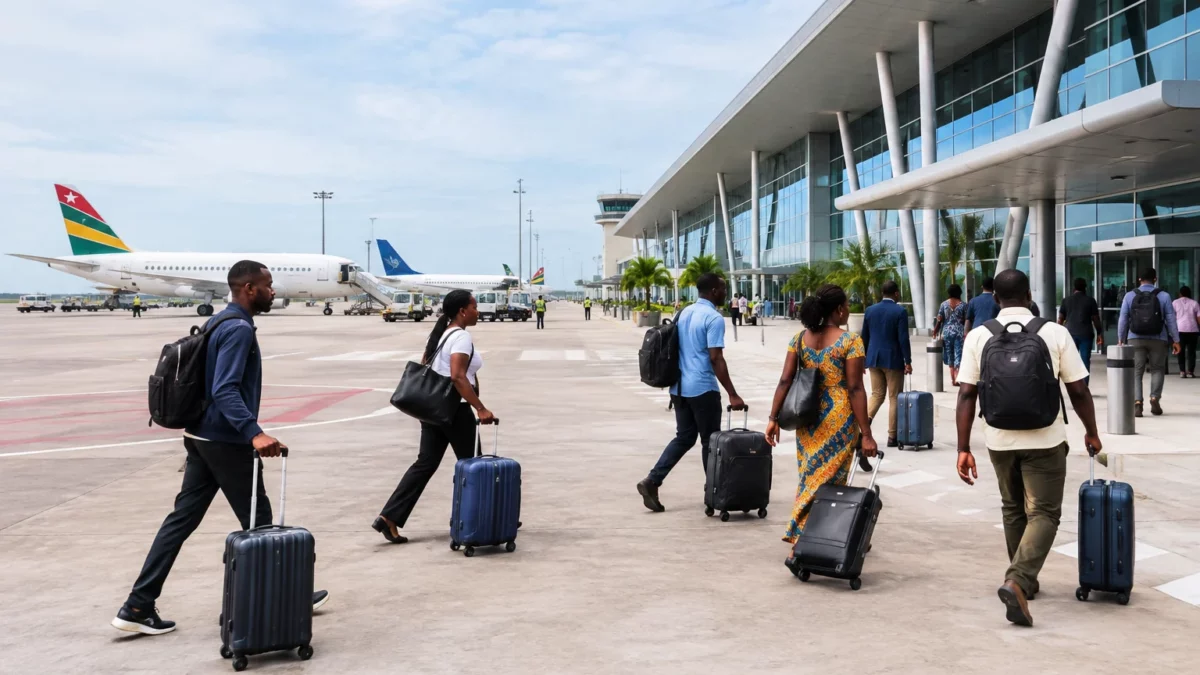
In Lomé, the rising number of travellers puts a very practical question centre stage: how can the necessary facilities be financed without confusing increased passenger numbers with available revenue? Gnassingbé-Eyadéma International Airport is handling more passengers, but not all its expansion projects have clearly defined funding or timetables.
A West African hub driven by connections
The Togolese airport serves as a link between several destinations in West Africa and beyond. This regional role rests in particular on ASKY, an airline based in Lomé, and on connections that allow travellers to continue their journey without leaving the airport.
Togo belongs to ECOWAS, the Economic Community of West African States. In this region, where trade and regional mobility matter to national economies, air links can facilitate business travel, tourism and freight transport. They are not, however, enough on their own to establish that the benefits are shared between the capital and the country’s other regions.
Lomé’s traffic had already exceeded 1.5 million passengers in 2024, according to an official Togolese statement. Recent growth is therefore part of a trajectory already marked by rising passenger numbers and investment in the parking apron.
Rising traffic, investments to finance
In the first nine months of 2026, the airport handled more than 1.217 million passengers, up 4.3% on the same period in 2025. The managing director of the Société aéroportuaire de Lomé-Tokoin (SALT), Kanka-Malik Natchaba, presented these figures on 23 November. ASKY carried 821,249 passengers. There were 343,512 connecting passengers, or 28.3% of the total. These figures have been reported by Togolese media, but no detailed statistical table from the operator was identified to verify them independently.
SALT plans to combine increased revenue with public-private partnerships and structured financing — arrangements that bring together several funding sources or lenders around a project. The company also intends to make better use of existing facilities, improve services, attract other airlines and develop freight. The amounts sought and the breakdown of contributions have not been made public in the information consulted.
The state is also being called on to facilitate financing, revise fees and secure land. These measures can affect operating costs, airport revenue and investment conditions. Airport charges can also be passed on to airlines and, depending on their commercial decisions, to travellers. The arrangements being considered have yet to be specified.
Two projects, timetables still uncertain
The first capacity expansion, on the airside, has already been completed. Two stands for wide-body aircraft were inaugurated in July 2025. The investment, carried out with the participation of a Chinese company, increased the number of aircraft that can be parked simultaneously to 17, from 15 previously. Togolese announcements and a local media outlet agree that the two stands were added.
For passengers, the plan to expand the existing terminal includes a 2,608-square-metre south wing and 500 additional seats in the waiting areas. The stated aim is to increase annual handling capacity from 1.4 million to 2 million passengers. A technical publication by the Agency for the Safety of Air Navigation in Africa and Madagascar (ASECNA) confirms the planned floor area. However, continuation of the project still appears among the 2027 budget priorities: the public information consulted therefore does not make it possible to confirm that the work has been completed.
A second terminal, covering about 21,000 square metres, is also among SALT’s plans. The company says it is seeking financing for it. No cost or construction timetable has been announced. This project is separate from the expansion of the existing terminal; the two should not be presented as a single construction project.
SALT is also counting on commercial revenue. In October 2026, the Togolese authorities discussed modernising the duty-free shops, with refurbished spaces and a wider range of products. These shops could contribute to the airport’s revenue, particularly through connecting passengers. Their expected financial contribution has not, however, been quantified.
The benefits will depend on financing choices
For airlines, more capacity can make it easier to organise flights and connections. For passengers, the immediate priority is smooth journeys on departure, arrival and during transit. Air freight also matters to companies shipping urgent or high-value goods. But the benefits will depend on the actual pace of construction, the costs incurred and demand, not just on announced capacity.
Traffic growth does not automatically guarantee that the operator’s revenue will rise in the same proportion. Revenue also varies according to charges, commercial services, operating costs and the composition of passenger flows. That is why financing choices matter as much as traffic forecasts: borrowing, private partnerships and public contributions entail different risks and different allocations of costs.
Across West Africa, Lomé’s ability to handle more connecting passengers also matters for links between countries and competition among regional hubs. The next milestone will be the specification of allocations in the 2027-2029 budget programme, followed by publication of a timetable and financing plan for each project. Until those details are available, the growth ambition is clear, but its cost and terms remain open.