Algeria
 Egypt
 Libya
 Morocco
 Sudan
 Tunisia
 Benin
 Burkina Faso
 Cabo Verde
 Côte d'Ivoire
 Ghana
 Guinea
 Guinea-Bissau
 Liberia
 Mali
 Mauritania
 Niger
 Nigeria
 Senegal
 Sierra Leone
 The Gambia
 Togo
 Cameroon
 Central African Republic
 Chad
 DR Congo
 Equatorial Guinea
 Gabon
 Republic of the Congo
 São Tomé and Príncipe
 Burundi
 Comoros
 Djibouti
 Eritrea
 Ethiopia
 Kenya
 Malawi
 Mauritius
 Mozambique
 Rwanda
 Seychelles
 Somalia
 South Sudan
 Tanzania
 Uganda
 Angola
 Botswana
 Eswatini
 Lesotho
 Namibia
 South Africa
 Zambia
 Zimbabwe
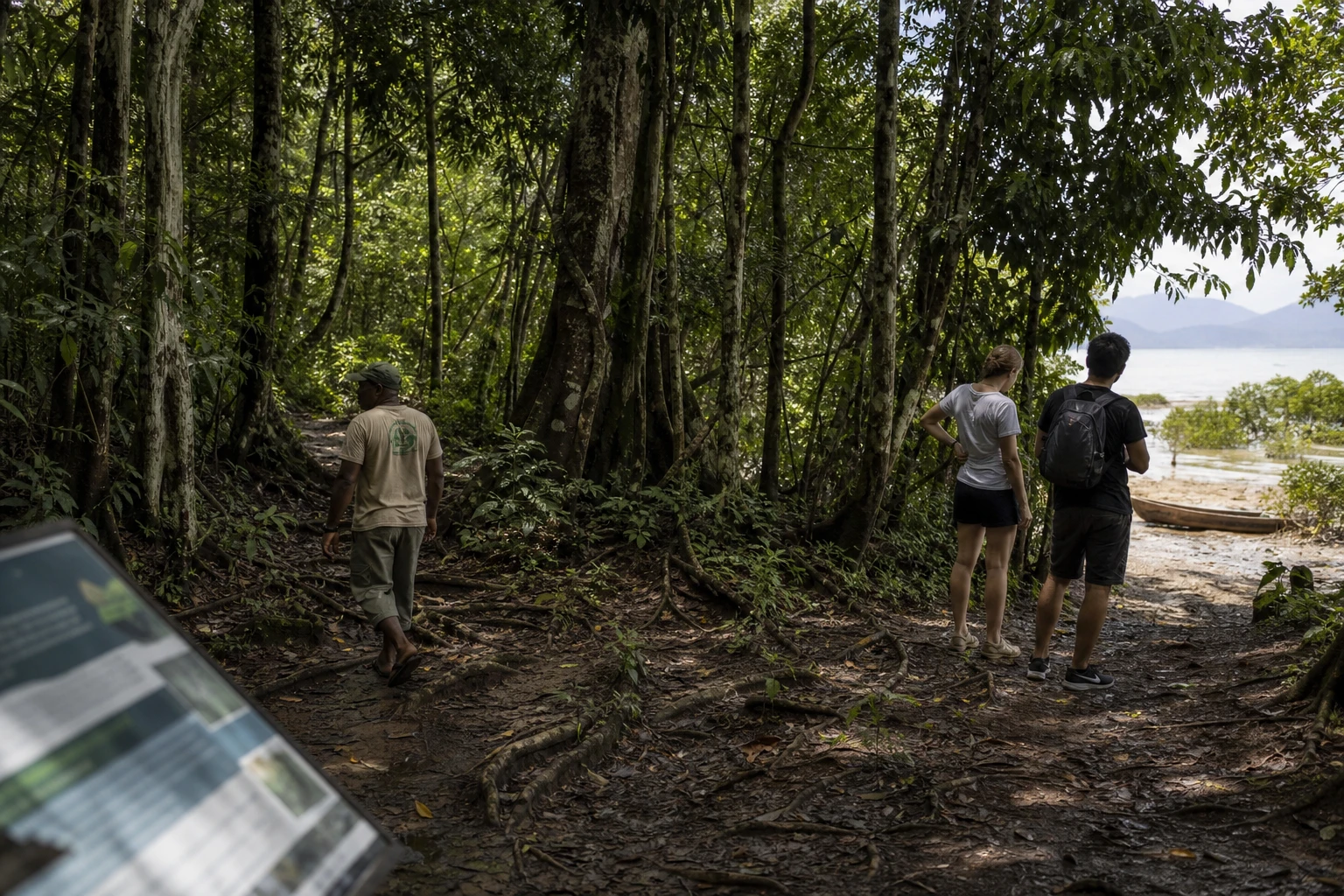
In Nosy Be, the forest does not end at the beaches. In the south-east of the island, Lokobe National Park preserves a rare fragment of rainforest, among hills, springs, mangroves and coastline. Covering 862 hectares, including 740 hectares of land and 122 hectares of marine area, this protected space contains a remarkable share of Madagascar’s biodiversity.
Lokobe is a reminder of a reality that is often overlooked: Nosy Be’s appeal does not rest solely on its coastal scenery. It also depends on a natural heritage that shapes the island’s ecological balance and supports a local economy linked to visits, guiding and community activities.
A rare forest massif in the Nosy Be archipelago
The park is in the DIANA region, in north-west Madagascar, but on the south-eastern part of Nosy Be island. This island location gives Lokobe particular value. Its habitats have long been separated from those of the Big Island, encouraging the emergence of species unique to this territory.
The site was established as a strict nature reserve by a decree dated 31 December 1927. Its status and boundaries later changed. Decree No. 2011-500 of 6 July 2011 converted the protected area into a national park, with a terrestrial component and a marine extension. It is now managed by Madagascar National Parks, the Malagasy body responsible for dozens of the country’s protected areas.
Lowland forest is the ecological heart of Lokobe. It is home to endemic trees and palms, in a landscape characterised by lianas, dense undergrowth and modest hills. The park also has twelve springs, an important asset for both natural environments and nearby villages.
Public data do not always give the same historical areas. However, the Malagasy protected areas platform’s fact sheet lists 862 hectares for the current perimeter. This distinction matters because it separates the former forest core from the boundaries of the national park adopted in 2011.
Species made unique by their island home
Lokobe’s wildlife illustrates Madagascar’s biological distinctiveness. The black lemur, or Eulemur macaco, is among the park’s emblematic species. Males generally have dark fur, while females display more varied shades. Their presence is a reminder that conservation protects not just scenery, but animal populations tied to a specific habitat.
Two small nocturnal lemurs further underline this importance. Claire’s mouse lemur, Microcebus mamiratra, and the Nosy Be sportive lemur, Lepilemur tymerlachsonorum, are associated with the island and its forests. Spotting them requires patience. It also depends on the quality of scientific surveys, since nocturnal species are difficult to record.
Reptiles and amphibians add to this heritage. Lokobe is home to the Nosy Be panther chameleon and several species of gecko. Endemic frogs have also been reported in or around the reserve. In this forest, a species’ small size does not diminish its ecological significance: it may reveal the island’s distinctive evolutionary history.
Birds also play a central role. Forest species depend on mature trees, fruit and insects found in the different layers of vegetation. For visitors, this diversity turns a hike into an experience of listening and observation. For managers, above all, it provides indicators of habitat health.
Tourism needs careful management
Lokobe can be reached by land or by canoe from coastal villages. The sea crossing offers a gradual introduction to the landscape. It links tourism with local skills, but also requires safety rules and an organisation capable of limiting disruption.
Routes in the park combine walking and exploration of the forest, and, depending on the itinerary, travel on the water. The facilities are more modest than those of a seaside resort. This simplicity can preserve the place’s character, provided that visitor services, trails, waste and safety are monitored regularly.
The principle is simple: visits should help fund conservation without turning the forest into a space for consumption. Madagascar National Parks’ rules prohibit feeding animals, leaving the trails and removing natural materials, among other things. These rules protect the species’ wild behaviour and limit soil erosion.
Nearby communities, for their part, have an interest in benefiting directly from the park’s presence. Guiding, maritime transport, accommodation, crafts and catering services can generate income. But this balance cannot simply be decreed. It depends on transparent sharing mechanisms, training and residents’ participation in decisions concerning natural resources.
Protection faces local and climate pressures
Conserving Lokobe is not simply a matter of preventing the loss of trees or animals. It must also address pressures linked to land use, erosion, extraction and climate change. Changes in temperature and rainfall can alter plant regeneration, water availability and breeding cycles.
The park is therefore part of a broader national policy. Madagascar has a network of terrestrial and marine protected areas managed by several institutions and partners. The central challenge now is to maintain effective protection on the ground, beyond decrees and administrative maps.
In 2025, a national project focused on climate resilience and biodiversity conservation included Lokobe among six selected parks. This approach confirms that protected areas are now seen as ecological infrastructure. They help protect water, soils and local economies while conserving irreplaceable species.
A concern for Madagascar and the Indian Ocean
Lokobe gives conservation in Madagascar regional significance. In the western Indian Ocean, islands share several challenges: pressure on coastlines, dependence on tourism, fragile ecosystems and exposure to extreme weather events. Madagascar nevertheless has a particular responsibility because of its exceptional level of endemism.
For Antananarivo, protecting Lokobe is therefore a matter of the environment, tourism and land-use planning. For Nosy Be, it directly affects water quality, the island’s appeal and community incomes. For researchers, the park remains a living laboratory. For residents, above all, it must remain a protected, accessible and useful resource.
The next step will be to measure the tangible effects of management: changes in lemur populations, the condition of the forest, tourist numbers, local incomes and reductions in pressure. Lokobe’s value cannot be summed up by its beauty. It will be proven by the collective ability to sustain the balance between conservation, research and local development.