Algeria
 Egypt
 Morocco
 Sudan
 Tunisia
 Benin
 Burkina Faso
 Cabo Verde
 Côte d'Ivoire
 Ghana
 Guinea
 Guinea-Bissau
 Liberia
 Mali
 Mauritania
 Niger
 Nigeria
 Senegal
 Sierra Leone
 The Gambia
 Togo
 Cameroon
 Central African Republic
 Chad
 DR Congo
 Equatorial Guinea
 Gabon
 Republic of the Congo
 São Tomé and Príncipe
 Burundi
 Comoros
 Djibouti
 Eritrea
 Ethiopia
 Kenya
 Madagascar
 Malawi
 Mauritius
 Mozambique
 Rwanda
 Seychelles
 Somalia
 South Sudan
 Tanzania
 Uganda
 Angola
 Botswana
 Eswatini
 Lesotho
 Namibia
 South Africa
 Zambia
 Zimbabwe
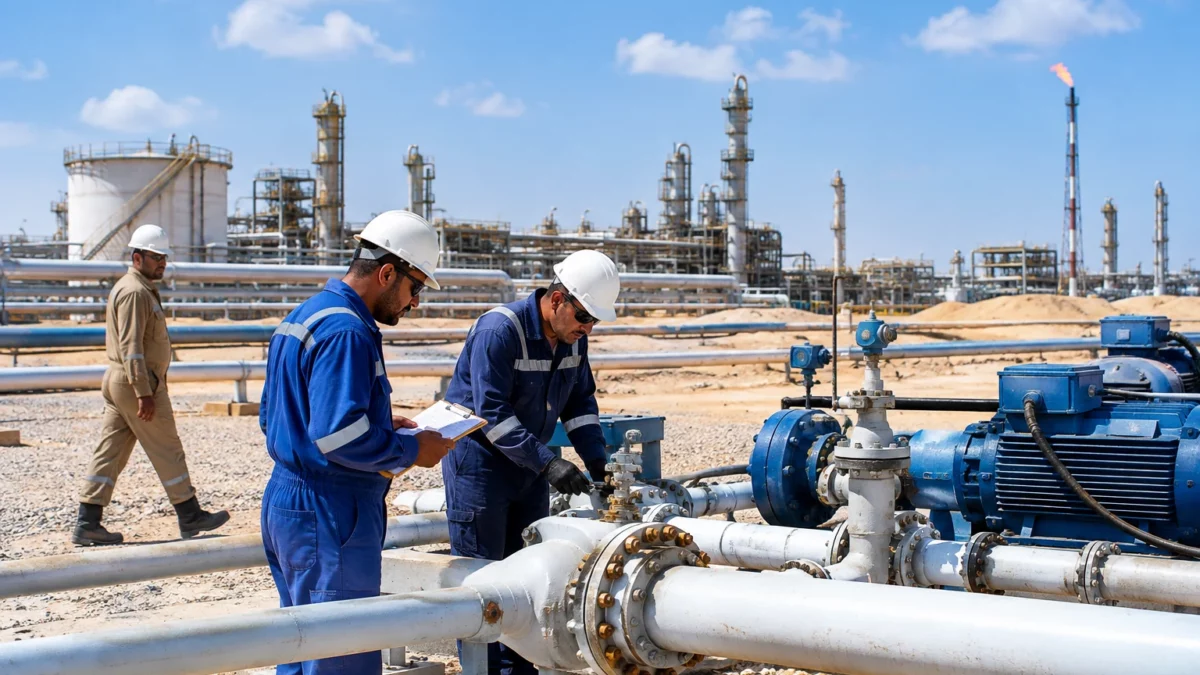
In Libya, producing more oil depends on more than discovering new deposits. Existing fields must also be brought back into production, facilities financed and sites kept accessible. The national oil company is now banking on two rounds of tenders to attract partners.
Two procedures, two timetables
In Tripoli on 24 November 2026, National Oil Corporation (NOC) chairman Masoud Suleman announced a first procedure for 2027. It will cover fields that have been discovered but not developed, as well as so-called marginal deposits, which are often more complex or less profitable to exploit.
A second procedure, focused on exploring new blocks, is planned for early 2028. At this stage, the NOC has not detailed the sites concerned or the terms of participation. The company has also reached an agreement with engineering group KBR, tasked with preparing a plan to increase production. These announcements are set out in the National Oil Corporation statement on projects announced in Tripoli.
The timetable was confirmed by specialist media outlet The Energy Year, which also reported that details on the blocks and access conditions were lacking. The next concrete step will therefore be the publication of tender documents. Without this information, investors cannot yet assess the risks or expected financial commitments.
A revival amid a fragmented political landscape
The initiative is part of a resumption of exploration licensing. The campaign launched in 2025 was the first in many years. On 11 February 2026, the NOC announced the results of the process. Five international companies were selected, according to reports by the company and Libyan media outlet Libya Herald.
But Libya’s oil policy is being pursued in a country where institutions and authorities remain divided between east and west. The NOC is a central state-owned company, but its ability to stick to a timetable also depends on the security of facilities, infrastructure and continuity in public decision-making. The risk of disruption therefore weighs on long-term projects as much as geological uncertainties do.
Libya belongs to the Arab Maghreb Union (AMU), a North African regional organisation. However, the oil issue also involves partners beyond this structure: foreign companies, importing countries and the Organisation of the Petroleum Exporting Countries (Opec), of which Libya is a member. The regional stakes include the stability of Mediterranean supplies and the ability of African producer countries to negotiate their partnerships.
Ambitious targets meet constraints
Production figures should be treated with caution. The NOC cited about 1.3 million barrels a day at the end of November. An article published by Libya Herald on 25 November instead put the current level at 1.4 million barrels a day. The World Bank, in its annual estimate in October, puts the 2026 average at 1.3 million. These figures do not necessarily refer to the same day or period.
Masoud Suleman is targeting an increase to 2 million barrels a day. He said such a goal would require at least $20 billion in investment, according to the Libya Herald report on investment needs. The NOC has not, however, presented a detailed timetable to measure progress towards this target. The World Bank, for its part, forecasts average production of 1.4 million barrels a day in 2027 and 2028, highlighting the gap between the stated ambition and medium-term projections.
New licences alone will therefore not be enough. Enhanced oil recovery, which involves using techniques to extract more oil from an existing field, can contribute to an increase. Equipment will also need to be replaced, infrastructure developed and contracts made sufficiently clear to interest investors over several years. Production-sharing agreements, or PSAs, involve the state and private operator sharing production from a project.
The benefits are not automatically distributed throughout the country. Investment can support local employment and Libyan service companies, but public benefits depend on how revenues are managed. The World Bank notes that hydrocarbons weigh heavily on national finances and that budget execution remains opaque. For households, an increase in exports therefore does not, by itself, guarantee improved purchasing power or a regular fuel supply.
Next steps to watch
In the short term, attention will focus on the results of the blocks awarded in 2026, the start of the announced work and the precise terms of the offers planned for 2027. Contract details will be decisive: they will show the share of risks borne by investors, the revenues expected by the state and the role reserved for Libyan companies.
For neighbouring countries and African energy partners, the issue is a reminder of a central reality: geological potential only becomes sustainable production when institutions can secure sites, ensure contracts remain in force and account for how revenues are used. The success of the tenders will therefore be measured as much by the investment actually made as by the barrels announced.