Algeria
 Egypt
 Libya
 Morocco
 Sudan
 Tunisia
 Benin
 Burkina Faso
 Cabo Verde
 Côte d'Ivoire
 Ghana
 Guinea
 Guinea-Bissau
 Mali
 Mauritania
 Niger
 Nigeria
 Senegal
 Sierra Leone
 The Gambia
 Togo
 Cameroon
 Central African Republic
 Chad
 DR Congo
 Equatorial Guinea
 Gabon
 Republic of the Congo
 São Tomé and Príncipe
 Burundi
 Comoros
 Djibouti
 Eritrea
 Ethiopia
 Kenya
 Madagascar
 Malawi
 Mauritius
 Mozambique
 Rwanda
 Seychelles
 Somalia
 South Sudan
 Tanzania
 Uganda
 Angola
 Botswana
 Eswatini
 Lesotho
 Namibia
 South Africa
 Zambia
 Zimbabwe

In Monrovia, the docks are advancing faster than the roads
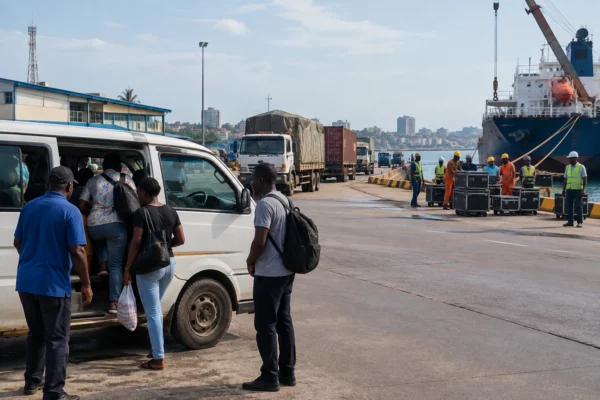
The port of Monrovia is changing. The laws are changing, too, as are the investments. But one truth remains in Liberia: a more modern terminal is not enough if goods then run into poor roads and fragile logistics corridors. This is where the price of rice, fuel, cement and spare parts for Liberian households and small businesses is determined in very concrete terms.
The country is entering this phase with a clear challenge. The National Port Authority, established by law in 1967 and reorganised in 1970, oversees four public ports: Monrovia, Buchanan, Greenville and Harper. It says it aims to “facilitate trade” and manage the ports with efficiency, commercial excellence and transparency. The Freeport of Monrovia remains the country’s main gateway and is important to the entire sub-region, in a West African area where ECOWAS is also promoting tools to streamline trade, such as SIGMAT, its electronic customs transit system.
Reforms, concessions and a new legal framework
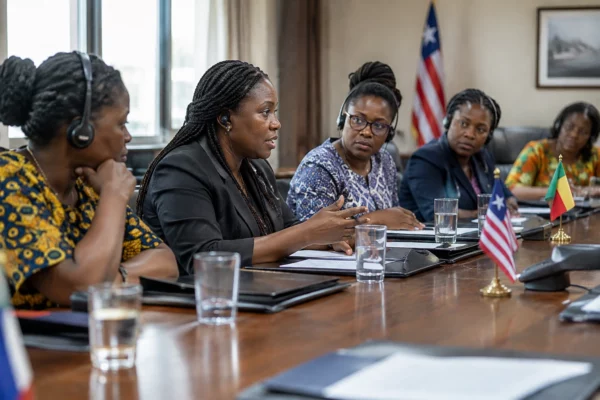
At the heart of the issue, two laws on the autonomy of seaports and inland ports have recently been adopted, according to the Liberian press. The debate is not merely institutional. It concerns governance, the speed of decision-making and the ability to attract private operators without adding to the administrative burden. In July 2026, parliamentary information reported by the local press indicated that the laws were intended to replace Chapter VI of the Public Authorities Law, which governs the NPA, and establish a new framework for autonomous ports.
The overhaul follows months of political friction. In January 2026, the Ministry of Justice advised against approving a re-registered version of the Liberia Sea and Inland Ports Regulatory Act, saying governance shortcomings had not been addressed, according to media reports. Even without repeating the details of that dispute, the signal is clear: in Monrovia, port autonomy has become a question of power, but also of process.
At the same time, the executive and the NPA have stepped up the modernisation of the sector. In October 2025, the NPA launched a $550 million strategic plan for 2025-2030 to transform the entire port system. The document is presented as a pillar of the national development programme. The port of Monrovia is to play a central role, alongside the country’s other maritime entry points.
Real gains, but still incomplete
Progress is visible. The port of Monrovia features in the World Bank’s Container Port Performance Index 2025, an indicator that measures the time ships spend in ports and allows for international comparisons. The report also notes that port efficiency depends not only on cranes and docks, but on the global maritime transport environment. In other words, a port can operate better while still being constrained by its immediate surroundings.
This is precisely the situation in Liberia. A US Department of Commerce note cited in the source material referred in 2024 to high handling charges and suspicions of corruption. Such costs feed into a reality familiar to shippers: when port transit becomes too expensive or too slow, some bypass Monrovia and turn to other ports in the region, notably Conakry. The competition is not just between ports, but between entire logistics chains.
The problem continues further down the chain. Liberia’s road network remains largely unpaved. The National Road Fund said in 2022 that only about 9% of roads were paved. A 2025 IMF report puts the figure at 8.7% of the network, or about 1,131 kilometres out of a national network of roughly 13,000 kilometres. As long as this weakness persists, the advantage gained at the port will dissipate before reaching the hinterland.
Rail, mining and the hoped-for ripple effect
Rail adds another piece to the puzzle. In Liberia, railway infrastructure is used mainly to transport iron ore. But major mining projects can also help improve logistics. In 2025, ArcelorMittal Liberia confirmed a significant investment in the Tokadeh-Buchanan line and the port of Buchanan, with shipments set to rise from 5 million tonnes a year to 20 million in 2026, and studies under way to increase this to 30 million. The company has also referred to a multi-user agreement for the railway, a sign that, over time, the route could serve more than just iron ore.
This matters to the real economy. When railways and roads remain inadequate, port activity mainly benefits large operators able to manage their own logistics corridors. Medium-sized importers, meanwhile, pay for congestion, delays and intermediary margins. In a country where goods arriving by sea supply a large share of urban consumption, the impact is quickly felt in Monrovia’s markets and then in the inland counties. The capital often benefits first, but the final cost is borne well beyond the port.
Liberia is not alone in facing this dilemma. For several months, ECOWAS has been promoting digital transit and cross-border connectivity reforms between Côte d’Ivoire, Guinea and Liberia. It has also linked this work to the smooth operation of corridors and the competitiveness of West African trade. The regional message is consistent: without continuous logistics chains, modern ports are not enough to support fluid regional trade.
What Liberia’s case says about Africa’s ports
The Monrovia issue extends beyond Liberia. It sums up a choice many African coastal countries are facing today: invest in docks, or also invest in roads, rail, governance and customs coordination. The World Bank notes that the CPPI measures only one aspect of performance: the time ships spend in port. Yet true competitiveness is often determined after a ship leaves port, when a container must reach the country’s interior or a landlocked neighbour.
For Liberia, what happens next will depend on a fine balance. If the new legal framework brings greater agility without creating fresh opacity, Monrovia can become more efficient. If, by contrast, autonomy remains disconnected from roads, rail and cost controls, the benefits will be partial. The country therefore has a real lever at its disposal. But it will be valuable only if it moves the entire chain, from the dock to the domestic market.