Algeria
 Egypt
 Libya
 Morocco
 Tunisia
 Benin
 Burkina Faso
 Cabo Verde
 Côte d'Ivoire
 Ghana
 Guinea
 Guinea-Bissau
 Liberia
 Mali
 Mauritania
 Niger
 Nigeria
 Senegal
 Sierra Leone
 The Gambia
 Togo
 Cameroon
 Central African Republic
 Chad
 DR Congo
 Equatorial Guinea
 Gabon
 Republic of the Congo
 São Tomé and Príncipe
 Burundi
 Comoros
 Djibouti
 Eritrea
 Ethiopia
 Kenya
 Madagascar
 Malawi
 Mauritius
 Mozambique
 Rwanda
 Seychelles
 Somalia
 South Sudan
 Tanzania
 Uganda
 Angola
 Botswana
 Eswatini
 Lesotho
 Namibia
 South Africa
 Zambia
 Zimbabwe
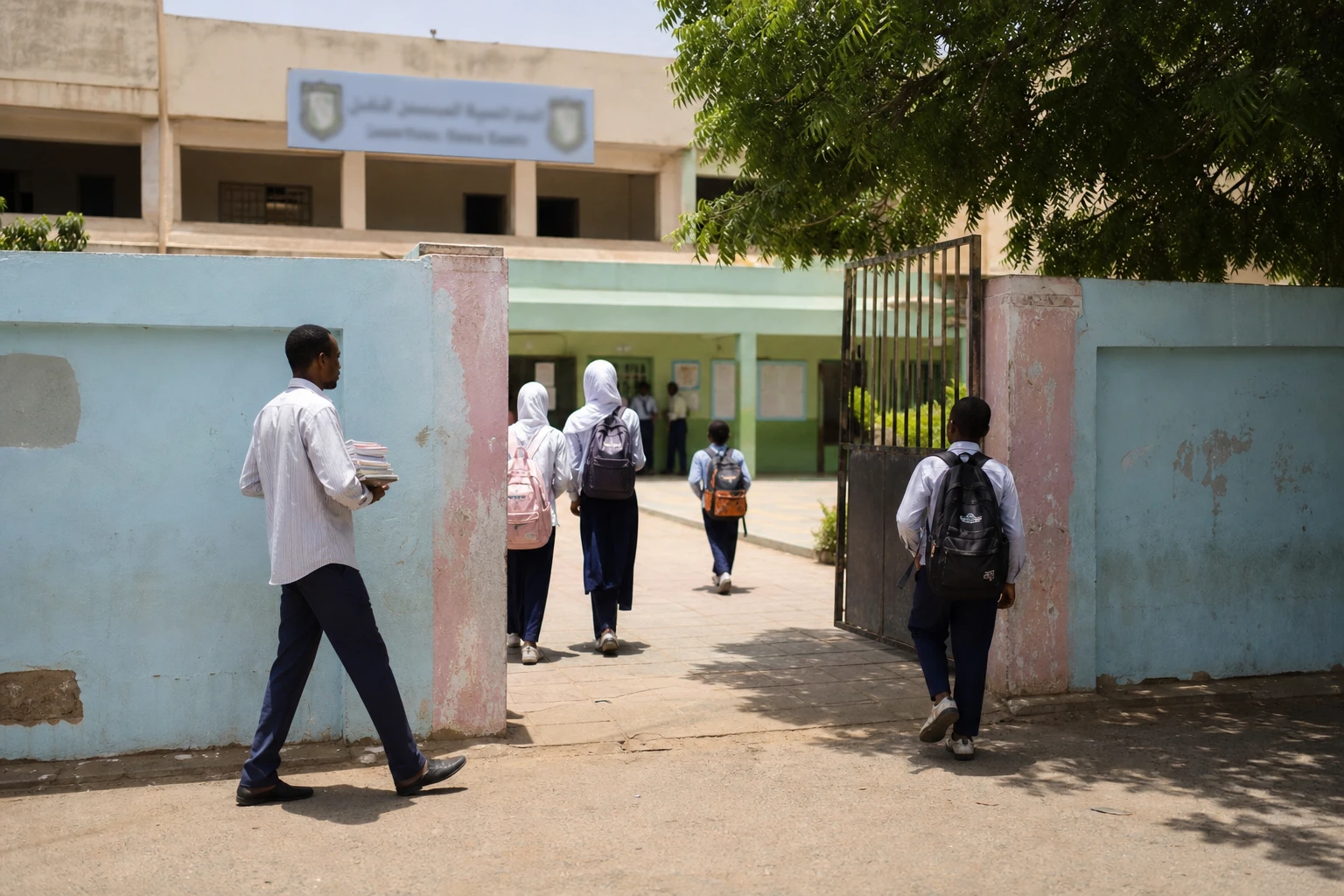
In a capital still scarred, reopening a school means far more than simply returning to class
In Khartoum, the start of the school year is no ordinary scene. It signals the return of a minimum level of public life in a city where war has shattered familiar routines, displaced families and weakened essential services. For many Sudanese, sending a child to school is not simply about resuming lessons: it is an attempt to bring a period of survival to a close.
This return is part of a broader trend. Since 2026, some areas of Khartoum have seen a relative improvement in security, encouraging families to return and public services to resume. But Sudan remains embroiled in a war that has been raging since April 2023 between the Sudanese Armed Forces and the Rapid Support Forces, with massive effects on education, health and population displacement. The country also remains under regional scrutiny by IGAD, the East African organisation responsible for cooperation and mediation in the Horn of Africa.
Pupils are returning in Khartoum, but the school system is recovering slowly
Schools in Khartoum reopened gradually during the winter of 2026 after a long interruption caused by the conflict. The educational authorities in Khartoum State said that about 280 schools in the capital had been damaged or destroyed during the fighting. Meanwhile, the classrooms still standing have to accommodate more pupils, with limited materials and incomplete teaching staff.
The figures show the scale of the shock. In May 2026, UNICEF estimated that more than 8 million children remained out of school in Sudan, despite efforts to resume education in some areas. The organisation also said that the country had 9,139,309 internally displaced people at the same time. In other words, Khartoum’s return to school concerns more than just the capital: it affects a country where mass displacement has disrupted children’s education for years.
In schools that are reopening, the challenge is not only material. Teachers and school administrators describe children being absent because they have been displaced, or because their families have found refuge in South Sudan, Chad, Egypt or elsewhere. Other pupils have returned, but with significant gaps in their learning after months or years without regular education. The challenge, then, is not just to open doors, but to re-establish continuity in learning.
The real cost of reopening: money, infrastructure and mental health
For families who have returned to Khartoum, the start of the school year comes at a cost. Transport, uniforms, exercise books and school supplies all add to expenses at a time when many households have already lost income, housing or jobs. In an economy weakened by war, school once again becomes a daily trade-off. Between feeding the family, getting around and paying school costs, the burden of returning to class falls first on the most vulnerable households.
The challenge also extends beyond school walls. Some facilities are still being used as shelters for displaced people, or were occupied during the conflict, contributing to the collapse of the urban education system. Elsewhere in the country, UNICEF says school buildings have been looted, damaged or repurposed as reception centres, a sign that war turned schools into places of survival before they could become places of learning again.
There is also the often-invisible issue of trauma. Teachers say they have to support pupils psychologically as well as academically. This is central in Sudan, where the war has exposed millions of children to fear, the loss of loved ones, repeated displacement and instability. Without psychosocial support, efforts to help pupils catch up risk remaining incomplete, even when buildings reopen.
What the return to school says about the balance of power in Sudan
The resumption of classes in Khartoum sends a political as well as a social signal. It shows that the authorities are seeking to restore state functions in the capital, even as other parts of the country remain exposed to fighting, drone raids and repeated displacement. In this context, reopening schools amounts to testing the institutions’ ability to return to areas where the war had driven them out.
The reopening also exposes a regional imbalance. Khartoum has seen a relative improvement in some neighbourhoods, while areas of Darfur and Kordofan remain among those hardest hit by the education crisis. UNICEF points this out: the most serious disruptions are concentrated in these regions, meaning the capital can reopen sooner than the rest of the country without the crisis being truly resolved.
For parents, returning to school embodies a practical hope: protecting children from enforced idleness, rebuilding routines and preventing an entire generation from permanently losing what they have learned. For teachers, it is a restart under pressure, with full classrooms, salaries under strain in several areas and limited resources. For pupils, finally, it often means learning to live together again after months of separation, fear and displacement.
A Sudanese issue, but also an African one
The situation in Sudan resonates far beyond Khartoum. In the Horn of Africa and around the Red Sea, the war is disrupting mobility, humanitarian flows and the educational paths of thousands of children. Neighbouring countries are taking in some of the displaced people and refugees, while IGAD and the African Union are seeking to maintain a political framework for dialogue, without which the reconstruction of education will remain hostage to security.
The continental significance is clear: in Sudan, schools reflect the country’s true condition. When a capital can resume classes, it signals a local lull in the fighting. But when more than 8 million children remain out of school and buildings are still being used as shelters, the recovery remains incomplete. The next test will be sustaining it: reopening schools, bringing teachers back, financing repairs and finding ways to return displaced children to a continuous course of education.