Algeria
 Egypt
 Libya
 Morocco
 Sudan
 Tunisia
 Benin
 Burkina Faso
 Cabo Verde
 Côte d'Ivoire
 Ghana
 Guinea
 Guinea-Bissau
 Liberia
 Mali
 Mauritania
 Niger
 Nigeria
 Senegal
 Sierra Leone
 The Gambia
 Togo
 Cameroon
 Central African Republic
 Chad
 DR Congo
 Equatorial Guinea
 Gabon
 Republic of the Congo
 São Tomé and Príncipe
 Burundi
 Comoros
 Djibouti
 Eritrea
 Ethiopia
 Madagascar
 Malawi
 Mauritius
 Mozambique
 Rwanda
 Seychelles
 Somalia
 South Sudan
 Tanzania
 Uganda
 Angola
 Botswana
 Eswatini
 Lesotho
 Namibia
 South Africa
 Zambia
 Zimbabwe
When technology meets the classroom
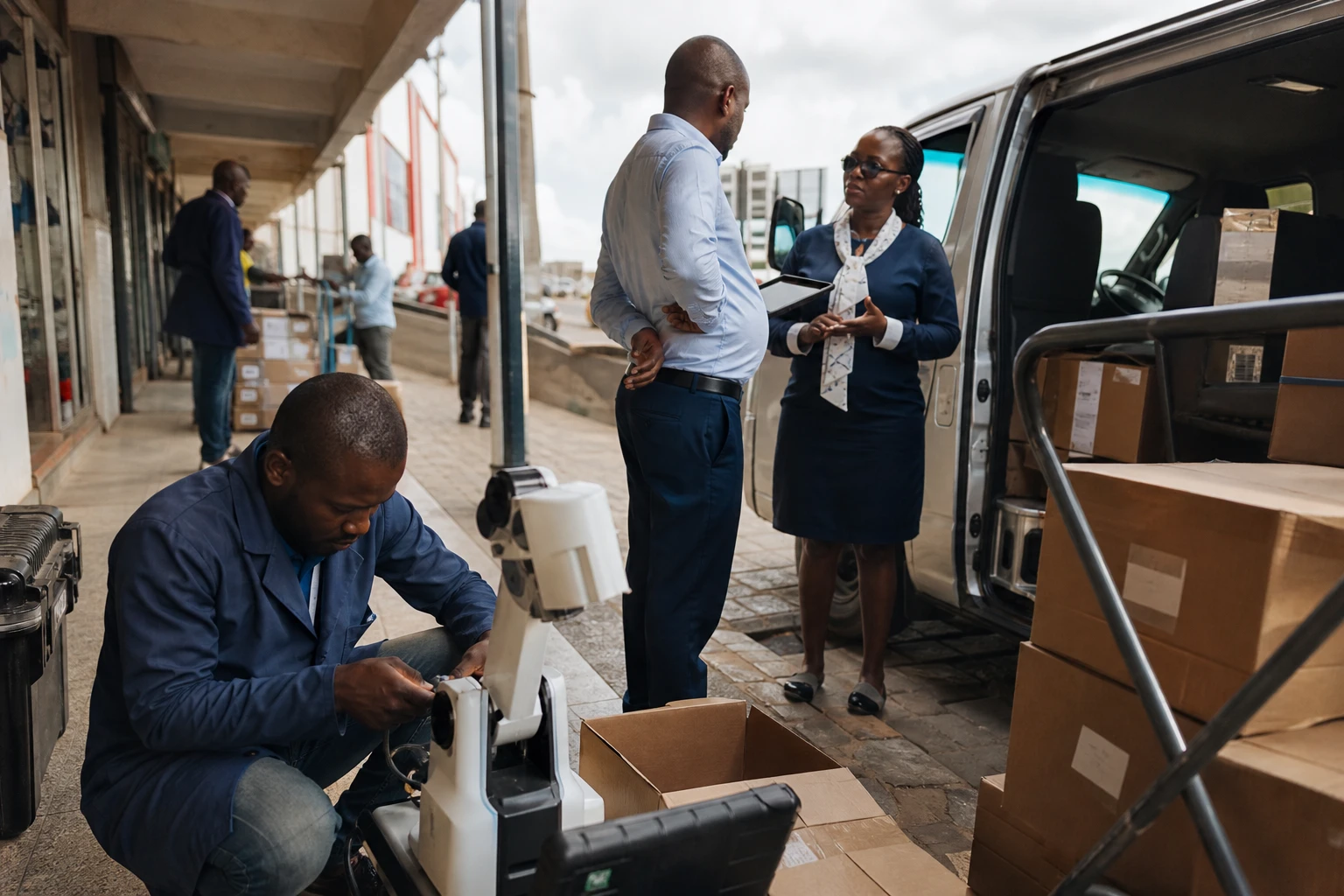
In Nairobi, a robotic hand is not seeking to replace the teacher. Instead, it is trying to make the teacher’s voice visible. In a classroom for deaf pupils, the idea seems simple. In reality, it touches on a profound problem: how can pupils learn science, mathematics or technology when school vocabulary is still lacking in sign language?
This is a very tangible question in Kenya, where education policy recognises the right of learners with disabilities to inclusive schooling, while maintaining the role of special schools and dedicated units. The Ministry of Education also calls for sign language to be developed at every level, teachers to be trained in it and interpreters to be provided in schools. In other words, the issue is not merely technical. It is institutional, educational and social.
A Kenyan robot fills a very human gap
Nairobi-based start-up Zerobionic has developed a device that can convert a teacher’s speech into sign-language gestures in real time. The company, co-founded by young Kenyan engineer Norah Kimathi, first unveiled a mechanical hand before expanding its system into a more complete robot. Specialist inclusive-innovation sources describe the project as a tool designed for STEM lessons, covering science, technology, engineering and mathematics.
During a demonstration at Kasarani Treeside Secondary School for the Deaf in Nairobi, the device reproduced hand movements, greetings and fingerspelling. The system also works in the other direction: a built-in screen allows a pupil to ask a question in sign language, and the machine then delivers the answer to the teacher in spoken form. The school itself says on its website that it is an important specialist institution in the Kenyan capital.
The device is already said to have been deployed in 78 schools in Kenya. Specialist inclusive-innovation sources also cite a claimed 92% accuracy rate for offline translation. Such a figure should be treated with caution, as it is a performance claim made by the company. But the scale of the deployment already shows one thing: the project has left the laboratory and entered real classrooms.
The real challenge is vocabulary, not just translation
The heart of the problem is not simply recognising a voice. In many subjects, technical signs do not always exist, or are not standardised. In physics, for example, some concepts remain difficult to explain when the language of instruction lacks a sufficiently rich vocabulary. Research on Kenyan Sign Language has long shown that school vocabulary develops unevenly and that practices vary between regions and schools.
Zerobionic says it is also building a database of specialist signs. Deaf teachers record new gestures using a robotic suit. The company brings together resources from British, American and Kenyan sign languages. This work highlights a broader reality: the absence of a standardised African sign-language database makes it harder to produce shared educational tools across the continent. This is a linguistic limitation, but also an issue of educational sovereignty.
The need is all the more pressing because, according to the Kenya Society for Deaf Children, the country has about 300,000 school-age children with hearing disabilities, but only around 20,000 were in school in 2024. Kenya News Agency has reported the same order of magnitude, linking it to 141 schools specifically for deaf pupils. These figures have an old source, but they remain useful for measuring the gap between need and educational provision.
For families, this gap comes at a direct cost. In major cities such as Nairobi, some resources are available, but they remain scarce and unevenly distributed. In rural areas, access to a trained teacher, an interpreter or suitable equipment becomes even more difficult. The robot does not erase these disparities. It simply makes them more visible.
What this innovation says about Kenya and the region
Kenya is moving forward in a regional environment where inclusive education is gaining ground in policy documents, but remains difficult to implement in practice. In August 2026, East Africa held its second regional education conference in Nairobi, with an explicit focus on inclusion, digitalisation and foundational learning. The East African Community also called for better harmonisation of education data and policies among its member states, including Kenya.
In this context, Zerobionic’s experience goes beyond a technological curiosity. It raises a fundamental question: how can African educational tools be built for African needs, rather than importing solutions designed elsewhere? The use of recycled materials and 3D printers in Nairobi shows that useful innovation can also be frugal. This matters in a country where specialist school equipment is expensive and financial sustainability remains central.
Finally, this project should be viewed on a continental scale. In several African countries, the issue is not only hearing disability. It is also the language of instruction, the lack of suitable tools and the place given to locally produced knowledge. If the Kenyan experience takes root, it could support wider use in the East African Community and beyond, where education systems are still seeking to reconcile inclusion, quality and cost control.
For now, its most tangible impact is elsewhere: in a Nairobi classroom, where technology born in a Kenyan laboratory is trying to do what schools have long promised deaf pupils — to let them learn without being left behind.