Algeria
 Egypt
 Libya
 Morocco
 Sudan
 Tunisia
 Benin
 Burkina Faso
 Cabo Verde
 Côte d'Ivoire
 Ghana
 Guinea
 Guinea-Bissau
 Liberia
 Mali
 Mauritania
 Niger
 Nigeria
 Senegal
 Sierra Leone
 The Gambia
 Togo
 Cameroon
 Central African Republic
 Chad
 DR Congo
 Equatorial Guinea
 Gabon
 Republic of the Congo
 São Tomé and Príncipe
 Burundi
 Comoros
 Djibouti
 Eritrea
 Ethiopia
 Madagascar
 Malawi
 Mauritius
 Mozambique
 Rwanda
 Seychelles
 Somalia
 South Sudan
 Tanzania
 Uganda
 Angola
 Botswana
 Eswatini
 Lesotho
 Namibia
 South Africa
 Zambia
 Zimbabwe
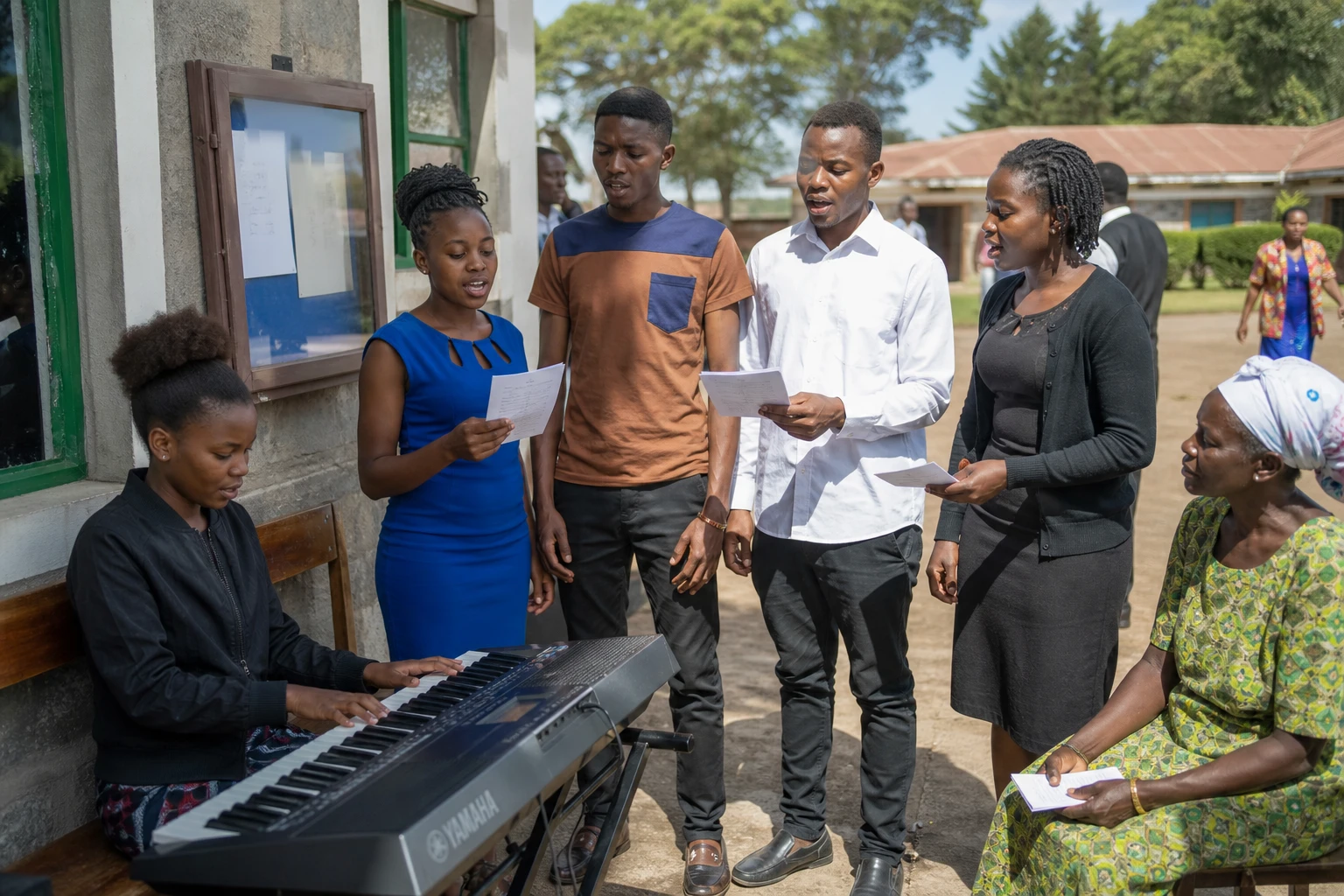
In Cheptulu, western Kenya, silence has not disappeared from Quaker meetings. It now shares the space with keyboards, rhythmic songs, applause and dancing. For religious leaders, this change addresses a practical question: how can they remain a living community for young people accustomed to more participatory celebrations?
A global tradition, a Kenyan expression
The Quakers, officially known as the Religious Society of Friends, originated in England in the 17th century. Some of their meetings practise what is known as “ unprogrammed ” worship. Members gather in silence and speak when they feel moved to bear witness. No sermon, song or order of service is necessarily planned in advance.
Kenya has developed a different expression of Quakerism. In 1902, American missionaries Arthur Chilson, Edgar Hole and Willis Hotchkiss settled in Kaimosi, in what is now Vihiga County. Their mission combined evangelism, education and vocational training. The first school opened the following year, followed by other institutions, a hospital and training centres.
This history explains the Quakers’ particular place in Kenyan society. Their network remains especially dense in the west of the country, where Friends institutions have helped train teachers, religious leaders and health professionals. The history of Kaimosi is documented in several historical studies and in the archives held at Friends Theological College.
Kenya’s Quaker community is now among the largest in the world. The Friends Church in Kenya, which brings together the country’s congregations, claims 23 “ yearly meetings ”, or regional coordinating bodies, as well as nearly 1 839 local congregations. It estimates its membership at about 146 000, a figure that differs from broader global estimates depending on the counting methods used.
In Cheptulu, music becomes a pastoral concern
In several churches in western Kenya, worship is now “ programmed ”. Services include Bible readings, a sermon, hymns and an address by a pastor. This format departs from the silent model still practised by some Quaker meetings in Europe and North America.
In Cheptulu, the change is most noticeable in the music. Services feature keyboards, faster songs and more visible collective participation. This approach is not simply an aesthetic choice. It responds to competition from the many evangelical, Pentecostal and independent churches that attract young people with choirs, music groups and highly interactive celebrations.
Catherine Ikalakala, a Quaker for nearly half a century, says several young people had stopped attending services. They found traditional celebrations too slow, while other religious communities offered more energetic music. For this generation, the form of worship directly affects how they experience religious belonging.
Pastor Kennedy Shiverenje therefore argues for adapting to the social context. His reasoning is simple: a religious institution cannot ignore the cultural habits of its time if it wants to pass on its message. In congregations where young people take part in singing and leading services, they are no longer just spectators. They also become participants in community life.
Modernisation divides generations
The change is not universally welcomed, however. For older members, Quaker identity remains associated with restraint, contemplation and the simplicity of early services. Thomas Amalemba, 90, a former employee of the Friends Africa Mission, says he feels uneasy about some contemporary celebrations.
This reserve does not necessarily mean rejecting young people. Rather, it reflects a fear that a religious memory built over several generations may disappear. In western Kenya, old songs, accounts of the first converts and liturgical practices form part of the local heritage. Abandoning them could weaken the connection between current members and the history of their communities.
The debate therefore goes beyond the question of instruments. It concerns the very definition of continuity. For some leaders, remaining faithful to the Quaker heritage means preserving values such as peace, collective responsibility and inner listening. For others, it also means allowing Kenyan communities to create their own forms of expression.
Preserving archives to navigate change
In Kaimosi, this reflection goes hand in hand with conservation work. The Africa Quaker Archive project brings together institutional documents, oral testimonies and life stories dating back to the arrival of Quakers in East Africa. Its aim is to pass on a history that does not rely solely on archives produced by missionaries.
This initiative gives African voices a central place. It makes it possible to document the role of teachers, local leaders, families and communities that adapted Quakerism to Kenya’s realities. It also serves as a reminder that the country’s religious history cannot be reduced to the arrival of foreign missionaries. It was shaped by exchanges, adaptations and decisions made by Kenyans.
Friends Theological College, based in Kaimosi, contributes to this work by training religious leaders for Kenya and several East African countries. The Kaimosi site also brings together schools and higher education institutions, extending the educational role played by the Quakers since the beginning of the 20th century.
An issue that reaches beyond Kenya’s borders
The debate over music reflects a broader transformation of Christianity in East Africa. Churches must contend with a young population, rapid urbanisation and the constant circulation of religious styles through the media and social networks. Expectations differ between Nairobi, western towns and rural areas. A solution that works for Cheptulu cannot therefore be applied uniformly across the country.
Kenya also holds an important place in regional Quaker networks. From Kaimosi, leaders and trainers have contributed to the development of Friends communities in Uganda, Tanzania, Rwanda, Burundi and the Democratic Republic of the Congo. This influence gives decisions made in Kenyan congregations an impact beyond Sunday worship alone.
The question now facing Kenya’s Quakers is one of balance. They must attract a new generation without turning their heritage into mere scenery. They must preserve the voices of older members without closing the door to the cultural forms chosen by young people. In Cheptulu, this negotiation plays out at every service, between the silence of historic meetings and the rhythms of a community seeking to root its future in the present.