Algeria
 Egypt
 Libya
 Morocco
 Sudan
 Tunisia
 Benin
 Burkina Faso
 Cabo Verde
 Côte d'Ivoire
 Ghana
 Guinea
 Guinea-Bissau
 Liberia
 Mali
 Mauritania
 Niger
 Nigeria
 Senegal
 Sierra Leone
 The Gambia
 Togo
 Cameroon
 Central African Republic
 Chad
 DR Congo
 Equatorial Guinea
 Gabon
 Republic of the Congo
 São Tomé and Príncipe
 Burundi
 Comoros
 Djibouti
 Eritrea
 Ethiopia
 Madagascar
 Malawi
 Mauritius
 Mozambique
 Rwanda
 Seychelles
 Somalia
 South Sudan
 Tanzania
 Uganda
 Angola
 Botswana
 Eswatini
 Lesotho
 Namibia
 South Africa
 Zambia
 Zimbabwe
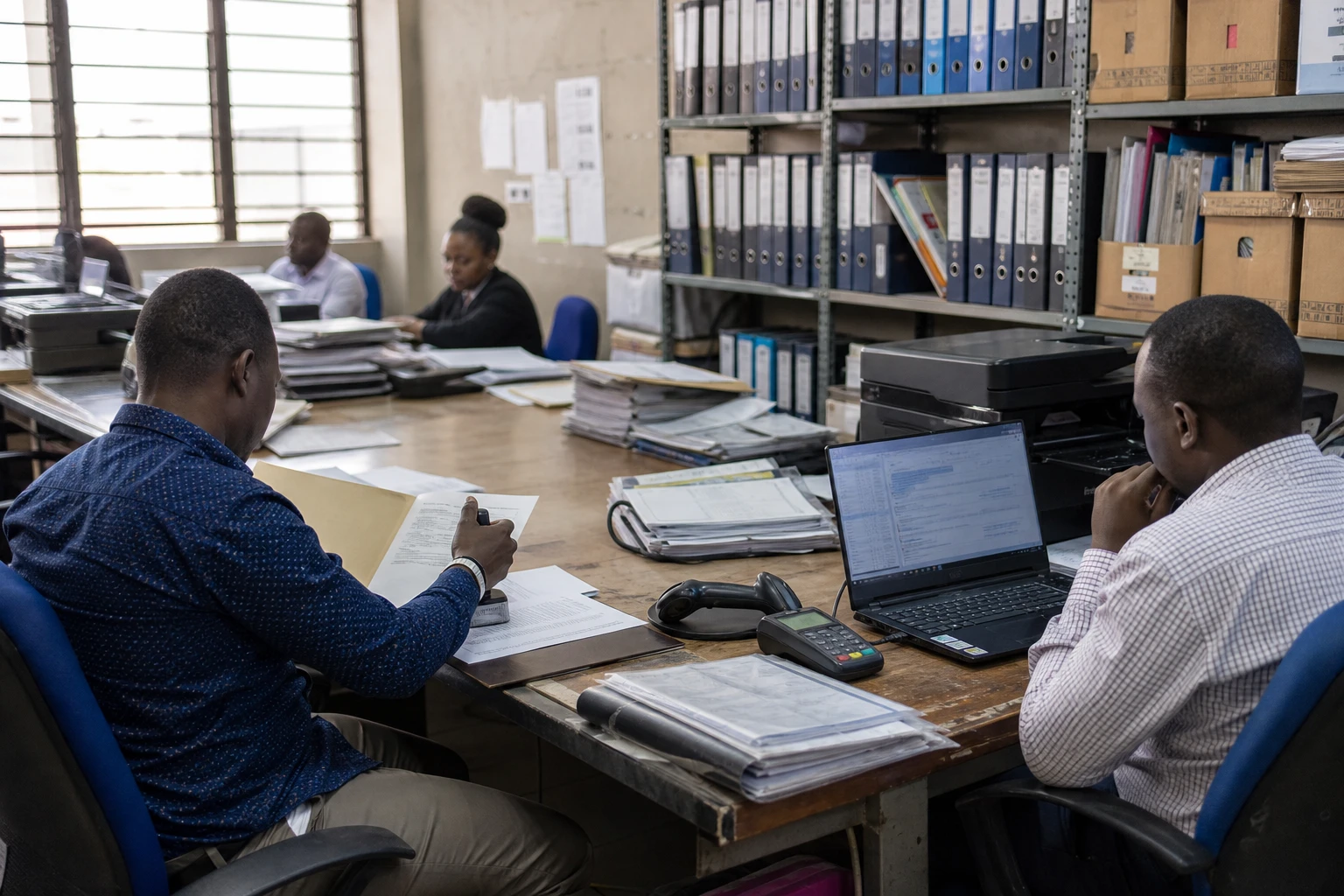
Tax invoices become compulsory for payment by the state
In Kenya, public suppliers will no longer be able to treat invoices as a mere administrative formality. The document’s tax validity will now count as much as the delivery of goods or provision of a service. The change directly affects companies working with the Kenyan administration, from Nairobi to the counties, where cash flow often depends on the pace of public payments.
The aim is clear: to reduce discrepancies between what companies declare for tax and what the state actually pays its suppliers. In a system where public spending, invoicing and tax collection were previously more separate, Kenya is tightening the digital links in its financial chain. The country has already undertaken several reforms of this kind, including eTIMS for electronic tax invoices and IFMIS for public financial management.
What the eTIMS-IFMIS connection changes
On 31 August 2026, the Kenya Revenue Authority, in collaboration with the National Treasury, announced the launch of the connection between the Electronic Tax Invoice Management System, or eTIMS, and the Integrated Financial Management Information System, known as IFMIS. The KRA says the integration is intended to strengthen transparency, traceability and accountability in public transactions.
In practice, companies supplying goods or services to the state will have to generate a valid eTIMS invoice before submitting any payment request through IFMIS. The information on the invoice must match what is recorded in the tax system. The KRA describes the mechanism as an automatic invoice validation process designed to limit inconsistencies between documents submitted to the administration and data held by the tax authority.
The principle is not new. The National Treasury notes that IFMIS is the system used by the Kenyan government to manage public finances at both national and county level, across all 47 counties, and that it has already been connected to some supplier validation services. What is new here is the closer link between tax invoices and public payments, putting compliance at the centre of the budget process.
The measure therefore affects both large companies and SMEs that depend on public contracts. The former will need to synchronise their internal accounting systems with eTIMS. For the latter, which often have fewer resources, the burden of adapting may be greater. The KRA has nevertheless said it will support the transition with awareness sessions and technical assistance.
A tax reform serving a budget under pressure
Kenya has been pushing to digitise its public finances for several years. The strategy responds to a straightforward constraint: domestic revenue remains the backbone of the budget amid heavy pressure on public accounts. The KRA said it collected 2.572 trillion Kenyan shillings in the 2024/2025 financial year, and is targeting 2.968 trillion for 2025/2026. In March 2026, it said it had already passed the 2 trillion shilling mark in the first nine months of the 2025/2026 financial year.
In this context, eTIMS-IFMIS integration is a control tool as well as a lever for budgetary discipline. The state wants to reduce irregular invoices, better link spending and revenue collection, and make it harder for public suppliers to conceal turnover. For the tax administration, the potential gains go beyond revenue collection: they also include better data quality, greater audit capacity and faster verification.
This approach is part of a broader sequence of reforms. The Kenyan Treasury has begun rolling out e-GP, the electronic public procurement platform, with the aim of making digital tenders standard across all 47 counties. Kenya News Agency reported in early September 2026 that 31 counties had already been approved for budget integration into the e-GP system. The government’s message is therefore consistent: bring procurement, invoicing and payment flows together in a single digital environment.
What the decision says about Kenya, and beyond
For the Kenyan authorities, the goal is as much political as fiscal. In an East African country that is a member of the East African Community, the credibility of public financial management increasingly depends on the ability to track every shilling. This direction reflects a wider continental trend: several African administrations are now using digital data to limit losses, modernise public procurement and reduce payment delays.
But the change will not affect everyone equally. Large operators able to automate their invoicing will absorb the reform more quickly. Small businesses, meanwhile, will have to invest in technical adjustments, update their tax identifiers and maintain rigorous documentation. In the counties, where budget execution is often more fragile than at central level, the reform could improve discipline but also temporarily slow some payments if the data do not match.
The expected benefit is nevertheless significant: fewer fictitious invoices, fewer discrepancies between tax records and spending, and greater visibility for public auditors. The risk lies in implementation. As with many digital reforms, everything will depend on data quality, supplier training and administrations’ ability to process blocked cases quickly. Kenya is testing a form of integrated financial governance that could inspire other African states if implementation matches the stated ambition.