Algeria
 Egypt
 Libya
 Morocco
 Sudan
 Tunisia
 Benin
 Burkina Faso
 Cabo Verde
 Côte d'Ivoire
 Ghana
 Guinea
 Guinea-Bissau
 Liberia
 Mali
 Mauritania
 Niger
 Nigeria
 Senegal
 Sierra Leone
 The Gambia
 Togo
 Cameroon
 Central African Republic
 Chad
 Equatorial Guinea
 Gabon
 Republic of the Congo
 São Tomé and Príncipe
 Burundi
 Comoros
 Djibouti
 Eritrea
 Ethiopia
 Kenya
 Madagascar
 Malawi
 Mauritius
 Mozambique
 Rwanda
 Seychelles
 Somalia
 South Sudan
 Tanzania
 Uganda
 Angola
 Botswana
 Eswatini
 Lesotho
 Namibia
 South Africa
 Zambia
 Zimbabwe
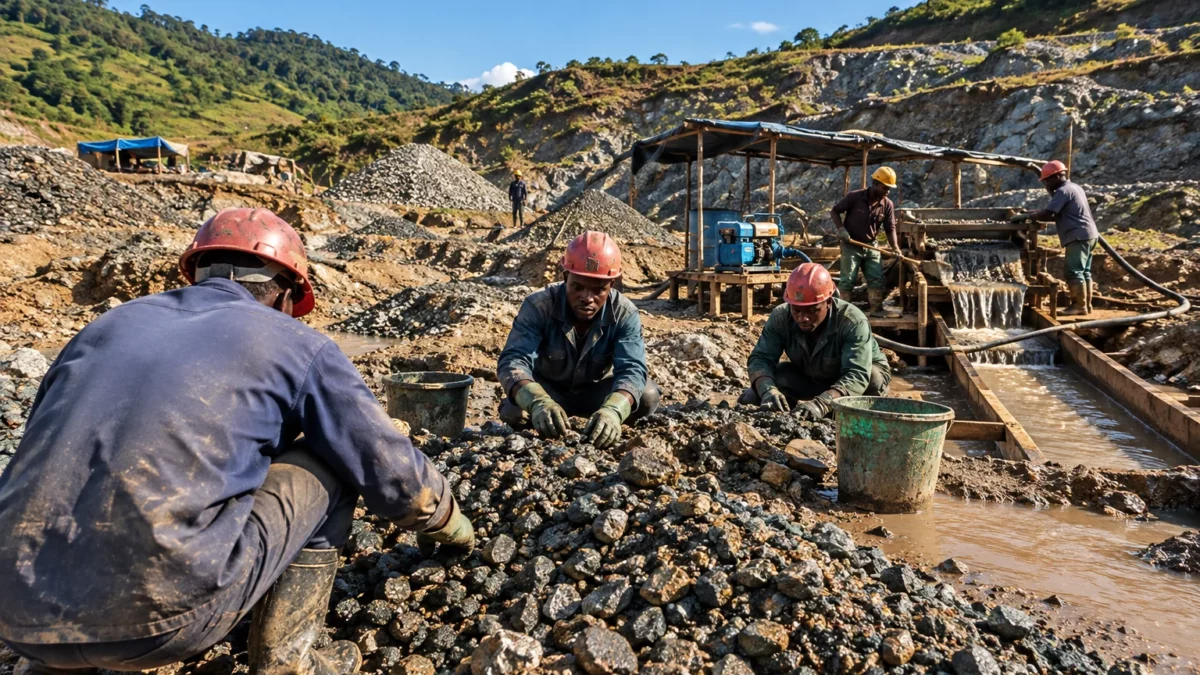
In Walikale, North Kivu, a first small-scale tin production is testing a project still far from becoming an industrial mine. For the Democratic Republic of the Congo (DRC), the stakes go beyond the volume extracted: the challenge is to turn a local resource into a sustainable activity, as foreign buyers seek to secure their supplies.
A project at the pilot stage in eastern Congo
Walikale territory lies in a mineral-rich region marked by insecurity and logistical difficulties. Bisie North, Rome Resources’ project, is located near the Bisie mine, operated by Alphamin Resources. The latter is already a major tin producer. The two projects should not, however, be confused: their geographical proximity implies neither common ownership nor any announced partnership.
This distinction matters in a region where resource extraction is intertwined with security, control of sites and the movement of minerals. In 2025, the Southern African Development Community (SADC), a regional organisation in southern Africa, ended the mandate of its military mission in eastern DRC and began its withdrawal. Developments around mining sites therefore remain linked to a sensitive local context, although the available information does not establish any direct effect of the security situation on Rome Resources’ trial.
The Congolese mining sector is also governed by rules on the allocation and conversion of permits. The Mining Code provides that a small-scale mining permit may be converted into a mining permit when technical conditions justify it. This procedure does not, by itself, guarantee the project’s profitability: it opens a different legal framework, while financing, studies, infrastructure and security remain decisive.
Two tonnes of concentrate, not yet commercial production
On 16 November 2026, Rome Resources announced that it had obtained about two tonnes of concentrate from the Kalayi deposit. The product has a tin grade of about 58.5%, according to data provided by the company and cited in mining reports. The ore was extracted near the surface, then sorted, crushed and washed. The trial did not require a complex processing circuit.
The concentrate is to be sold to a local facility in Walikale, according to the company’s announcement. This first production is intended, among other things, to test methods for extracting and preparing the ore. It is also part of the regulatory process required to convert the current small-scale mining permit. At this stage, it proves neither that the project can produce on a large scale nor that an industrial buyer has committed to future volumes.
Rome Resources estimates Kalayi’s inferred resources at 460,000 tonnes of ore grading an average of 1.47% tin, equivalent to about 6,760 tonnes of contained metal. An “inferred” resource is a geological estimate with limited confidence, based on data that must be strengthened. The Bisie North project also includes Mont Agoma, a polymetallic deposit where the company has reported 3.16 million tonnes of inferred resources containing copper, zinc, tin and silver.
The company says it is continuing discussions with potential strategic partners. It has, however, announced no US supply agreement for Bisie North. The next steps to watch are therefore permit conversion, the results of exploration work and the ability to finance a larger-scale development. The road from an estimated resource to commercial production remains long.
Bisie already has a US buyer
The commercial context is shaped by a separate agreement concerning the neighbouring Bisie mine. On 9 November 2026, Alphamin announced that it would reserve up to 3,600 tonnes of contained tin a year for two years for Nathan Trotter, a US refiner. The agreement concerns Bisie concentrate, not Rome Resources’ output. Alphamin and the International Tin Association have also issued statements about the allocation.
The metal is to supply a new processing facility that Nathan Trotter is building in the United States. The company is targeting first production in 2027, according to information published by Alphamin. Tin is used, among other things, in electronic solder and some industrial equipment. The agreement thus links a mine in eastern Congo to a US processing project, but its terms should not be extrapolated to the neighbouring Kalayi project.
For Alphamin, the sale helps diversify outlets for its production. For the United States, it provides an overseas source of supply for future domestic refining capacity. For the DRC, the goal is to turn resource extraction into local benefits and public revenue. Yet the mere fact that ore is sent to a new market does not demonstrate increased processing locally or an equitable benefit for the communities concerned.
The next stage will also be shaped on the ground
In Walikale, the effects of any development would depend on practical factors: jobs, purchases from local suppliers, access to infrastructure and revenue actually collected. Information published on the Kalayi trial does not yet detail these benefits. Nor does it allow the operation’s impact on workers or neighbouring communities to be assessed. These issues will remain essential if the project moves from a trial to more sustained mining.
The regional implications also bear watching. The Alphamin-Nathan Trotter agreement shows that Central African producers can supply processing plants located outside the continent. But it does not, on its own, indicate how much value will remain in the DRC. In Kinshasa, as in the mining provinces, debate also centres on permits, oversight and economic benefits, while communities in the east experience the direct consequences of activity and local tensions.
Kalayi’s first production is therefore a technical and regulatory milestone, not yet an industrial turning point. The project will have to show that its resources can support viable mining, secure the necessary authorisations and attract partners without confusing them with the agreement already reached for Bisie. This distinction between geological potential, actual production and economic transformation will determine Bisie North’s place in the tin supply chain.
Kalayi’s production data and the announced resources were published by Rome Resources and cited by several specialist media outlets. The Bisie agreement is confirmed by Alphamin and the International Tin Association. The resources remain company estimates, while the commercial agreement applies only to Alphamin’s mine.