Algeria
 Egypt
 Libya
 Morocco
 Sudan
 Tunisia
 Burkina Faso
 Cabo Verde
 Côte d'Ivoire
 Ghana
 Guinea
 Guinea-Bissau
 Liberia
 Mali
 Mauritania
 Niger
 Nigeria
 Senegal
 Sierra Leone
 The Gambia
 Togo
 Cameroon
 Central African Republic
 Chad
 DR Congo
 Equatorial Guinea
 Gabon
 Republic of the Congo
 São Tomé and Príncipe
 Burundi
 Comoros
 Djibouti
 Eritrea
 Ethiopia
 Kenya
 Madagascar
 Malawi
 Mauritius
 Mozambique
 Rwanda
 Seychelles
 Somalia
 South Sudan
 Tanzania
 Uganda
 Angola
 Botswana
 Eswatini
 Lesotho
 Namibia
 South Africa
 Zambia
 Zimbabwe
When balance sheets speak louder than slogans
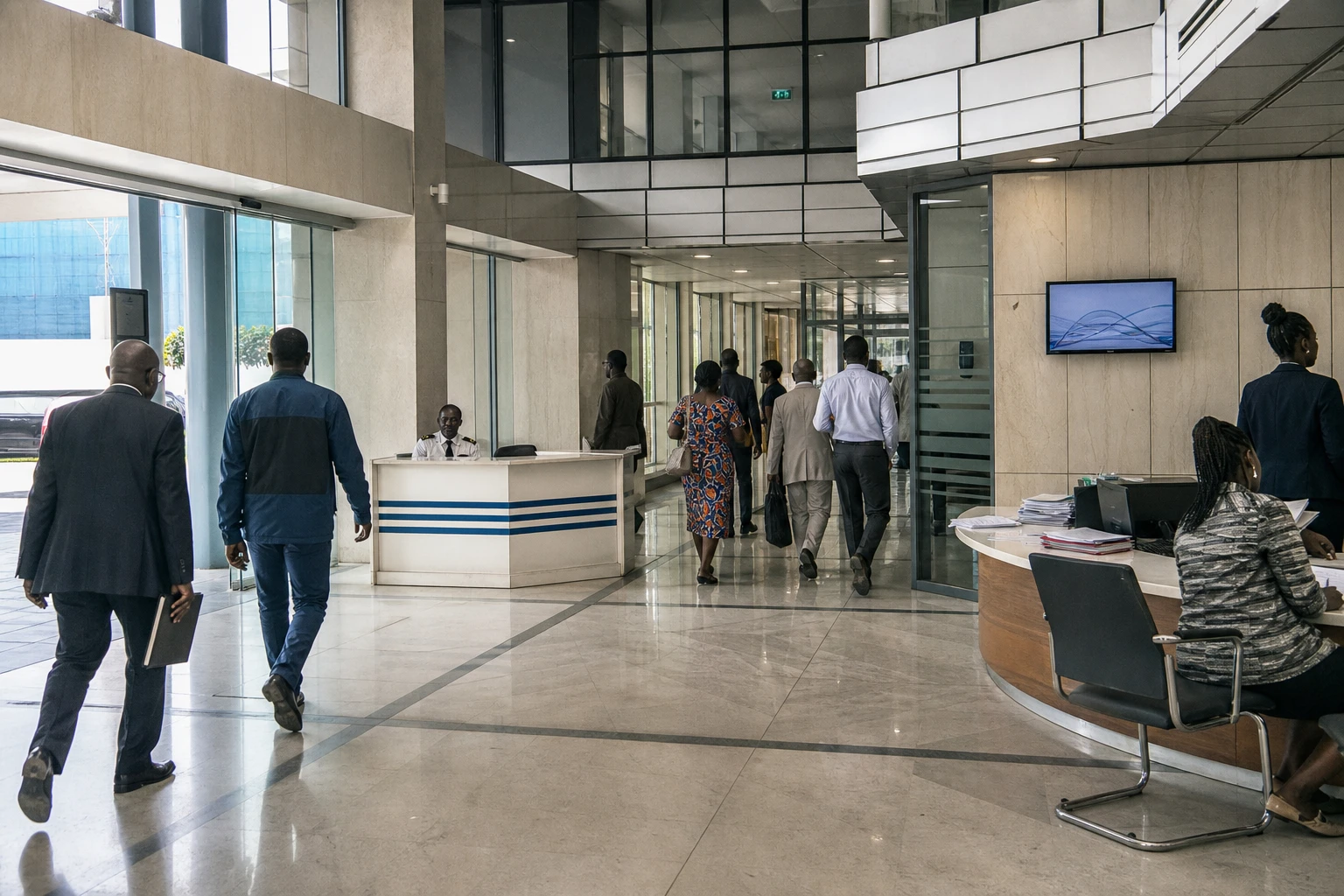
In Abidjan, the banking battle is rarely fought through speeches. It is better read in balance sheets, branch networks and the capacity to finance the real economy. In 2025, the hierarchy of the UMOA’s major banks shifted again, but one trend remains unchanged: Côte d’Ivoire is still the centre of gravity of the regional market.
This matters beyond the financial sector alone. In a common monetary union, the UMOA — the West African Monetary Union — the largest banks influence credit, savings, trade and, at times, the pace at which businesses grow. The BCEAO is headquartered in Dakar, but these rankings concern the entire region.
Top spot unchanged, Ivorian podium tightened
The 2025 annual report of the UMOA Banking Commission confirms the dominance of Société Générale Côte d’Ivoire, which remained first in the regional ranking by total assets, at 3 783,4 billion FCFA. The National Investment Bank (BNI) rose to second place with 3 210,3 billion FCFA. NSIA Banque Côte d’Ivoire fell to third, with 3 076,1 billion FCFA.
The top 10 has therefore changed shape. BNI moved up one place, while BIIC, the International Bank for Industry and Commerce of Benin, entered the ranking in eighth place. Meanwhile, Société Générale Sénégal dropped out of the top 10, as CBAO, Groupe Attijariwafa bank, took tenth place. The report lists 136 banks and 161 licensed credit institutions in the Union as at 31 December 2025.
| 2025 ranking | Bank | Total assets 2025 | Notable change |
|---|---|---|---|
| 1 | Société Générale Côte d’Ivoire | 3 783,4 billion FCFA | Remains at the top |
| 2 | BNI | 3 210,3 billion FCFA | Up 2 places |
| 3 | NSIA Banque Côte d’Ivoire | 3 076,1 billion FCFA | Down 1 place |
| 4 | Coris Bank International | 2 807,6 billion FCFA | Down 1 place |
| 8 | BIIC Benin | 1 886,8 billion FCFA | Entry into the top 10 |
The picture is clear: six of the UMOA’s ten largest banks are based in Côte d’Ivoire. Société Générale Côte d’Ivoire, BNI and NSIA Banque Côte d’Ivoire alone have combined total assets of 10 069,9 billion FCFA. The report adds that Côte d’Ivoire accounts for 37,9% of the Union’s banking system market share, far ahead of Senegal at 19,2%.
What the ranking says about Côte d’Ivoire’s standing
BNI’s rise is not just good news for an Ivorian public bank. It also reflects the growing strength of an institution attracting more resources and deposits and handling more financing operations. In a banking market, moving up the rankings is not a matter of prestige. It boosts visibility, makes it easier to raise funds and strengthens access to major public and private projects.
Côte d’Ivoire also benefits from a broader ecosystem. Its banking sector had 33 licensed credit institutions at the end of 2025, the same number as Senegal, but with a much greater weight of assets. The report also shows that the country has 8 263 326 bank accounts, 1 279 branches and 868 staff in credit institutions, making it the Union’s leading banking centre.
For Ivorian businesses, this market depth facilitates working-capital lending, foreign trade operations and investment financing. For households, it broadens access to accounts, cards and digital channels. But concentration also has a downside: as the top end of the market tightens around a handful of major players, mid-sized banks face tougher competition on margins.
The Banking Commission report also states that total assets of UMOA credit institutions reached 82 298,8 billion FCFA in 2025, up 14,1% year on year. Growth is therefore real at regional level. It is not, however, benefiting all countries equally. Côte d’Ivoire and Senegal continue to capture most of the value, while Niger and Guinea-Bissau remain at the bottom of the market-share table.
Regional perspective: a larger market, but still highly polarised
Across West Africa, this reshuffling is a reminder of a simple reality: the UMOA is not a uniform market. Major banks operate across several capitals, but most resources remain concentrated in a few hubs. The report distinguishes 70 sub-regional banks and 64 international banks, evidence of a system open to capital from both within and outside the region.
For ECOWAS, the momentum of Ivorian banking has practical significance. It supports cross-border trade, payments and supply chains linking Abidjan, Dakar, Lomé, Cotonou and Ouagadougou. It also raises a question of economic sovereignty: how can financing be expanded beyond the major centres without weakening the prudential soundness of banking groups?
What happens next will depend less on rankings than on the 2026 figures. It will be important to watch whether BNI can hold on to its new position, whether NSIA Banque Côte d’Ivoire can withstand the pressure, and whether new players enter a market where scale is increasingly important. In West Africa, banking hierarchies change quickly. But one thing stands out in 2025: Côte d’Ivoire is not following the regional trend; it is shaping it.