Algeria
 Egypt
 Libya
 Morocco
 Sudan
 Tunisia
 Benin
 Burkina Faso
 Cabo Verde
 Ghana
 Guinea
 Guinea-Bissau
 Liberia
 Mali
 Mauritania
 Niger
 Nigeria
 Senegal
 Sierra Leone
 The Gambia
 Togo
 Cameroon
 Central African Republic
 Chad
 DR Congo
 Equatorial Guinea
 Gabon
 Republic of the Congo
 São Tomé and Príncipe
 Burundi
 Comoros
 Djibouti
 Eritrea
 Ethiopia
 Kenya
 Madagascar
 Malawi
 Mauritius
 Mozambique
 Rwanda
 Seychelles
 Somalia
 South Sudan
 Tanzania
 Uganda
 Angola
 Botswana
 Eswatini
 Lesotho
 Namibia
 South Africa
 Zambia
 Zimbabwe
A paved road is more than a line on a map. For residents and businesses, it can cut journey times, improve access to markets and bring public services closer. But the announcement of a major road programme also raises an essential question: how will construction be funded, and how will the routes built be maintained over the long term?
A national network at the heart of West African trade
Côte d’Ivoire has a classified road network of more than 80,000 kilometres. However, estimates published by national sources are not entirely consistent: the ministry cites 9,000 kilometres of paved interurban roads, while the Ivorian economic portal lists around 9,200 kilometres of surfaced roads, including motorways. These figures cover different scopes or reference dates.
This infrastructure plays a role that extends beyond domestic travel. Côte d’Ivoire is a member of WAEMU, the West African Economic and Monetary Union, and ECOWAS, which brings together the countries of West Africa. Its road corridors link ports, production centres and landlocked countries in the hinterland. The condition of the roads therefore matters as much for regional trade as for the mobility of Ivorians.
Network development is part of a trajectory already marked by extensions and rehabilitation. Ivorian sector data report 400 kilometres of motorways and growth in the surfaced road network in recent years. However, building new roads alone does not meet the needs for maintenance, safety and local access.
Targets announced for 2030
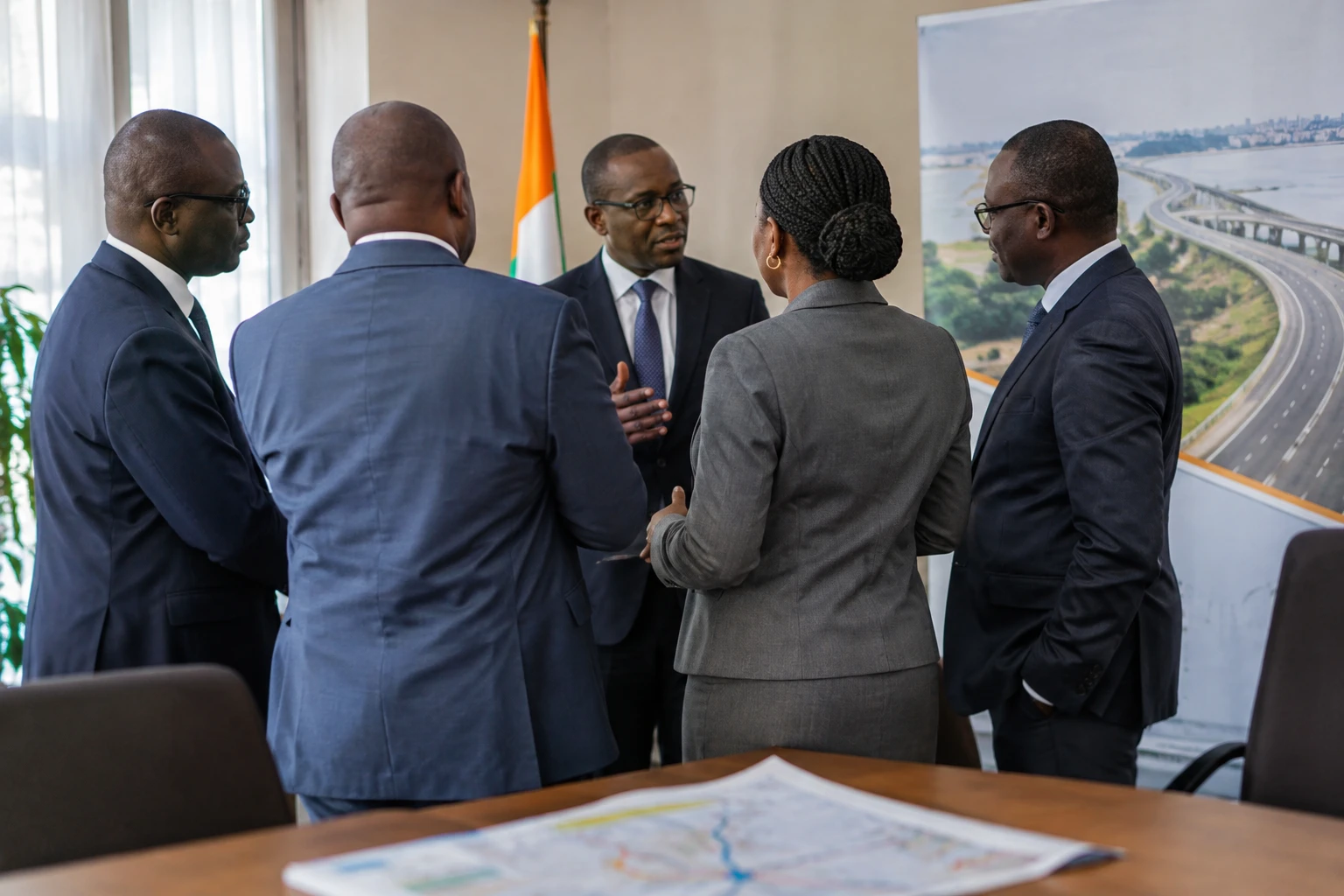
On Thursday 12 November 2026, in Abidjan-Plateau, the Minister for Infrastructure and Road Maintenance, Yacouba Hien Sié, presented the road targets of the 2026-2030 National Development Plan (NDP). During an online discussion organised by the Government Information and Communication Centre, he announced 3,000 kilometres of paved interurban roads and an additional 300 kilometres of motorways by 2030.
According to the minister, the paved interurban network would thus grow from 9,000 to 12,000 kilometres, while motorways would increase from 400 to 700 kilometres. He also said that three departmental capitals remain to be connected to the paved network: Séguélon, Transua and Sandégué. Once these links are in place, the government intends to consider connecting sub-prefectural capitals, taking their populations into account, among other factors.
The stated priorities also include connections between major cities, agricultural areas and industrial zones. The NDP identifies several road projects, including routes to Transua and Sandégué. These documents set out planning priorities; they do not mean that every project has already been funded, started or completed.
Access, funding and maintenance at stake
For communities still far from surfaced roads, improved access can make it easier to transport harvests and reach healthcare, schools and markets. For transport operators and businesses, better routes can reduce delays and logistics costs. The impact will nevertheless depend on the routes chosen, the condition of secondary roads and the regularity of connections, particularly outside major urban centres.
Costs and the distribution of benefits also warrant attention. Major routes can boost trade and formal economic activity, but small-scale producers and informal traders will benefit fully only if local roads effectively connect them to markets. Road safety, expropriation terms and access for people living alongside the roads are also issues to monitor as projects progress.
The 2026-2030 NDP sets out an overall budget of 114,838.5 billion CFA francs. The Presidency puts the plan’s overall public financing requirements at 38,000 billion. This financing requirement should be distinguished from total investment and not presented as an amount earmarked solely for roads. The authorities will need to specify the resources allocated to projects, their timelines and maintenance arrangements.
Published data on the condition of the network also indicate that some surfaced roads require particular attention: at the end of 2024, the Ivorian economic portal classified 25% of the network concerned as being in poor condition and 6% as under repair. The announced expansion will therefore need to go hand in hand with maintenance, or the benefits of improved access could quickly erode.
Regional impact to be measured over time
Ivorian roads are also links in West African corridors. The government has referred, in particular, to the first Ivorian section of the Abidjan-Lagos corridor, between Bingerville and Grand-Bassam. The project is a reminder that the continuity of trade depends on coordination between countries, not just on building a national road section.
For ECOWAS and WAEMU partners, the question will be whether the new routes strengthen cross-border links and genuinely improve the movement of goods. For Ivorians, the test will be more tangible: will the projects reduce practical distances between regions without relegating maintenance of existing roads to the background? The NDP sets out an ambition; its implementation and regional results remain to be seen.
The minister’s announcements and the plan’s data are available on the Ivorian government portal. Figures on the network and its condition are also available on the Côte d’Ivoire economic information portal, while the Presidency’s statement on the 2026-2030 NDP details its financial parameters.