Algeria
 Egypt
 Libya
 Morocco
 Sudan
 Tunisia
 Benin
 Burkina Faso
 Cabo Verde
 Ghana
 Guinea
 Guinea-Bissau
 Liberia
 Mali
 Mauritania
 Niger
 Nigeria
 Senegal
 Sierra Leone
 The Gambia
 Togo
 Cameroon
 Central African Republic
 Chad
 DR Congo
 Equatorial Guinea
 Gabon
 Republic of the Congo
 São Tomé and Príncipe
 Burundi
 Comoros
 Djibouti
 Eritrea
 Ethiopia
 Kenya
 Madagascar
 Malawi
 Mauritius
 Mozambique
 Rwanda
 Seychelles
 Somalia
 South Sudan
 Tanzania
 Uganda
 Angola
 Botswana
 Eswatini
 Lesotho
 Namibia
 South Africa
 Zambia
 Zimbabwe
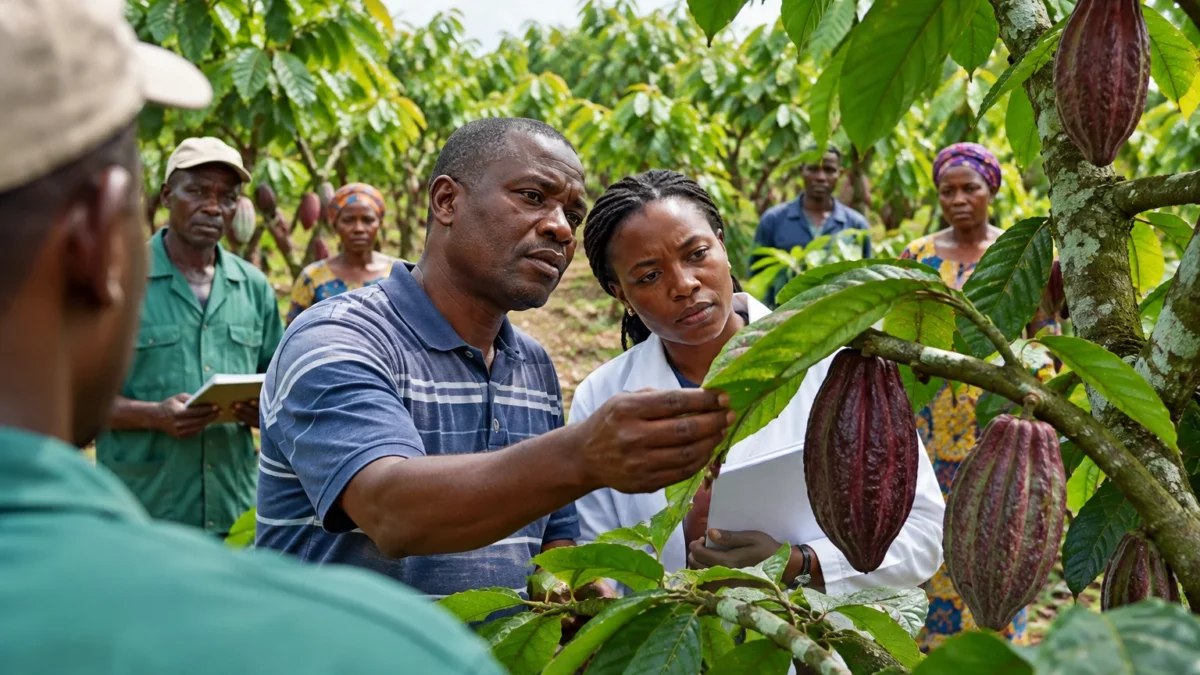
In Divo, the future of Ivorian cocoa and coffee will also be shaped in trial plots and laboratories. Côte d’Ivoire is preparing a specialised institute to address ageing plantations, disease and climate disruption.
A new stage for agricultural research in Divo
The project will build on the research station of the National Centre for Agronomic Research (CNRA), which already has experimental plots and genetic resources. The Council of Ministers approved the principle of creating the Coffee and Cocoa Institute (I2C) on 23 September 2026. The Coffee and Cocoa Council subsequently presented it to the scientific community on 23 November, according to the Ivorian Press Agency and the official statement.
The future institute is intended to bring together researchers, universities and scientific partners to carry out applied work: improving yields, developing more resistant varieties and preserving the quality of harvests. The project, announced in April by the Coffee and Cocoa Council, envisages a site covering 800 hectares in Divo. However, the official documents consulted do not confirm a budget of 54 billion CFA francs or a precise opening timetable.
This development is part of a reorganisation of research into the two crops. According to officials quoted by the AIP, it does not mean that the I2C will replace the CNRA or universities. The stated aim is instead to co-ordinate expertise and provide more resources for research focused on coffee and cocoa.
Plantations facing several risks
The sector needs to renew some of its plantations and contain swollen shoot, a viral disease that weakens cocoa trees and can kill them. The Coffee and Cocoa Council reports that its programme uprooted 105,015 hectares of infected plantations between 2018 and 2021. The FIRCA, for its part, documents separate initiatives involving agricultural advice, awareness-raising and replanting. These figures refer to different programmes and periods and should not be added together as a single total.
Climate change brings further uncertainty. Heatwaves and variations in rainfall can affect flowering, pod formation and harvesting. The I2C’s remit — to work on productivity and resistance to disease and climate change — therefore responds to risks already identified by industry stakeholders, although results will depend on funding, teams and the transfer of innovations to farms.
The stakes go beyond export volumes. The FIRCA estimates that nearly 800,000 producers work in the coffee and cocoa sectors, which support several million people. The consequences will not be the same everywhere: smallholders, often dependent on a single harvest, need accessible solutions, while co-operatives and buyers must maintain bean quality and traceability.
Research must reach producers
An institute cannot protect a plantation on its own. Promising varieties must be tested in different production areas, then multiplied and distributed. Producers also need advice, suitable seedlings and support as they renew plantations, a period when trees have yet to deliver their full yield.
Côte d’Ivoire already has experience in agricultural research and extension. The FIRCA cites, among other things, earlier CNRA work on varietal improvement, disease and farming techniques, as well as training initiatives carried out with ANADER. The challenge will be to link these achievements to the I2C’s priorities without spreading teams too thinly or interrupting ongoing programmes.
The sector also faces growing commercial demands. To access certain markets, operators must provide better documentation of bean origins and production conditions. Research can contribute to crop quality and resilience, but traceability also depends on monitoring systems, co-operatives and investment in producing areas.
An Ivorian challenge with West African reach
Cocoa directly connects Ivorian farms to global markets, while agronomic challenges cross borders. Côte d’Ivoire shares crop diseases, climate risks and the challenge of renewing plantations with several other West African countries. Regional scientific co-operation could therefore speed up the exchange of findings and help adapt solutions to local realities.
Côte d’Ivoire, a member of ECOWAS — the Economic Community of West African States —, is seeking to consolidate its position in these sectors while increasing their added value. The I2C alone guarantees neither larger harvests nor higher incomes. Its impact will be measured by researchers’ ability to develop practical solutions and then make them accessible to producers in Divo and other agricultural regions.
The next steps to watch are the institute’s effective establishment, clarification of its resources and definition of its partnerships with the CNRA, universities and agricultural advisory services. The project’s usefulness will depend on how science, fieldwork and economic outlets are connected.