Algeria
 Egypt
 Libya
 Morocco
 Sudan
 Tunisia
 Benin
 Burkina Faso
 Cabo Verde
 Ghana
 Guinea
 Guinea-Bissau
 Liberia
 Mali
 Mauritania
 Niger
 Nigeria
 Senegal
 Sierra Leone
 The Gambia
 Togo
 Cameroon
 Central African Republic
 Chad
 DR Congo
 Equatorial Guinea
 Gabon
 Republic of the Congo
 São Tomé and Príncipe
 Burundi
 Comoros
 Djibouti
 Eritrea
 Ethiopia
 Kenya
 Madagascar
 Malawi
 Mauritius
 Mozambique
 Rwanda
 Seychelles
 Somalia
 South Sudan
 Tanzania
 Uganda
 Angola
 Botswana
 Eswatini
 Lesotho
 Namibia
 South Africa
 Zambia
 Zimbabwe
A sector where quality depends as much on networks as on regulation
In Côte d’Ivoire, the telephone is no longer just a communications tool. It is integral to payments, commerce, education and public services. In this context, relations between the regulator and operators cannot be limited to technical exchanges. They affect the stability of a sector that has become strategic for growth and for the daily lives of Ivorians. Regional digital momentum is adding to the pressure. ECOWAS is urging its member states to harmonise their policies, coordinate spectrum management and create an environment conducive to investment in broadband.
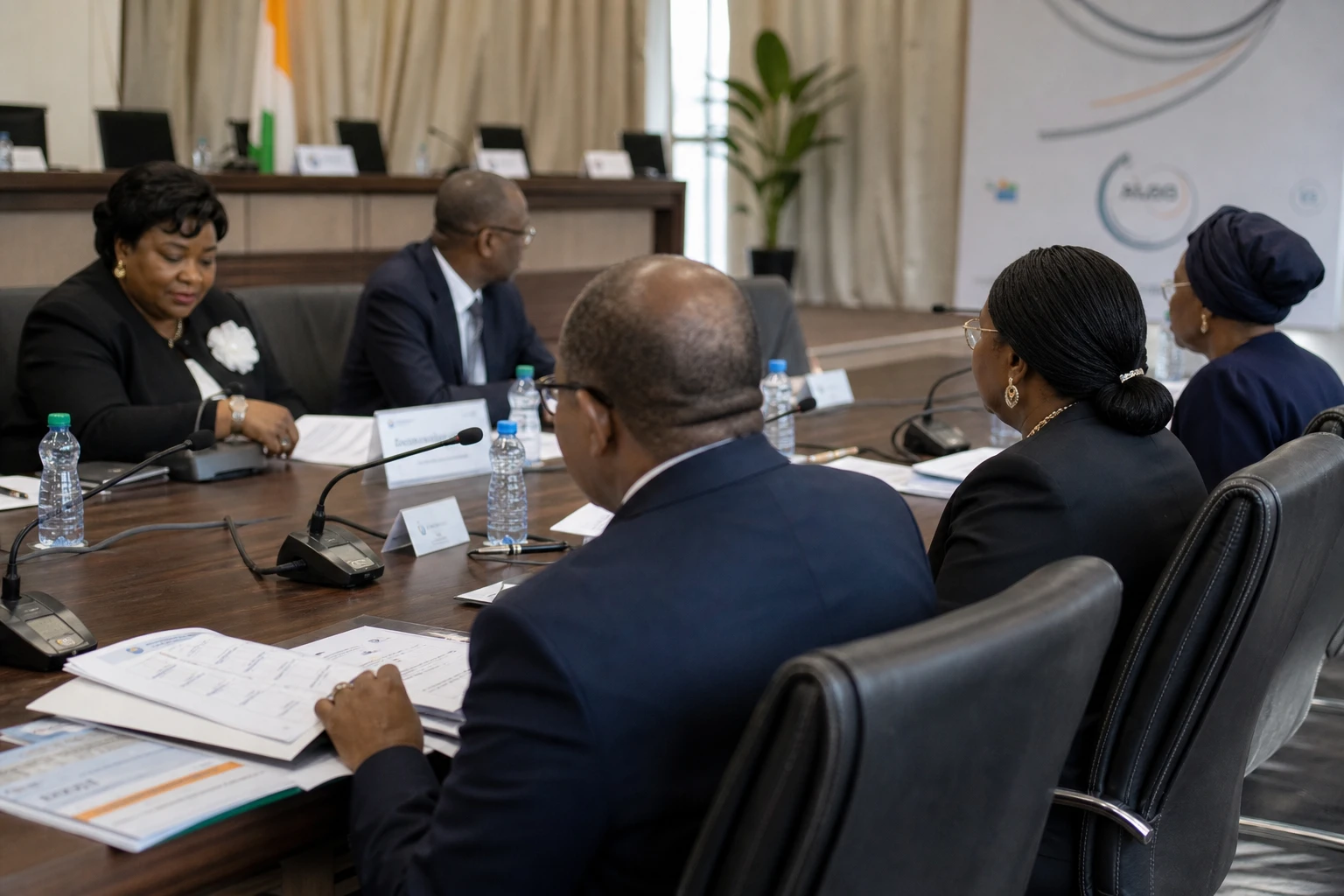
In Yamoussoukro, Côte d’Ivoire’s political capital, ARTCI has recently sent several signals of internal reorganisation. In June, the institution held an induction seminar, chaired by Roger Félix Adom, to strengthen the governance of its leadership bodies. This provides a useful context for the meeting with Orange Côte d’Ivoire, led by its managing director, Mamadou Bamba. It shows a regulator seeking to establish its approach while remaining open to dialogue across the sector.
What the two sides put on the table
The working session focused on ARTCI’s responsibilities, its new governance and the market’s main challenges. The operator set out its concerns about regulation, investment and the affordability of offers. The central question remains the same across West Africa: how can services be improved without undermining the financial capacity of the companies deploying networks? ECOWAS says telecommunications and the digital economy are now drivers of integration, inclusion and sustainable growth.
Orange Côte d’Ivoire stressed the need to preserve the sector’s capacity to invest. The message is clear: without the margins to fund infrastructure, coverage, network capacity and innovation, quality will eventually stagnate. In a market where demand is rising rapidly, each regulatory decision can directly affect the pace of network expansion, service availability and the price paid by users. This is also where the regulator comes in: to maintain competition, monitor prices when necessary and prevent short-term financial balance from coming at the expense of the service provided to the public.
This dialogue is not new. In its decisions and reports, ARTCI has already documented technical exchanges with the operator on issues including service quality, audits and compliance. This shows that relations between the regulator and operators are based less on one-off face-to-face encounters than on continuous oversight of a sensitive sector. The aim is not to block investment. Rather, it is to regulate market growth so that subscribers genuinely benefit from the improvements being promised.
An economic, social and regional issue
The telecommunications sector carries considerable weight in Côte d’Ivoire’s economy. Data compiled by ECOWAS show that telecommunications services generate substantial revenue in Côte d’Ivoire, underscoring the sector’s fiscal and industrial importance. This explains why every regulatory decision matters to operators, but also to the state, which depends on tax revenue and a thriving digital market. In major cities, the main issues are quality and capacity. In less well-served areas, the priority is access itself.
For users, the issue is tangible. Better sector governance could improve coverage, reduce some of the frustration caused by outages or slow connections, and support the digital services that sustain informal trade, money transfers and small businesses. For operators, the challenge is different: they must invest in networks, absorb rising traffic and meet more detailed regulatory requirements. The regulator, meanwhile, must strike a balance between consumer protection, fair competition and market attractiveness.
Across West Africa, the implications extend beyond Côte d’Ivoire. ECOWAS is already working on roaming, cybersecurity, radio spectrum and its 2024-2029 digital strategy. This means Abidjan is not discussing only a national issue. The country is part of a regional framework in which rules on competition, investment and interoperability are becoming increasingly interconnected. In this equation, Côte d’Ivoire remains an important player, both a major market and a regulatory testing ground for West Africa. The next decisions on service quality, investment and regional coordination will show whether this dialogue delivers visible gains for users.