Algeria
 Egypt
 Libya
 Morocco
 Sudan
 Tunisia
 Benin
 Burkina Faso
 Cabo Verde
 Côte d'Ivoire
 Ghana
 Guinea
 Guinea-Bissau
 Liberia
 Mali
 Mauritania
 Niger
 Nigeria
 Senegal
 Sierra Leone
 The Gambia
 Togo
 Central African Republic
 Chad
 DR Congo
 Equatorial Guinea
 Gabon
 Republic of the Congo
 São Tomé and Príncipe
 Burundi
 Comoros
 Djibouti
 Eritrea
 Ethiopia
 Kenya
 Madagascar
 Malawi
 Mauritius
 Mozambique
 Rwanda
 Seychelles
 Somalia
 South Sudan
 Tanzania
 Uganda
 Angola
 Botswana
 Eswatini
 Lesotho
 Namibia
 South Africa
 Zambia
 Zimbabwe
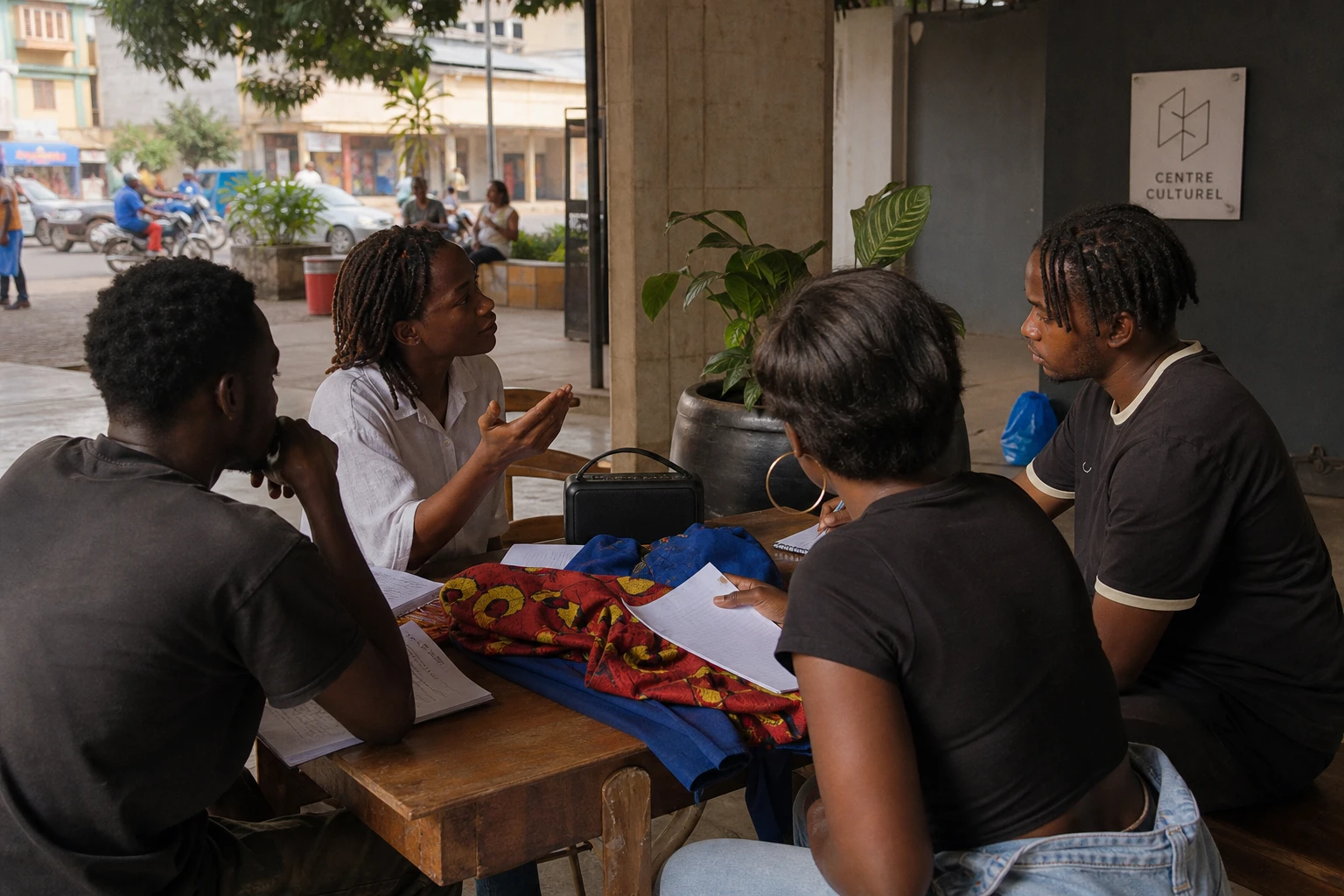
In Yaoundé and Douala, the recognition awarded to Hermine Yollo goes beyond an individual distinction. It confirms the vitality of a Cameroonian theatre scene that trains its artists through companies, workshops and regional collaborations, sometimes outside traditional institutional circuits.
The Cameroonian playwright, actor, director and translator received the RFI Theatre Prize on Sunday 27 September 2026 for Ima Maryam : le jugement de Marie. The announcement came during the international Zébrures d’automne festival, organised in Limoges by Les Francophonies. The winning text is also due to be read as part of the festival. The 2026 Zébrures programme confirms that the prize-winning text will be presented.
Cameroonian writing that shifts familiar narratives
In Ima Maryam, Hermine Yollo takes up a religious figure known across several traditions. She is not seeking to tell Mary’s story again. Instead, she examines how religious, social and political narratives have shaped her image.
The play gives Maryam, a historical and spiritual figure associated with the Virgin Mary, a voice once more. The character confronts the weight of representations accumulated over the centuries. Between woman, idealised mother and religious icon, the text creates a tension that touches on memory, the body and the place accorded to women in collective narratives.
This approach places the work within a broader reflection on historical erasure. Women often appear in myths, chronicles and traditions without having full command of their own voices. By bringing them back to centre stage, Hermine Yollo turns an ancient narrative into a space for contemporary debate.
The text is not, however, limited to a message. It also rests on formal experimentation. Silences, shifts in rhythm and short sentences help shape a fragmented voice. The writing asks audiences to connect different eras and experiences rather than follow a linear plot.
The award is therefore both thematic and aesthetic. The jury recognises a work that questions dogma and power relations, as well as a dramaturgy capable of bringing these tensions to the stage.
A career shaped by transmission and creation
Born in 1981 in Douala, Hermine Yollo grew up in a family of theatre professionals. Her parents, Jean Mingele and Edwige Nto Ngon, were actors before becoming directors. They founded Compagnie Ngoti, an organisation that has contributed to training artists and helping them work across Cameroon.
The artist-to-be later grew up in Yaoundé, in an environment shaped by books, rehearsals and performances. She studied translation, including at the Advanced School of Translators and Interpreters at the University of Buea. This training informed her relationship with language, precision in the choice of words and movement between cultural worlds.
Her career developed through workshops and residencies. She worked with Cameroonian professionals and took part in training programmes at the El Hamra Arab-African Centre for Theatre Training and Research in Tunis, as well as the Regional School for Actors in Cannes and Marseille. She also took part in the ÉLAN laboratory at Les Récréâtrales in Ouagadougou.
This regional movement is significant to the artist’s career. It connects Cameroon with several Francophone creative spaces without reducing her work to a single territory. It also enables playwrights from Central and West Africa to compare their methods, stage languages and concerns.
Hermine Yollo has led Compagnie Ngoti since 2009. She helped revive the organisation’s activities after her parents’ deaths. In Yaoundé, the company runs workshops, residencies and projects to pass on theatre practices. The revival of the Ngoti writing residency brought together professional playwrights and young creators from the sub-region.
In 2024, the company also organised an introductory workshop for children in Yaoundé. This activity highlights another dimension of Hermine Yollo’s work: theatre is not limited to producing performances. It also serves to educate audiences and strengthen the local arts ecosystem. Compagnie Ngoti’s work with young audiences follows this approach.
An award with resonance across African theatre
The RFI Theatre Prize, created to support Francophone dramatic writing, gives the winning text international visibility. It also promotes readings, networking and professional support. For Hermine Yollo, the distinction could therefore open the way to new collaborations while strengthening the circulation of writing that originated in Cameroon.
The prize comes amid a rapidly developing African theatre landscape. Artists work across independent companies, festivals, cultural institutes, drama schools and writing residencies. This structure remains fragile, but it produces works that can travel without losing their roots.
The distinction also highlights Cameroon’s place in contemporary Francophone creation. The country belongs to the Central African Economic and Monetary Community, CEMAC, which brings together six states around economic policies and regional cooperation. In this region, artistic exchanges often take place through professional networks rather than large shared institutions.
Compagnie Ngoti contributes to this momentum. Its projects bring together Cameroonian artists and partners from other African countries. Hermine Yollo’s career shows how an organisation based in Yaoundé can become a link between Central Africa, West Africa and European stages.
With Ima Maryam : le jugement de Marie, the winner continues an approach already evident in her previous works. She revisits the narratives that have shaped societies, viewing them from the perspective of an African woman and theatre practitioner. The prize she received in Limoges does not mark the end of her career. It puts a new stage in the spotlight and raises a practical question: how will this work be staged, translated and performed for audiences in Cameroon and across the continent?